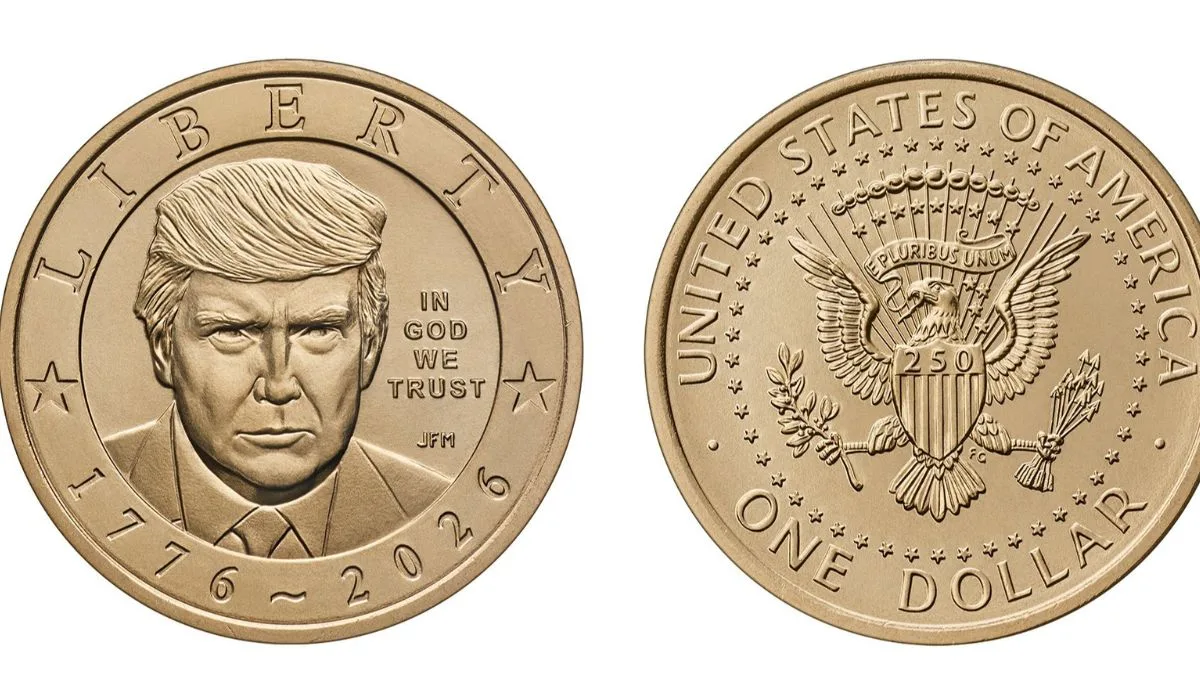
Trump to feature on new USD 1 coin commemorating 250 years of American Independence
The coin commemorating 250 years of American Independence carries a portrait of Trump on one side with words "In God We Trust" engraved beside his portrait.
US President Donald Trump arrived in Beijing hoping to showcase deal-making. He left having showcased something else: the changing balance of global power.





US President Donald Trump and Chinese President Xi Jinping during a friendship walk through Zhongnanhai Garden in Beijing on May 15, 2026. (Photo: Xinhua via IANS)
US President Donald Trump arrived in Beijing hoping to showcase deal-making. He left having showcased something else: the changing balance of global power. The most striking image of the visit was not a trade announcement, a tariff rollback or a major business agreement. It was Chinese President Xi Jinping personally escorting Mr Trump through Zhongnanhai, the heavily guarded compound at the heart of Communist Party authority.
Beijing understood precisely what it was doing. Access to Zhongnanhai is political symbolism of the highest order ~ an invitation into the nerve centre of the Chinese state. The message was unmistakable: China no longer sees itself as a rising power seeking acceptance from the West, but as an equal pole in a rapidly evolving world order. For years, Mr Trump built his political identity around confrontation with China. He accused Beijing of exploiting America, launched tariff wars and repeatedly framed China as the central threat to US economic power. Yet the tone of this visit was dramatically different. Mr Trump praised Xi as “warm” and “smart”, and publicly spoke of future cooperation. The shift was not merely personal diplomacy.
Advertisement
It reflected strategic necessity. The United States now faces a geopolitical reality it can neither ignore nor easily reverse: China has become too central to the global economy and too influential in global crises to be treated simply as an adversary. The Iran conflict and disruptions around the Strait of Hormuz appear to have reinforced that reality. Washington needs Beijing’s leverage over Tehran because China is Iran’s largest oil customer and most important economic partner. Beijing used the summit to project confidence rather than concession. Despite the warm rhetoric, no major breakthrough emerged on tariffs, technology controls or market access. Claims about Boeing purchases and agricultural deals remained vague. Even on artificial intelligence and semiconductors ~ now the true battlegrounds of US-China competition ~ both sides avoided substantive public commitments. The symbolism was grand; the deliverables were limited. That imbalance itself reveals the deeper story. China appeared patient and self-assured, while the United States looked eager for stability.
Advertisement
Beijing understands that its manufacturing dominance, control over rare earth processing and expanding global trade networks have increased its strategic leverage. Washington, meanwhile, is discovering that economic decoupling from China is far more difficult than political slogans once suggested. Yet beneath the ceremony and smiles, the central fault line remains Taiwan. Mr Xi reportedly warned Mr Trump that mishandling Taiwan could bring the two powers into direct conflict. That was not diplomatic rhetoric; it was a warning that despite economic interdependence, the rivalry remains fundamentally geopolitical. What emerged from Beijing was therefore not reconciliation, but managed coexistence. Both countries need each other enough to avoid rupture, yet distrust each other too deeply to forge genuine partnership. The summit’s real significance lies not in what was signed, but in what was silently acknowledged: the era of uncontested American primacy is fading, and both Washington and Beijing are now adjusting to a world shaped by strategic interdependence between rival superpowers.
Advertisement