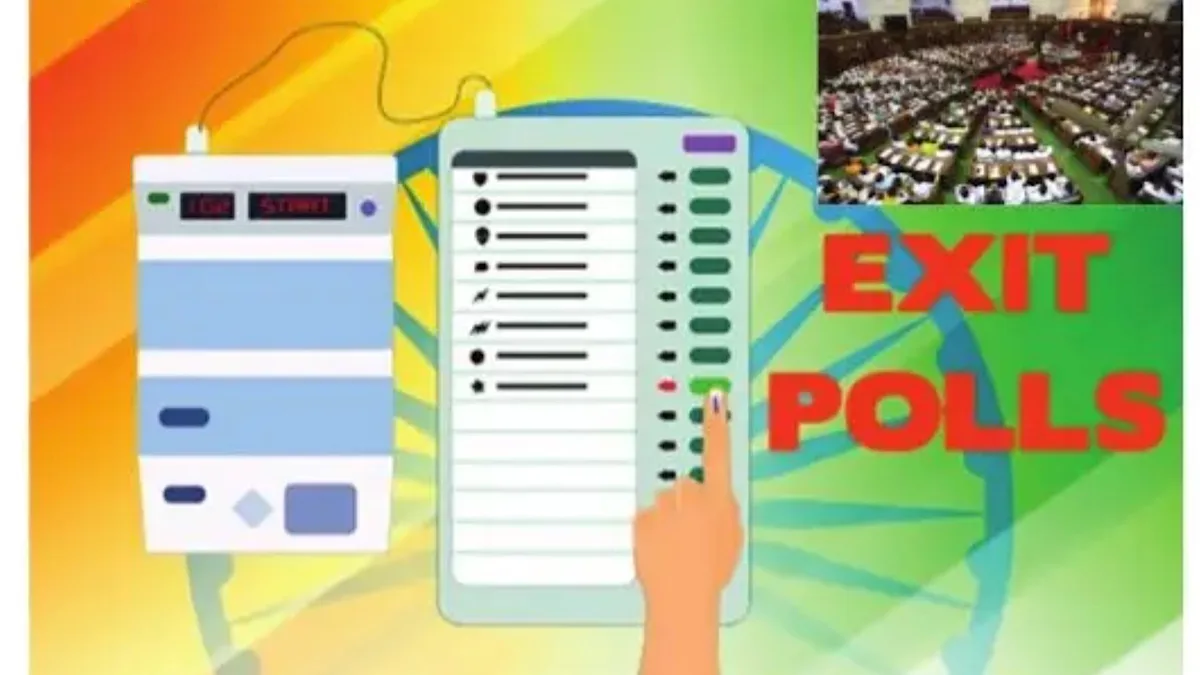
Exactly at 5 pm on 29 April, all TV stations worth their salt began to harangue viewers with electoral data ~ never mind the fact that due to Election Commission restrictions, no exit poll results could be broadcast till 6.30 pm. Politicians had a gala time jousting on prime-time TV, so did TV channels, who raked in moolah through highly priced, jarring advertisements. Exit polls monopolised TV screens for days on end, and in different forms ~ debates, speculation on what would happen if exit polls mirrored actual results, etc. ~ till the time, counting began, and actual results started to trickle in.
Psephology is a branch of political science that deals with the study and scientific analysis of elections, but in India, psephology has become synonymous with prediction of election results; that too often based on the caste or religious composition of a constituency ~ even before a single vote is cast. That said, exit polls are a recent phenomenon ~ an invention of the second half of the twentieth century. Not surprisingly, the popularity of exit polls has coincided with the growth of TV viewership, because exit polls serve little useful purpose other than boosting TRPs. Ersatz psephologists have no qualms in predicting election outcomes to the last seat.
Advertisement
Once the elections are over, these soothsayers go into hibernation ~ till the next election. Of course, political Chanakyas hone their strategy according to probable election results ~ identifying, and deciding the price of saleable legislators, and so no. Exit polls sometimes have unintended side effects, which many discovered to their grief on 4 June 2024. To recapitulate: Prior to declaration of election results of the 2024 General Elections, the PM, Home Minister and Finance Minister all claimed that the BJP and its allies were winning by a wide margin, and advised investors to buy shares before 4 June, as the share market would zoom upwards on 4 June; this claim was buttressed by exit polls ~ all exit polls claimed that NDA would romp home, with 360 to 400 seats.
Actual results were otherwise ~ BJP was unable to cross the half-way mark, and NDA was restricted to 293 seats. Resultantly, the share market touched a high on 3 June 2024, but nosedived on 4 June, erasing US$386 billion in market value. Prannoy Roy, formerly of NDTV, is credited with bringing exit polls to India. While studying at the Delhi School of Economics, Roy correctly predicted the outcome of the 1977 General Elections. Based on an exit poll, meticulously crafted by him, Roy produced an extremely accurate election forecast for the 1984 General Elections ~ laying the foundation of exit polls, in India.
Roy’s company, NDTV produced the first election result telecast, after the 1989 General Election, featuring hotlines, visual graphics, discussions and debates. This template is now the gold standard for election results, and also for exit poll results. With close to 100 crore voters, unevenly divided over 543 constituencies, an average Lok Sabha constituency has close to 20 lakh voters. The biggest constituency Malkajgiri (Telangana), has more than 31,50,000 voters, while Ladakh, spread over 1.75 lakh kilometres has barely 1.85 lakh electors. Also, there are differences of religion, caste, economic status, age group etc. Drawing a sufficiently large and representative sample for such a humongous, and diverse population is a daunting task.
Not surprisingly, more often than not, exit polls fail spectacularly; in addition to the 2024 General Elections, the 2015 Bihar Assembly Elections when the Mahagathbandhan trounced the BJP, the 2020 Bihar Assembly Elections when the BJP emerged victorious, the 2015 Delhi Assembly Elections, the 2023 Chhattisgarh Assembly Elections, and the 2021 West Bengal Assembly Elections, all belied pollsters’ predictions. Psephologists face a formidable task in decoding election surveys; many respondents refuse to answer the samplers’ questions, or deliberately give wrong answers.
A conscientious pollster refused to publish exit poll results for the West Bengal polls because many voters had refused to answer the surveyors’ questions. This cannot be said about other such organisations, who pressed on regardless. Unsurprisingly, all exit polls except one, went completely off-track ~ while exit polls had predicted a neck-to-neck fight between the BJP and TMC, in actuality, the BJP surged far ahead. Exit polls could not have got it more wrong in Tamil Nādu; no exit poll, except one, came close to predicting that actor Vijay’s newly floated Tamilaga Vettri Kazhagam (TVK), would emerge as the largest party, and DMK and AIADMK would be left far behind. The results in Assam and Keralam were called correctly, but not the difference between the winning and losing parties.
Thus, the accuracy of exit polls is rather limited ~ good only for grasping the issues engaging the minds of voters. The current elections have brought into sharp focus the role of the Election Commission, which was designed as an impartial umpire, but has totally lost the confidence of opposition parties, through its intemperate actions and utterances. Neglecting to take all parties on board about its proposed initiatives, most of the Commission’s actions were assailed in the Supreme Court, denting the credibility of both the EC and its opponents.
Before voting, voters should examine the credentials of contesting candidates. Analysing the antecedents of candidates for the first phase of polling in West Bengal, the Association for Democratic Reforms found that of 1475 candidates analysed, 345 (23 per cent) had declared criminal cases against themselves, of which 294 (20 per cent) were of serious nature. Money power, too, played a major role, 106 out of 148 candidates (72 per cent) from Trinamool Congress, 71 out of 152 candidates (47 per cent) from BJP and 50 out of 151 candidates (33 per cent) from Congress had declared assets valued more than Rs.1 crore. Read together, this points to a serious blend of criminality and money power in legislators ~ hardly representative of a poor, and peace-loving electorate. Mutatis mutandis, this applies to legislators pan-India.
The Supreme Court has often tried to discourage criminals from holding public office, but the legislature has rarely cooperated. Across India, once elected, most MPs and MLAs only interfere in local administration, and vote according to the whip issued to them by their leaders. The interests of their constituents, for which they can at least spend their MLA LADS, are soon forgotten. Visuals of MLAs and MPs beating each other, or public officials, often with shoes, or watching porn in the Assembly have only added to the notoriety of our public representatives. Then, we had cases where lawmakers cast their votes for money, or asked motivated questions in return for cash.
The public is rightly wary of their representatives, whom they regard as a necessary evil. Often, the behaviour of newly elected public representatives, is so egregious that political parties have to mount courses on behavioural issues, for their first time MLAs and MPs. Perhaps we could have better governance if all aspiring public representatives had to pass a two-year course that would acquaint them with the rights and responsibilities of elected officials. Basics of public administration, economics, history and sociology could be part of the curriculum. An MLA enjoys many privileges, but his capacity to serve his constituency is limited; he can do little more than draw the attention of the House to the issues facing his constituents.
The power of an opposition MLA is even more limited ~ ruling parties often issues secret instructions to the district administration not to attend to grievances of opposition MLAs. A much better model could be to formalise the role of lawmakers in district administration and planning. Public representatives would then formally bring the concerns of their constituents to the knowledge of the administration, and participate in the resolution of their grievances. Similarly, planning and execution of Government schemes can be decentralised with most schemes being drafted at the regional and district levels. Peoples’ participation in planning would increase the chances of success of the hundreds of Government schemes.
Such productive employment of MPs and MLAs would reform both governance as well as the election process. Constituents would be able to judge the performance of their representatives on the basis of the work done by them. Additionally, instead of clandestine and mostly detrimental interference in administration, elected representatives would be responsible for providing better administration. Spelling out what bedevils exit polls, the German “Iron” Chancellor Otto Von Bismarck once said: “People never lie so much as after a hunt, during a war, or before an election.
(The writer is a retired Principal Chief Commissioner of Income-Tax)