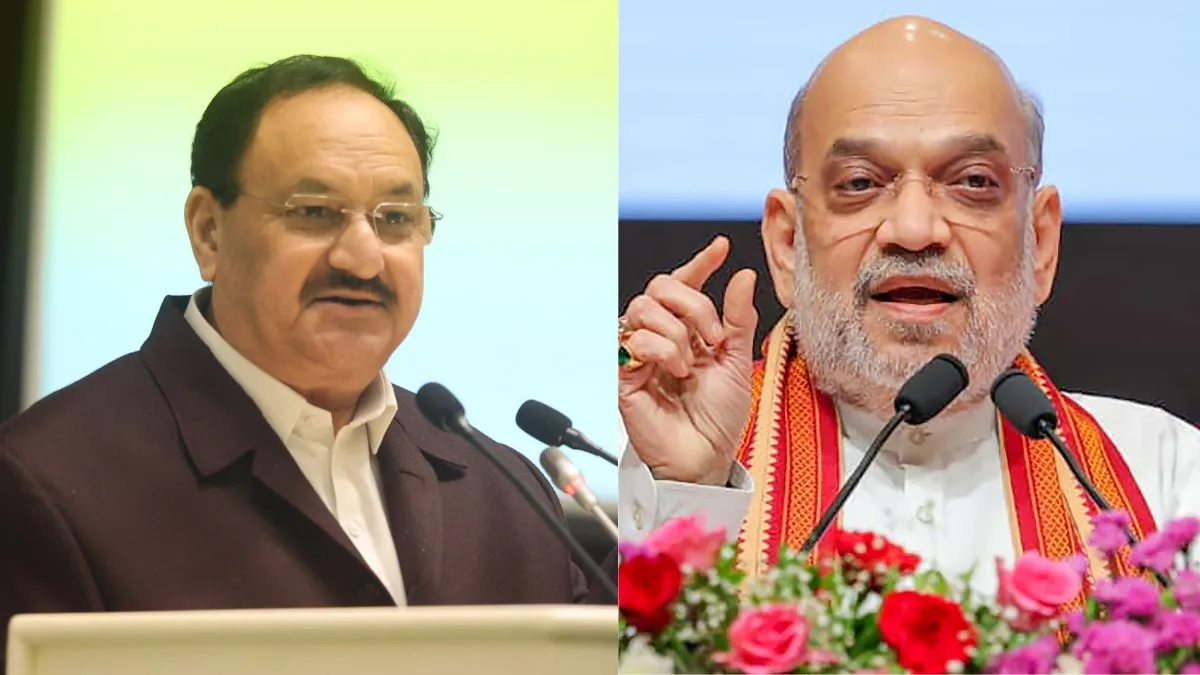
Setting in motion the process to select chief ministers in the states it swept on Monday — West Bengal and Assam — the BJP on Tuesday appointed Union Home Minister Amit Shah as the central observer for West Bengal and Union Health Minister J.P. Nadda for Assam. Odisha Chief Minister Mohan Charan Majhi will serve as co-observer for West Bengal, while Haryana Chief Minister Nayab Singh Saini will assist in Assam, the party said.
The BJP on Monday dislodged the Trinamool Congress (TMC) from power in West Bengal and retained Assam for a third consecutive term, paving the way for saffron governments in both states. In Assam, Chief Minister Himanta Biswa Sarma, who led the party to a decisive victory, further cemented his position as the BJP’s undisputed leader in the Northeast and also as the frontrunner for the top post. Sarma, a former Congress leader, replaced Sarbananda Sonowal as chief minister in May 2021. Sonowal, who led the party to victory in the 2021 Assembly elections, was subsequently inducted into the Union Cabinet.
Advertisement
In those terms, the BJP is known to spring surprises.
In West Bengal, the BJP’s emphatic victory — winning 207 seats in the 294-member Assembly — marks the end of the TMC’s 15-year rule. The scale of the win is underscored by Chief Minister Mamata Banerjee’s defeat in Bhabanipur to BJP leader Suvendu Adhikari positioned him as a leading contender for the chief minister’s post. But the BJP’s track record in states such as Rajasthan, Madhya Pradesh and Odisha suggests it can be anyone’s game until the name is officially announced.
The campaign in West Bengal was closely strategised by Amit Shah and led by Prime Minister Narendra Modi, with the central leadership playing a key role in the party comfortably crossing the halfway mark, sources say. “The chief minister will be finalised by PM Modi and Shah,” they say, adding that the leadership is also expected to consider inputs from central observers and state leaders,and may appoint a deputy chief minister after the final decision. The oath-taking ceremony is likely around May 9.
Apart from ‘giant slayer’ Adhikari — who contested from both Nandigram and Bhabanipur, directly challenging Mamata Banerjee — other names are also doing the rounds in power corridors such as state president Samik Bhattacharya, known for his RSS roots and credited with strengthening the party’s organisational base. Former state president Dilip Ghosh, also known for his grassroots connect, is another name along with leaders such as vice-president Agnimitra Paul.
Party insiders argue that Adhikari’s consistent victories over Banerjee give more power to his claim to the top post. “He should be rewarded for defeating Mamata Banerjee not once, but twice—this time in Bhabanipur. He had earlier defeated her in Nandigram in the 2021 polls. He had been relentlessly campaigning against her ever since leaving the TMC,” they said, adding that when Adhikari filed his nomination papers from Bhabanipur, Shah accompanied him, signaling the intent of the top brass. Notably, unlike in Lok Sabha elections, the BJP rarely ever fields candidates from two Assembly constituencies simultaneously, making Adhikari’s dual candidature a very significant and powerful strategic move.