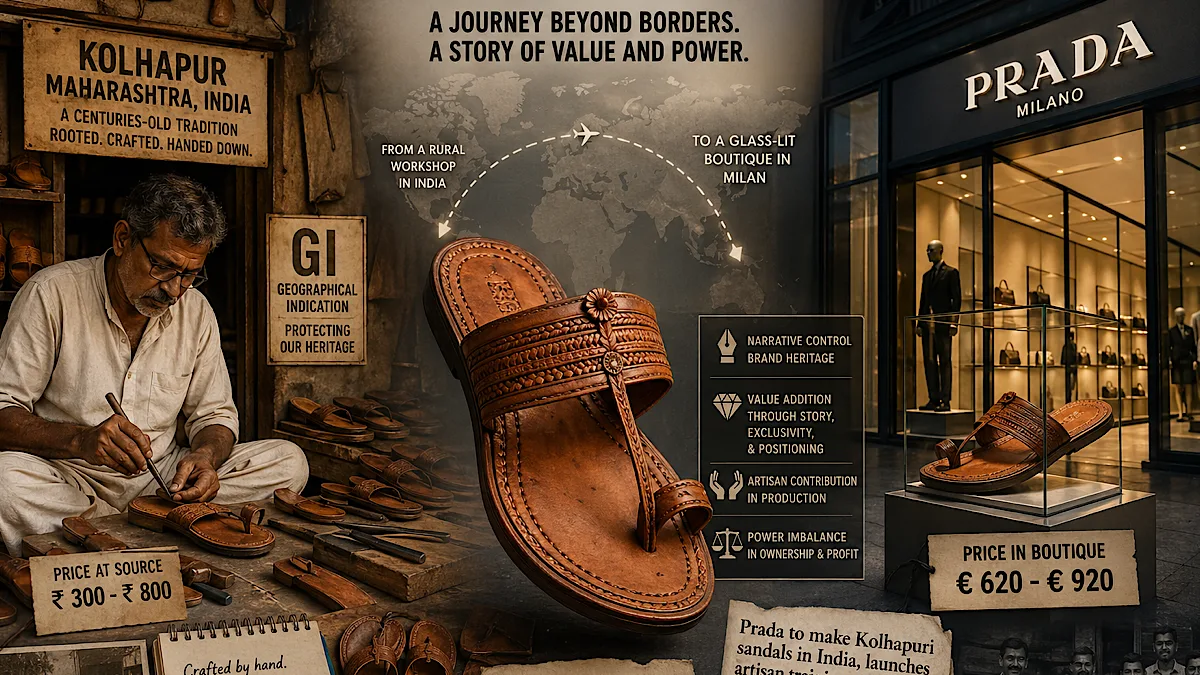
When a pair of handcrafted leather sandals travels from a rural workshop in Maharashtra to a glass-lit boutique in Milan, its journey is not merely geographic ~ it is economic, cultural, and political. The recent decision by Prada to produce high-end versions of Kolhapuri sandals in India, after earlier criticism for overlooking their origins, offers a revealing case study in how global luxury absorbs local tradition. Kolhapuri sandals are not anonymous design objects.
They are embedded in a centuries-old craft ecosystem spanning districts in Maharashtra and Karnataka, sustained by hereditary artisans whose work has historically operated outside the circuits of global capital. Their Geographical Indication (GI) status, granted by the Indian state, formally recognises this rootedness. Yet, recognition on paper has rarely translated into pricing power or global visibility for the artisans themselves. What luxury fashion does exceptionally well is narrative construction.
Advertisement
A product priced at a few hundred rupees in a local market can be reintroduced at hundreds of euros once it is reframed through the language of exclusivity, craftsmanship, and brand heritage. The value, in other words, lies less in the object than in the story attached to it ~ and in who controls that story. In countries such as India, where informal craft economies sustain millions, such imbalances are not symbolic – they shape livelihoods, determine survival, and influence whether traditional skills endure or quietly disappear. Prada’s course correction ~ acknowledging origins, manufacturing in India, and launching an artisan training programme ~ signals that reputational pressures now shape corporate behaviour more visibly than before.
In an era of social media scrutiny and postcolonial critique, global brands can no longer afford to treat non-Western traditions as design repositories devoid of authorship. This is not altruism; it is adaptation. However, the deeper asymmetry remains intact. The artisans participate in production, but not in brand ownership. They contribute labour and inherited knowledge, but not pricing authority or narrative control. A three-year training initiative, while welcome, does not alter the fundamental equation in which intellectual and symbolic capital is consolidated in European fashion houses while material craftsmanship is outsourced. This dynamic is not unique to India.
From Peruvian textiles to West African prints, traditional crafts have long been mined by global fashion for aesthetic inspiration. What distinguishes the current moment is the growing insistence ~ from consumers, designers, and policymakers ~ that such exchanges be more equitable and transparent. Yet, equity is a high bar. It requires not just acknowledgement, but structural shifts in how value is distributed. The Kolhapuri episode illustrates a transitional phase. Cultural appropriation, once denied, is now negotiated. Inclusion is offered, but on terms set by global capital. The language has evolved ~ from “inspiration” to “collaboration” ~ but the hierarchy is still visible beneath it. If heritage is to be more than a branding device, its custodians must share in its rewards. Otherwise, the global marketplace will continue to celebrate tradition while quietly relocating its profits.