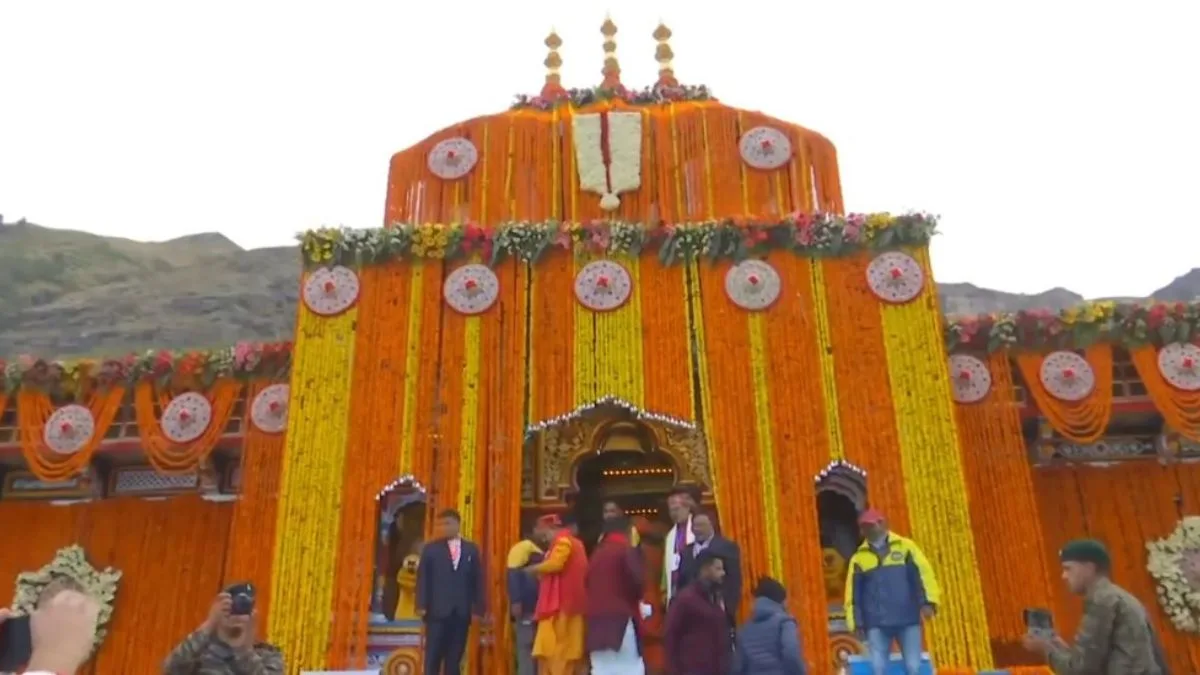
The Char Dham Yatra 2026 gained full momentum on Thursday with the opening of the portals of Badrinath Temple, a day after Kedarnath Temple. The shrine was opened to devotees at 6.15 am as scheduled, with Chief Minister Pushkar Singh Dhami performing the first Puja in the name of Prime Minister Narendra Modi, following traditional rituals and Vedic chants.
According to officials, the opening ceremony of the portals of the Badrinath Temple was witnessed by more than 15,000 devotees from across the country and abroad, who later visited inside the sanctum sanctorum to seek the blessings of Lord Badri Vishal and the akhand jyoti (eternal flame).
Advertisement
Uttarakhand Chief Minister Pushkar Singh Dhami performed the first mahabhishek puja in the name of Prime Minister Narendra Modi, praying for peace, prosperity and happiness for the nation and the Himalayan state.
After the puja at the shrine, Dhami also offered prayers at the Lakshmi Temple, Ganesh Temple, and the seat of Adi Shankaracharya within the temple premises.
Later, addressing the gathering and welcoming the pilgrims, the Chief Minister said that his government is committed to ensuring a safe, smooth, and well-organised Char Dham Yatra. He, however, appealed to devotees to support a “green and clean Char Dham Yatra,” making it an environmentally friendly pilgrimage.
Dhami inaugurated a bhandara (community kitchen) run by the NGO Manav Seva, Ishwar Seva Utthan Samiti. Following this, he took prasad with other devotees present there. The Chief Minister also interacted with the organisers and lauded the large-scale community kitchen being operated by the members of the Samiti.
Notably, the Char Dham Yatra to the four shrines — Kedarnath, Badrinath, Gangotri and Yamunotri — formally commenced on Thursday with the opening of the portals of Badrinath, the last in the sequence that began on April 19 with the opening of Gangotri and Yamunotri shrines. The portals of the Kedarnath Temple were opened on April 22.
The occasion was marked by the performance of the traditional Jhumailo dance by women folk artists from Mana and Bamni villages, accompanied by the tunes of jagar, in the temple courtyard.