China’s expansionism and military adventurism, Ukraine-Russia war and now US-Israel action against Iran, all have added to the emergence of an old military player on the block: Japan.
Tokyo for long—in the wake of World War II—had abandoned militarism and vowed by pacifism, but no more. It has understood that in the new world order, which is way less rules based than it was a decade ago, Japan needs to step up to its own military and defence needs, rather than rely on just the US.
Advertisement
Consequently, after ramping up its defence budget to a record 2 per cent of the GDP, it has now lifted longstanding defence export restrictions, something that is being hailed as the biggest ever overhaul of its military export regime.
Advertisement
“No single country can now protect its own peace and security alone, and partner countries that support each other in terms of defence equipment are necessary,” Japanese Prime Minister Sanae Takaichi said in a post on X. The shift away from pacifism had, in fact, started under Shinzo Abe and has continued unabated hence.
Japan is signalling a few extremely significant shifts, prodded on by global developments and the need for rejuvenating its own military-industrial base for economic reasons.
The Ukraine war showed the world that US support is not unequivocal, especially under the regime of Donald Trump. US support to Ukraine, despite a lot of exhortations by Volodymyr Zelensky, has not been out-and-out, but calibrated and with bounds. Russian aggression, on the other hand, has also exposed the fact to the world that US support does matter, but is not a guarantee against wars and not an absolute deterrent.
Moreover, the Ukraine war has also evidenced US’ own limits—its arsenal is big, but not unlimited or inexhaustible. There are limits to US production and, therefore, support.
The Iran war has further exposed US’ weakness: while Washingtom has significantly degraded Iran’s military might, but taking a cue from the Ukraine-style asymmetrical warfare involving drones, Tehran has wreaked havoc on US forces and Gulf nations harbouring US bases and military personnel using cheap drones that have huge financial advantage over expensive missiles used to stop the swam of them.
To the extent that Trump has been subtly pushing for patching up with North Korean dictator Kim Jong-un so that Japan is placated to the extent that the latter’s wish to join the Golden Dome—the super ambitious missile shield against hypersonic projectiles being developed by China and being passed on to North Korea—can be used to entice it to manufacture the intercepting missiles, thus, relieving the US of the financial burden.
The US, therefore, has come out to support Japan in the endeavour. “This historic step will not only enhance the defense capabilities of countries collaborating with the Japan-U.S. alliance but also strengthen our collective capacity to maintain peace throughout the region and safeguard freedom even further,” U.S. Ambassador to Japan, George Glass said on X.
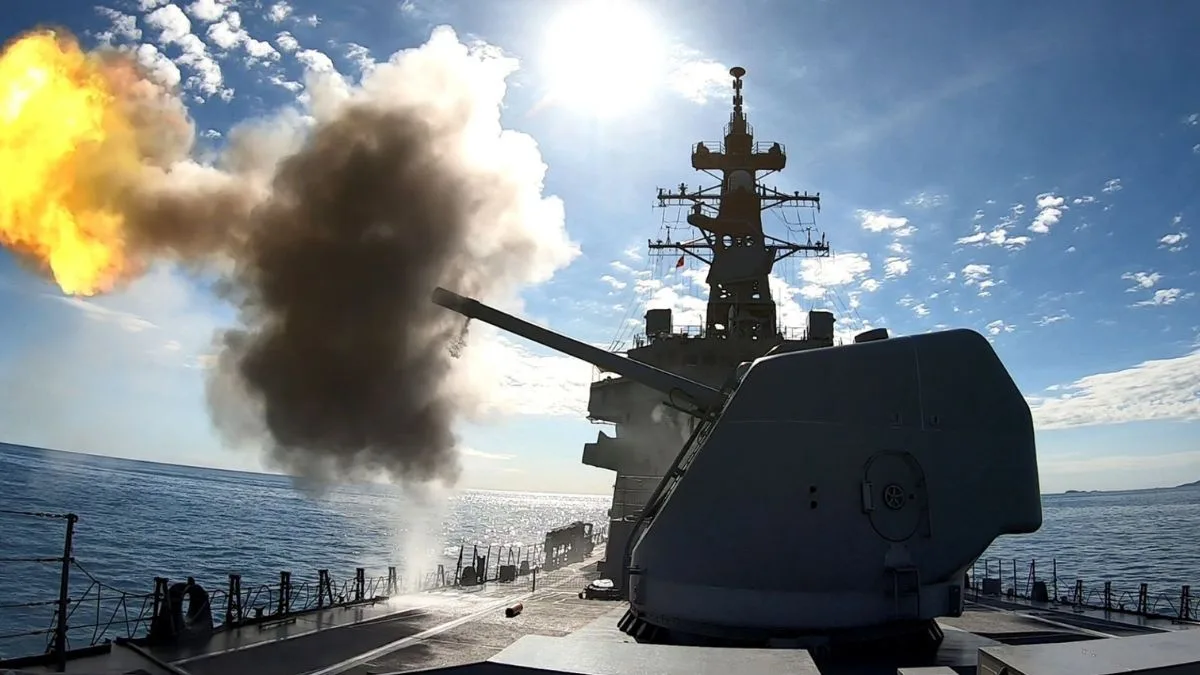
Meanwhile, Japan has made no bones about its newly-realised ambitions. Japan Tuesday did away with restrictions on overseas arms sales and opening the way for exports of warships, missiles and other weapon systems. The removal of restrictions means Japanese giants such as Mitsubishi can develop high-precision warfare manufactures, such as warplanes and missile technologies which can be sold to other nations, especially US allies such as Europe and nations in Asia.
The revised policy framework of the Takaichi regime has done away with five categories that were the main hurdle in exports, viz: rescue, transport, warning, surveillance and mine-sweeping equipment. On the other hand, each proposal would be weighed by the government against the touchstones of three principles: strict oversight, transfer to third countries, ban on sales to conflict-embroiled nations.
But, in effect Japan has kept all the doors open: exceptions to all these rules can be made if national defence and security merit so.
Japan has, in the recent past, made clear overtures to foreign allies of getting into joint development of military hardware, including sixth generation fighter jets.
Advertisement