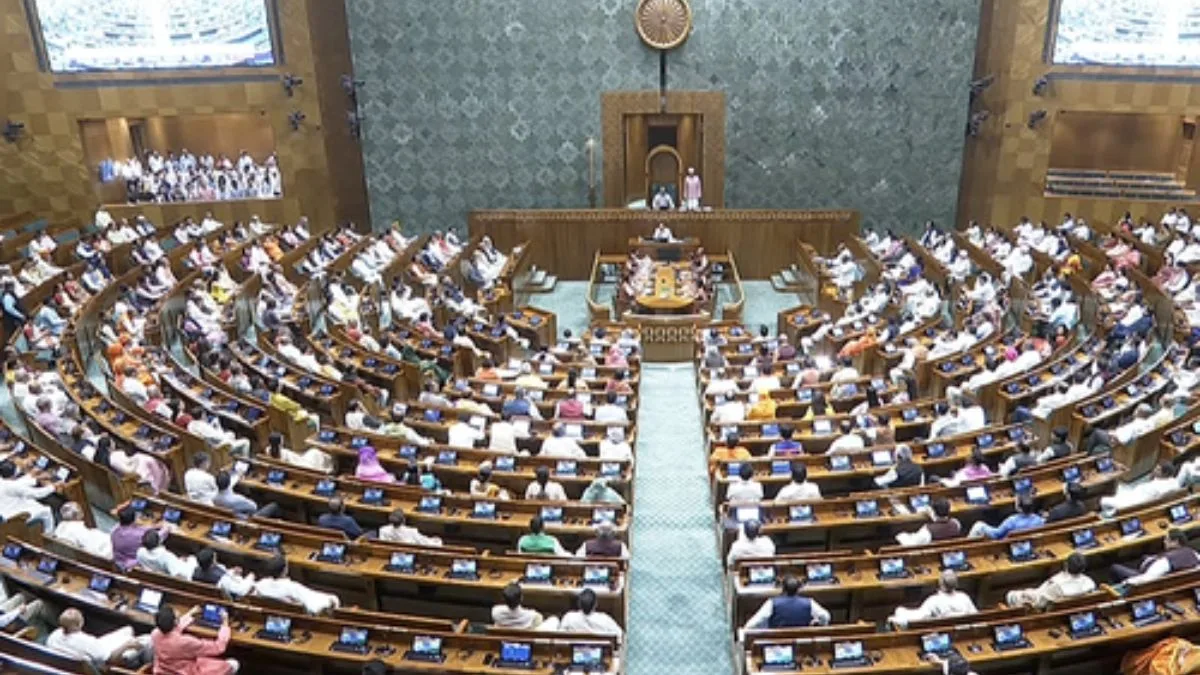
The Congress on Friday accused the Centre of bypassing democratic consultation and acting with “questionable intent” in moving ahead with proposed amendments linked to the Nari Shakti Vandan Adhiniyam, as well as a broader delimitation exercise, ahead of a special session of Parliament scheduled for April 16.
Addressing a press conference in the national capital, senior Congress leader Jairam Ramesh said the government had ignored repeated calls from the Opposition for wider consultations, including an all-party meeting. He pointed out that Congress president Mallikarjun Kharge had written multiple letters to Parliamentary Affairs Minister Kiren Rijiju seeking dialogue, but received no response.
Advertisement
“The government has chosen to proceed unilaterally on a matter that has far-reaching implications for India’s democratic structure,” Ramesh said, adding that the timing and manner of the proposed changes raised serious concerns. “There has been no transparency, no attempt to build consensus, and no clarity on the intent behind introducing delimitation into the agenda at this stage.”
The Congress Working Committee (CWC), which met earlier to deliberate on the issue, expressed support for the principle of women’s reservation but flagged what it described as “serious procedural and substantive gaps” in the government’s approach. According to Ramesh, the party remains committed to ensuring one-third reservation for women in Parliament and state assemblies, but insists that such a measure must be implemented through a fair and inclusive framework.
Central to the Opposition’s criticism is the reported plan to base the delimitation exercise on the 2011 Census, which Congress leaders argue is outdated. “A fresh Census is essential before undertaking any delimitation. Using old data will distort representation and undermine federal balance,” Ramesh said.
He also raised concerns about the proposed expansion of the Lok Sabha from 543 to 816 seats, with 273 seats earmarked for women. While the increase in representation has been presented as a progressive step, Ramesh cautioned that the absence of clarity on how these seats would be distributed across states could create fresh political and regional tensions.
Another key issue flagged by the Congress is the lack of provision for reservation for Other Backward Classes (OBCs) within the women’s quota. “The exclusion of OBC women from the framework is a glaring omission. Social justice cannot be selective,” Ramesh said, reiterating the party’s long-standing demand for a sub-quota.
He further alleged that states would have little to no role in the proposed process, calling it a departure from the spirit of cooperative federalism. “This appears to be a top-down exercise, with decisions being imposed rather than evolved through consultation with states and stakeholders,” he said.
The controversy comes against the backdrop of the passage of the Nari Shakti Vandan Adhiniyam in 2023, which was widely hailed as a landmark reform aimed at enhancing women’s political representation. However, its implementation has remained contingent on delimitation and Census-related processes, leaving room for political contestation.
With the special session of Parliament approaching, the Congress and other Opposition parties are expected to intensify their demand for wider consultations and greater clarity on the roadmap. “We support women’s empowerment unequivocally,” Ramesh said, “but it cannot be used as a cover for opaque decision-making or political manoeuvring.”