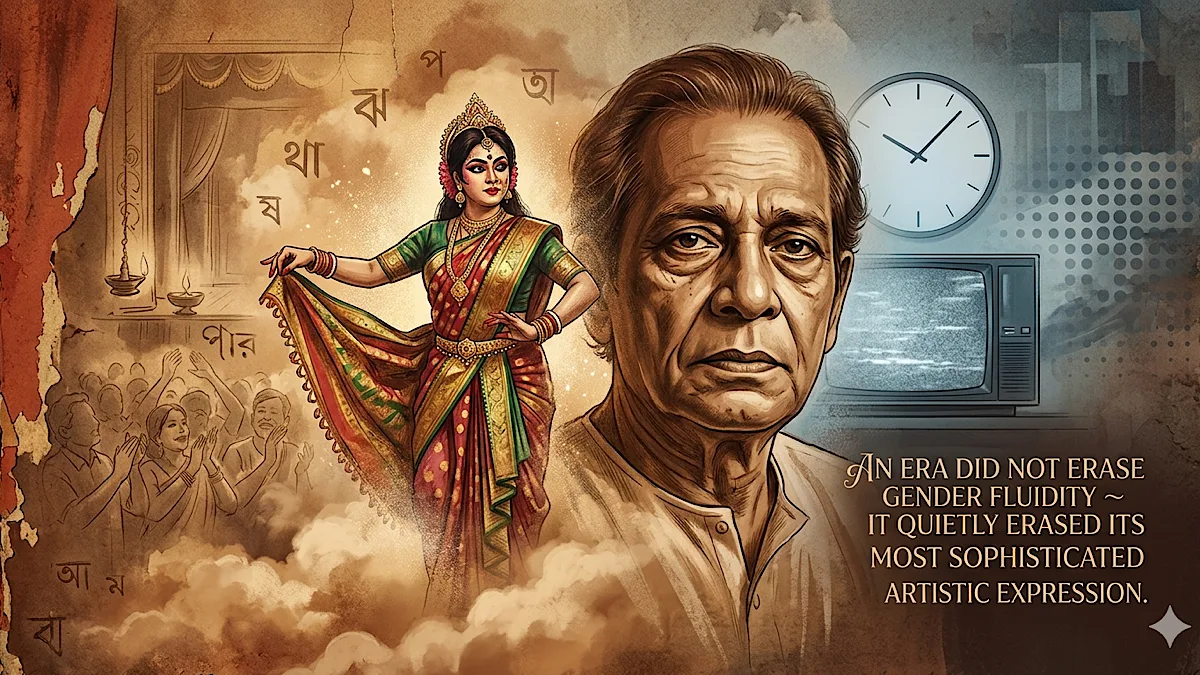
In an era when gender identity is debated in courts, campuses, and cultural spaces across India, it is easy to assume that fluid expressions of gender are a recent arrival. They are not. Long before contemporary vocabulary emerged, Bengal’s travelling theatre had already staged gender as performance, illusion, and craft. The life of Chapal Bhaduri forces us to confront an uncomfortable truth: modern India did not invent gender fluidity ~ it quietly erased one of its most sophisticated artistic expressions.
For decades, jatra theatre across Bengal relied on male actors to play female roles. These performers were not novelties or comic devices; they were central to the form. Bhaduri, known on stage as Chapal Rani, perfected a style that blended voice, gesture and costume into a convincing feminine presence. His work was not satire. It was an immersion. Audiences did not merely accept the illusion – they celebrated it. Yet this artistic convention did not survive the transition to modernity. As women entered the stage in greater numbers from the mid-20th century onward, the logic of representation shifted. Authenticity began to replace stylisation.
Advertisement
A woman should play a woman. What appears, on the surface, as social progress carried an unintended consequence: it rendered an entire category of performers obsolete. The “male queen” was no longer admired; he became an anachronism. This shift reveals a deeper cultural pattern. Modernisation in India has privileged realism over theatricality. Jatra’s symbolic world could not compete with cinema or television, nor could its gender conventions survive a society increasingly uncomfortable with ambiguity. What disappeared was not just an art form, but a way of inhabiting gender.
Bhaduri’s later life ~ marked by marginal work, partial rediscovery and uneasy recognition ~ mirrors this transition. He outlived the world that had made him a star, but not the stigma that kept him on its edges. Today, he is sometimes reclaimed as a queer icon, especially by younger audiences searching for historical precedents. But this retrospective framing, while well-intentioned, risks flattening his experience. Bhaduri did not speak the language of contemporary identity politics. His art existed in a different register ~ one where performance, not self-definition, was the primary mode of expression. What, then, does his story mean today? It suggests that cultural progress is rarely linear. Gains in one domain can produce losses in another.
The inclusion of women on stage was necessary and overdue. But it also narrowed a space where gender had once been fluid, stylised and artistically rigorous. In seeking authenticity, we may have sacrificed a richer theatrical imagination. The disappearance of Bengal’s stage “queens” is not merely a footnote in theatre history. It is a reminder that when cultural forms vanish, they take with them entire ways of seeing the world. And unlike laws or institutions, these losses are rarely debated ~ they simply fade, leaving behind figures like Bhaduri, who embodied possibilities we no longer quite know how to recognise.