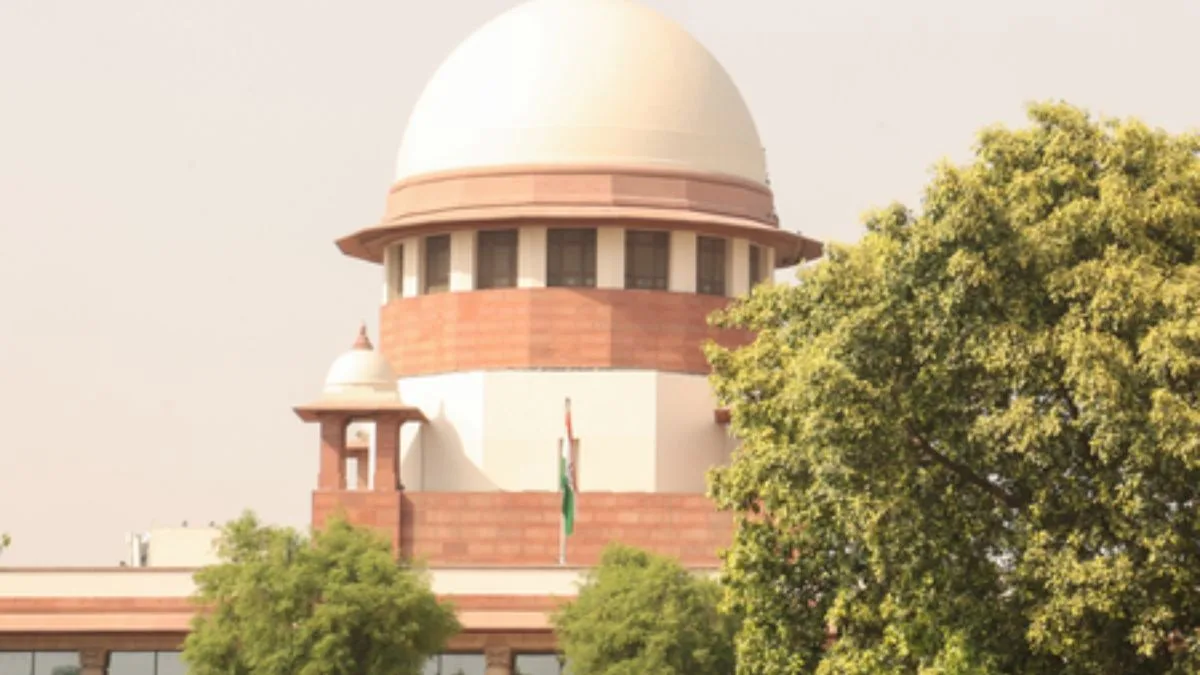
The Supreme Court on Monday handed over the investigation into the gherao of seven judicial officers, including three women judges, engaged in the Special Intensive Revision (SIR) of electoral rolls in the state, on the evening of April 1, 2026, to the National Investigation Agency (NIA). It directed the West Bengal Police to immediately transfer all FIRs, investigation records so far, and the custody of two accused to the central agency.
Reiterating that the gherao of judicial officers was a “motivated, pre-planned and calculated” act requiring investigation to its roots, a Bench comprising Chief Justice Surya Kant, Justice Joymalya Bagchi and Justice Vipul M. Pancholi entrusted the probe to the NIA by invoking its plenary powers under Article 142 of the Constitution, as the incident did not fall within the scheduled offences under the National Investigation Agency Act, 2008.
Advertisement
Permitting the agency to register further FIRs arising from different dimensions of the incident, the apex court directed the West Bengal Police to extend full logistical and other support to the NIA.
At the previous hearing on April 2, while directing the Election Commission of India to deploy central forces for the safety and security of judicial officers engaged in the SIR exercise, the court had observed that West Bengal was the “most polarised” state where everyone “speaks in political language”, and described the gherao as “calculated and motivated”.
The court had also taken serious note of the delayed response of both the Chief Secretary and the Director General of Police to the calls made by the Chief Justice of the Calcutta High Court while the gherao was underway. It noted that the Malda District Magistrate and the Senior Superintendent of Police allegedly failed to intervene and rescue the judicial officers.
On Monday, the Chief Secretary, Director General of Police, District Magistrate and Senior Superintendent of Police, Malda, appeared before the court. The Chief Secretary informed the court that he was in Delhi on April 1, 2026, and later boarded a flight back to Kolkata, while denying having received any call from the Chief Justice of the High Court.
As both the Chief Secretary and the DGP tendered an apology for the incident, the court directed them to apologise to the Chief Justice of the Calcutta High Court. It further directed all civil and police authorities to extend full cooperation to the Chief Justice in completing the ongoing SIR exercise, which is presently at the stage of hearing appeals by Appellate Tribunals against the inclusion and exclusion of names in the electoral rolls, including those flagged under “logical discrepancy.”
The claims and objections relating to “logical discrepancy” were overseen by around 700 former judicial officers—500 from West Bengal and 200 from Odisha and Jharkhand.
Meanwhile, the Supreme Court asked the Chief Justice of the Calcutta High Court to constitute a committee of the three seniormost retired Chief Justices to evolve a uniform procedure to be followed by presiding judges of the 19 Appellate Tribunals hearing such appeals.
The three seniormost former Chief Justices would be drawn from among former Chief Justices and senior judges of the High Court heading these tribunals.
The West Bengal government informed the court that, out of over 60 lakh names flagged under “logical discrepancy”, 55 per cent (around 24 lakh) have been included in the voters’ list, while 45 per cent (around 20 lakh) have been excluded. It submitted that those excluded could still be included, as they are mapped voters who had participated in past elections, though the number of exclusions remains significant.
The court declined to fix a deadline for disposal of appeals by the Appellate Tribunals, observing that the process should not be rushed.