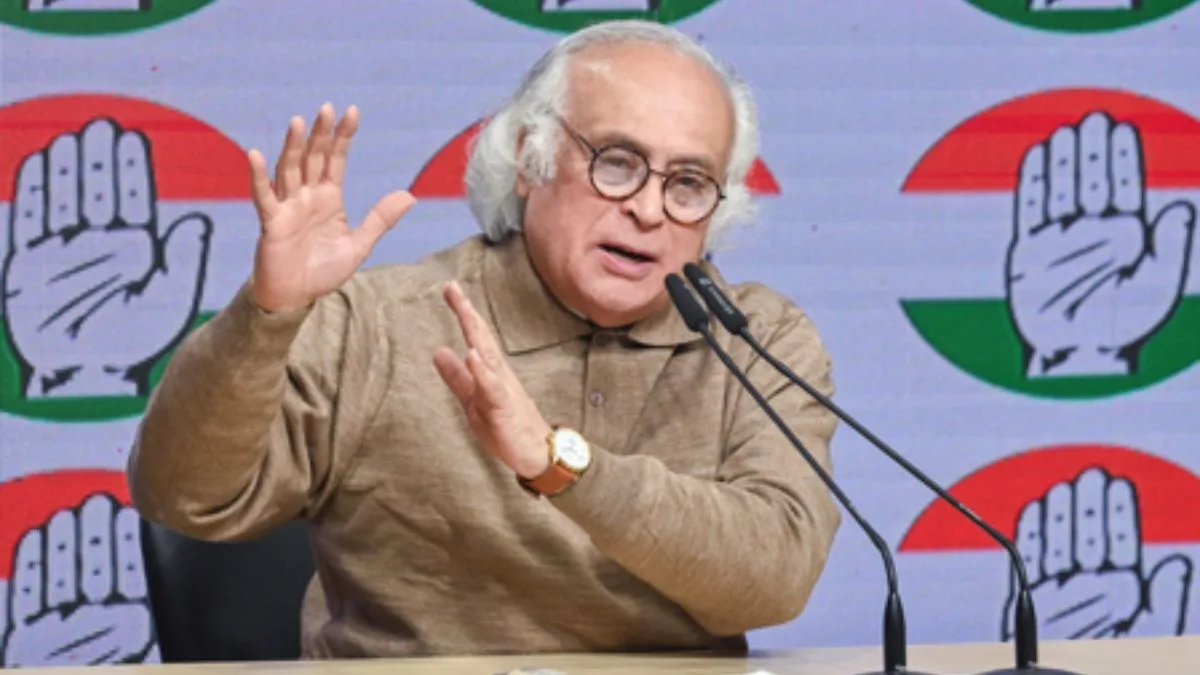
Senior Congress leader Jairam Ramesh on Friday accused the Union government of extending the current Parliament session in haste to secure electoral advantage, alleging that the move bypasses established consultation norms and coincides deliberately with upcoming state polls.
Addressing a press conference here, Ramesh said the decision to extend the Parliament session to April 16 for a three-day sitting had been taken without adequately engaging Opposition parties, despite repeated appeals from Congress president Mallikarjun Kharge. He described the government’s approach as a “gross violation” of the Model Code of Conduct (MCC), noting that elections in West Bengal and Tamil Nadu are imminent.
Advertisement
Both Houses had been adjourned on Thursday, with the Budget session—commenced on January 28—originally slated to conclude on April 2. The abrupt extension, Ramesh argued, raises “serious questions about transparency and intent”, particularly as the agenda now appears to include contentious issues such as delimitation, which had not been previously discussed with Opposition leaders.
“As you all know, the government has announced a special session on April 16, 17 and 18,” he said. “On March 16, Kiren Rijiju wrote to Mr Kharge stating that the government wished to discuss amendments to the Nari Shakti Vandan Adhiniyam. Mr Kharge responded that such discussions must take place in an all-party meeting. That request has been ignored.”
Mr Ramesh further alleged that the Centre had shown little urgency in implementing the women’s reservation law—formally the Nari Shakti Vandan Adhiniyam—since its passage, only to revive it now for political benefit. “The government kept sleeping for 30 months and is now attempting to take double credit during the election season,” he said.
He also voiced concern over reports of a potential delimitation exercise, stating that no formal proposal had been shared. “We have heard there may be a proportionate rise in seats, but in reality smaller states and those in the South, Northeast and West could suffer massively,” Ramesh warned, adding that such changes could significantly alter the balance of representation in Parliament.
Referring to speculative projections, he suggested that states such as Uttar Pradesh might see a sharp increase in seats, while others, including Kerala, could witness only marginal gains. “What we have heard unofficially would be very dangerous for many states,” he said.
Questioning the timing of the session, he said: “The only objective is to grab political mileage to influence polls in Tamil Nadu and West Bengal. Could this not have been scheduled after a fortnight?”
He accused the government of prioritizing “narrative management” over substantive governance. “This government functions on optics. They are losing the political and foreign policy narrative and want to reclaim it through a special session,” he remarked.
Detailing exchanges between the Centre and the Opposition, Ramesh said Congress and allied parties had jointly urged the government to defer consultations until after April 29. “Despite this, just thirty minutes after Mr Rijiju’s second letter, Mr Kharge renewed the call for an all-party meeting, but the government chose to proceed unilaterally,” he said.
He added that delimitation had not figured in earlier correspondence. “There was no prior reference to delimitation. Suddenly, we’re faced with plans to introduce amendments to the women’s reservation law alongside a constitutional amendment tied to delimitation,” he said.
The Congress has also raised concerns over shifting timelines for the national Census, with Ramesh pointing to indications that final data may not be available until 2029. He recalled that when the women’s reservation law was enacted, the Opposition had argued it could be implemented without awaiting Census or delimitation exercises—an argument rejected by the government at the time.
Senior Congress leaders, including Kharge and Rahul Gandhi, are expected to meet party MPs and other Opposition figures ahead of the session to formulate a coordinated response.
The forthcoming sitting is expected to consider legislative proposals linked to women’s reservation as well as a potential expansion of Lok Sabha seats from 543 to as many as 816, a prospect that has already sparked sharp political disagreement.
While the government maintains that it is acting within its legislative mandate, Opposition parties contend that it is attempting to push through significant constitutional changes without consensus, heightening tensions as the election season gathers momentum.