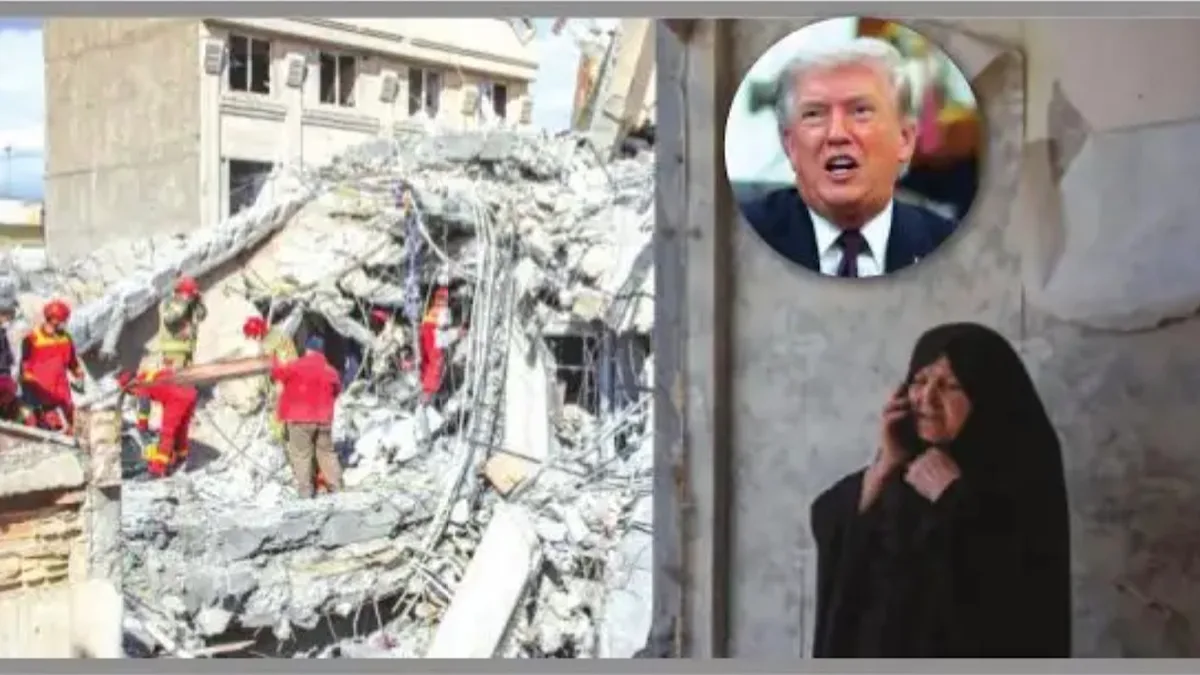
The United States now finds itself drawn into yet another conflict in the Middle East, one whose origins are as troubling as its consequences are far-reaching. The decision to wage war against Iran raises profound concerns about legality, prudence, and responsibility. At its core lies an uncomfortable reality: this is a war under taken without an imminent threat , without congressional sanction, and without a clearly defined objective. For a nation that prides itself on constitutional governance, the sidelining of Congress in matters of war is deeply unsettling.
The framers of the Constitution vested in the legislature the authority to declare war precisely to prevent unilateral executive action of this nature. When that safeguard is ignored, the implications extend far beyond procedure. They speak to a deeper erosion of democratic norms. Equally troubling is the absence of compelling evidence that Iran posed an immediate danger to the United States. Nor was there conclusive proof of an operational nuclear capability that might justify preemptive action. In the absence of such justification, the war appears less a necessity than a choice – one shaped by external pressures and strategic alignments rather than sober assessment. The lack of clarity surrounding the objectives of this conflict only compounds the problem.
Advertisement
Is the aim to weaken Iran’s regime, to secure energy routes, or to reassert regional dominance? Without a clearly articulated goal, military engagement risks becoming an open-ended commitment. History has shown that such ambiguity often leads to mission creep, mounting costs, and diminishing returns. Those costs are already staggering. The war is reportedly draining billions of dollars each day from American coffers. This is occurring at a time when domestic priorities – from infrastructure to healthcare – remain underfunded. The burden on taxpayers is immense, and the justification increasingly tenuous. Beyond its domestic impact, the war has triggered a cascade of global consequences. Iran’s closure of the Strait of Hormuz has disrupted one of the world’s most critical energy corridors.
The resulting shortages of oil and gas have reverberated across continents, unsettling economies and deepening existing vulnerabilities. The effects are particularly severe in developing countries. Nations across South and Southeast Asia are grappling with rising energy costs, supply disruptions, and economic instability. Businesses are shutting down, industries are slowing, and unemployment is rising. What began as a regional conflict is rapidly evolving into a global economic crisis. The repercussions are being felt in the United States as well. Financial markets have reacted sharply to uncertainty, and rising fuel prices are affecting everyday life. Inflationary pressures are intensifying, eroding purchasing power and straining household budgets. The economic ripple effects of this war are proving both immediate and enduring.
Even more alarming is the escalation now underway. The decision to deploy ground troops to seize key oil infrastructure represents a dangerous turning point. Military experts have long warned that introducing troops on the ground in such a volatile environment can transform a limited engagement into a prolonged and costly conflict. The shadow of past misadventures looms large. Conflicts that began with confidence and limited aims have often descended into protracted struggles with heavy human and material costs. The lessons of history are clear, yet they appear to be going unheeded. Compounding these concerns is the lack of clarity in official communication. Instead of transparency, there have been shifting narratives and premature claims of progress. Such inconsistencies erode public trust and undermine the credibility of leadership at a critical moment. Leadership in times of crisis demands more than resolve; it requires judgment and humility. It calls for the willingness to reassess decisions and to acknowledge missteps.
Pride and inflexibility can turn difficult situations into irreversible ones. The current trajectory of the conflict suggests a deepening quagmire. Each escalation narrows the path to resolution and increases the risks involved. The longer the war continues, the greater the toll – on lives, on economies, and on the stability of an already fragile world order. There is, however, an alternative. Diplomacy, often dismissed as a sign of weakness, remains the most viable path forward. It offers the possibility of de-escalation, of negotiated settlement, and of restoring a measure of stability. Engaging in dialogue does not diminish strength; it reflects a mature understanding of the complexities of conflict. The United States has, in the past, demonstrated its capacity for such leadership. It has helped broker peace, build coalitions, and navigate crises through negotiation rather than force. That tradition must now be revived.
Ending this war will not be easy. It will require difficult conversations, concessions, and a willingness to rethink entrenched positions. But the alternative – a prolonged and expanding conflict – carries far greater risks. The responsibility now rests with the American president. The moment calls for statesmanship of a high order: the courage to step back, to reassess, and to pursue peace with sincerity and resolve. The world is watching, and the stakes could not be higher. History will judge this moment not only by how the war was waged, but by how it was ended. There is still time to choose a different course – one guided not by force, but by wisdom.
(The writer is professor emeritus at Loyola Marymount University, Los Angeles.)