If nostalgia had a color it would probably be burnt ochre. Or a nuanced shade of sunset yellow, dipped in the dusty orange of oblivion like the fading pages of old photo albums, fraying at the edges. Pictures of those who passed on, their smiles still alive pulling at the heartstrings and drawing out tears from the tired eyes of those who look back. Sometimes the eyes smile though. In recollection.
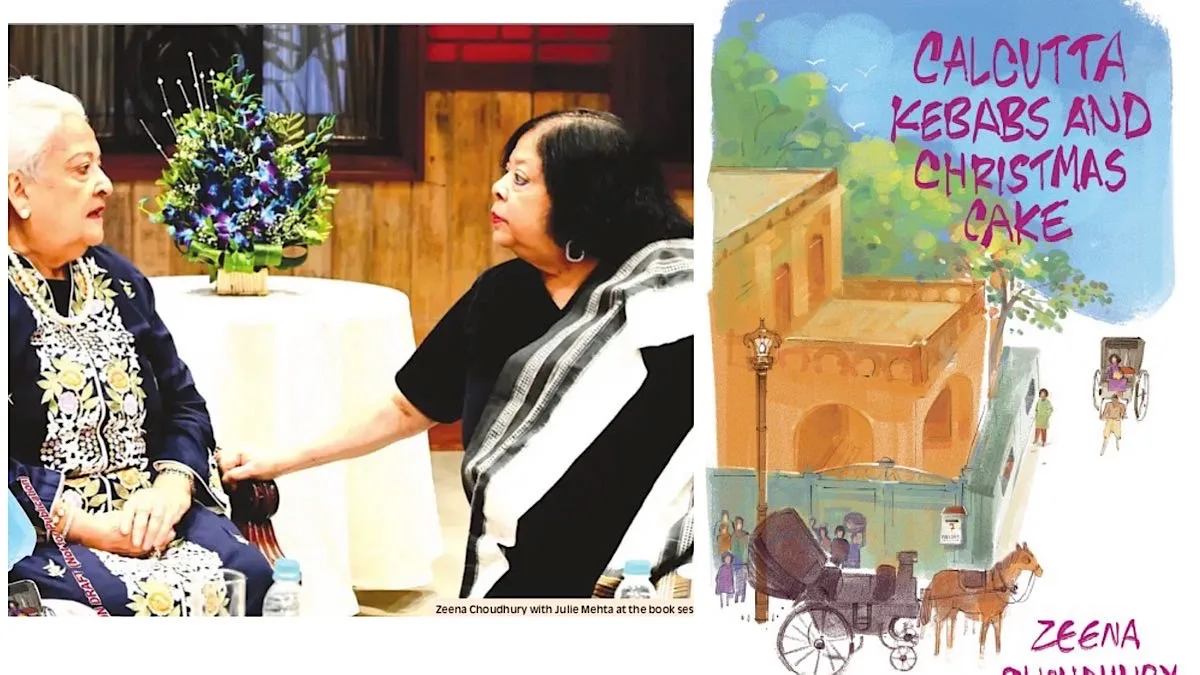
87-year-old Zeena Choudhury read out passages from her book, “Calcutta Kebabs and Christmas Cake” at a small gathering in a Kolkata room. The Bangladeshi author and her daughter Farzana Ahmed were in town for the prelaunch session organized by The Rising Asia Literary Circle and curated by Dr Julie Banerjee Mehta, author and professor.
Advertisement
Zeena’s story is a personal saga spanning decades. It is the tale of a long journey down memory lane beginning with the happy childhood days spent between Darjeeling and Calcutta, which kneads its way through the twists and turns of life – that are not always as happy – and arrives at an open-ended fusion of past, present and future where the path can only look ahead. There are no dead-ends and indeed, when an eager audience asks her after the reading and a Q and A with Mehta, whether they can expect another book soon enough, she does not rule it out.
Set, partly, in Calcutta (long before it became Kolkata), the writer weaves into her own story the city’s larger landscape – cultural, economic, social and obviously even political.
Chapter 1, subtitled “Two Queen” takes the reader right inside her home. She writes, “ 7 Park Lane, Calcutta, was a corner house behind the Nawab of Mursidabad’s palace. The two-story building had verandahs edging the house like frayed lace on a Victorian gown. 7 Park Lane is etched in memory like a beloved sepia photograph that one gazes at to recall the love, the unending happiness, and the excitement of surprise around every corner.
This was the fountainhead of love and affection I returned to every nine months. It was a world apart from the disciplined confines of Loreto Convent, Darjeeling. In Ranjit Singh’s taxi, bringing me from Sealdah Station at seven in the morning, the first thing I did was take off my shoes.
Nanna, sitting on my right, smiled indulgently, while Maggie, sitting on my left, gave me a little hug. These were my grandmothers, two queens of my special world. Two queens of 7 Park Lane.”
The author is able to establish the complex (and at the same time cosmopolitan) macrocosm of the social, religious and cultural context of those colonial times by merely telling the story of these two elderly women in her life and their microcosmic backgrounds.
“Nanna and Maggie came from different worlds. Nanna’s heritage was rooted in Muslim Bengal. Nanna’s father, Syed Abdur Rahman, came from Faridpur in East Bengal and was a zamindar. Her mother was English born and bred but after her marriage to Abdur Rahman, she considered herself a Muslim Bengali; her English connections were then considered incidental. Maggie was Anglo-Indian, a term legally defined by the Government of India Act as a person whose father is of European descent. However, it was more than a mix of Anglo-Indian blood; it was a culture born of history, giving it a unique ethnicity.”
Zeena grew up with her grandmothers as her guardians. Her parents were pursuing higher studies in the United States at that time. In 1959 she married Faruq Choudhury, whose diplomatic career took the family to many countries. Zeena too resumed her studies earning degrees in Sociology and International Law in universities abroad. After her husband’s retirement (he served as Bangladesh High Commissioner to India from 1986 to 1991) the family returned to Dhaka. There Zeena took up the work of running an educational centre, Kids’ Tutorial School, founded by her mother, Dr Amina Rahman.
As it was revealed during the riveting discussion at the session, Zeena’s daughter and granddaughter helped her with the digital work that was associated with the writing of the book. To transfer content from the old- fashioned, handwritten pen and paper text to the computer is no cakewalk of course (as emerged from a lively, fun Q and A with Farzana).
Speaking of cakewalk, the compelling narrative, the telling of the tale, is the charm of this book. It feels like a drive down a winding road on a drizzly, windy day or a swim through cool, placid waters on a warm sunny day.
But whether it the sunny or the drizzly, what seeps in page after page is the color of nostalgia. Ochre, orange, yellow in all its fading, foreverness.
The reviewer is Editor, Features