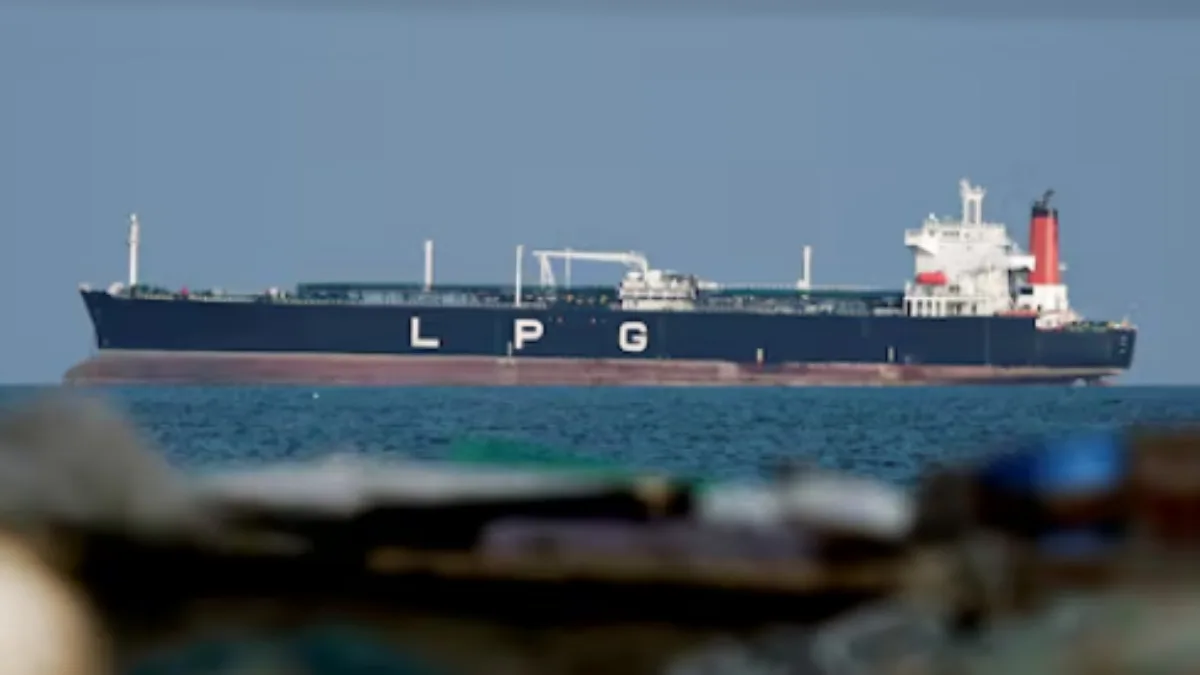
Two Indian-flagged liquefied petroleum gas (LPG) vessels, Jag Vasant and Pine Gas, carrying 92,612.59 MT of LPG, successfully resumed their journey towards India, passing the strategically crucial Strait of Hormuz, offering reassurance over energy supply continuity despite escalating tensions in West Asia.
The vessels have 33 and 27 Indian seafarers onboard, respectively. These vessels are are likely to reach Indian ports between 26 and 28 March 2026.
Advertisement
According to ship-tracking data, the two carriers navigated a carefully chosen route close to the Iranian coastline, moving northward from the UAE coast towards Iran’s Qeshm and Larak islands early Monday. Their passage through the Larak-Qeshm channel highlights a strategic adjustment aimed at ensuring safer transit in a high-risk maritime zone.
Safe passage amid conflict concerns
The development comes at a time when the Strait of Hormuz remains under intense global scrutiny following heightened military activity in the region. Despite fears of disruption, both Indian vessels are continuing their voyage toward India carrying critical LPG supplies.
Significantly, Indian naval task forces have been deployed in the region to monitor and safeguard commercial shipping routes, ensuring that essential cargo reaches its destination without incident. The coordinated movement underscores India’s proactive approach to securing its energy lifelines amid geopolitical uncertainty.
Earlier this month, two other Indian-flagged LPG carriers also completed a similar passage, indicating that while risks persist, controlled and escorted navigation remains viable.
Key energy corridor remains functional
The Strait of Hormuz is one of the world’s most vital energy transit routes, handling a significant share of global oil and gas shipments. Although tensions have surged following recent US and Israeli strikes on Iran, the continued movement of LPG carriers signals that the corridor, while sensitive, is not entirely disrupted.
For India, which relies heavily on energy imports, the safe transit of these vessels is a crucial indicator of supply stability. As the situation evolves, authorities and shipping operators are expected to maintain heightened vigilance to ensure uninterrupted flow through this critical maritime passage.