Print or Digital?
Is Generation Z (or Gen Z) really out and out rejecting hardcopies of things, like books, and opting for the digital versions or softcopies? Do they even read the newspaper, far less in print?
Across the country, young Indians are flocking to concerts that blend devotional bhajans with contemporary rhythms and songs. The popularity of “bhajan clubbing” is not a passing cultural fad.





(Representational Photo)
Across the country, young Indians are flocking to concerts that blend devotional bhajans with contemporary rhythms and songs. The popularity of “bhajan clubbing” is not a passing cultural fad. Rather, it conf irms a long- standing dimension of Indian society: religious practice is ubiquitous, and youngsters have merely adapted rather than giving up on faith and practice. We analyze data from a nationally representative survey to demonstrate that young Hindus, including Gen Z, remain highly religious. For years now, a familiar claim has circulated in public debates: as India becomes more educated, urban, and economically mobile, younger generations are drifting away from religion.
This is a narrative borrowed largely from Western societies, where modernization coincided with declining religious participation, and was then loosely applied to India. Contrary to this familiar Western reality, our analysis shows that young Indians report relatively high levels of religiosity. We analyze data from a nationally representative survey – India Political and Social Attitudes Study – conducted by us among 7,382 respondents across 18 states in 2025. We asked respondents how often they engage in religious practices ranging from daily rituals to weekly observance and festival participation, including both public and private activities. In this article, we restrict our analysis to the 6,187 Hindu respondents in the sample.
Advertisement
As the country’s largest religious group with diverse forms of practice, Hindus offer a useful lens to examine generational change in religious life. We find that a substantial proportion of young Hindus actively participate in religious life. The reported levels of regular religious observance among GenZ Hindus (those aged between 18 and 28 in 2025) are only marginally lower than older cohorts. A majority of Gen Z respondents (55 per cent) reported that they prayed daily, and around half (48 per cent) reported visiting a temple at least once a week.
Advertisement
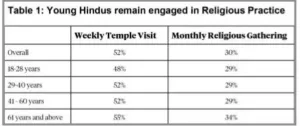
These figures are only marginally lower than the overall proportion across cohorts: 59 per cent of Hindu respondents reported praying daily, and 52 per cent pray at a temple at least once a week. The marginally lower levels among the youth should not be misconstrued as disengagement. Only a minuscule minority reported ‘never’ or ‘rarely’ undertaking various religious activities. Beyond private activities, young Indians are also engaging in socially embedded forms of participation. About three of ten (29 per cent) Gen Z respondents said they attend a religious gathering such as a Katha, Bhajan or Sangat at least once a month. This is why the enthusiasm for Bhajan Clubbing should not be viewed merely as a passing trend.
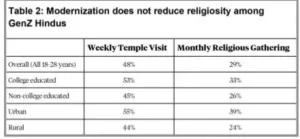
The secularization theory predicts that religious practice will decline due to modernization forces such as urbanization, upward economic mobility, and expansion in education. Contrary to this expectation, we find that a relatively similar proportion of college and non-college-educated youngsters actively engage in religious practice. For example, college-educated Indians (53 per cent) are slightly more likely to pray at a temple at least once a week than those with lower levels of education (45 per cent). Similarly, college education does not reduce attendance at public religious gatherings. It is evident that modern education and religious life coexist in contemporary India. Urbanization shows a comparable pattern.
Urban youth were at least as likely-and in some cases slightly more likely-to report engagement in religious practice. A majority of urban Gen Z respondents report visiting temples at least once a week (55 per cent), compared to 44 per cent among rural youth. The gap is even wider for socially embedded participation: nearly four in ten urban youth (39 per cent) attend religious gatherings such as kathas or bhajans each month, versus just one in four rural youth (24 per cent). Rather than crowding religion out of everyday life, urban environments appear to provide new social spaces and opportunities for collective religious participation.
Finally, religious participation among the youth is not confined to particular social groups. Across General, OBC, SC, and ST respondents, engagement remains widespread, even though frequency and modes of participation vary somewhat. Religion in India continues to function as a shared social institution rather than a shrinking remnant of tradition. Taken together, these findings challenge the common assumption that modernization naturally produces secularization. India’s trajectory looks very different from the Western historical experience that often dominates sociological thinking. Rather than abandoning religion, young Indians-including collegeeducated and those from urban areas – continue to embrace religion.
The Secularization myth persists partly because it offers a simple story: development replaces tradition. But social change is rarely so linear. The IPSAS evidence suggests that modern India is not becoming less religious. Young Hindus still gather in temples, enthusiastically celebrate festivals, engage in both public and private religious activities, and maintain strong religious identities. Borrowed historical templates cannot provide an accurate understanding of Indian society and belief structures. Moreover, it requires shedding commonly used binaries and adopting nuance. In this case, our survey suggests that modernity is not erasing faith. The enthusiastic embrace of Bhajan Clubbing is therefore not an anomaly. It is a visible expression of an enduring religious impulse finding new cultural forms. The medium has changed; the commitment endures.
(The writers are, respectively, a sociologist and researcher at University of Maryland, College Park, and a doctoral candidate in Political Science at the University of California, Berkeley.)
Advertisement