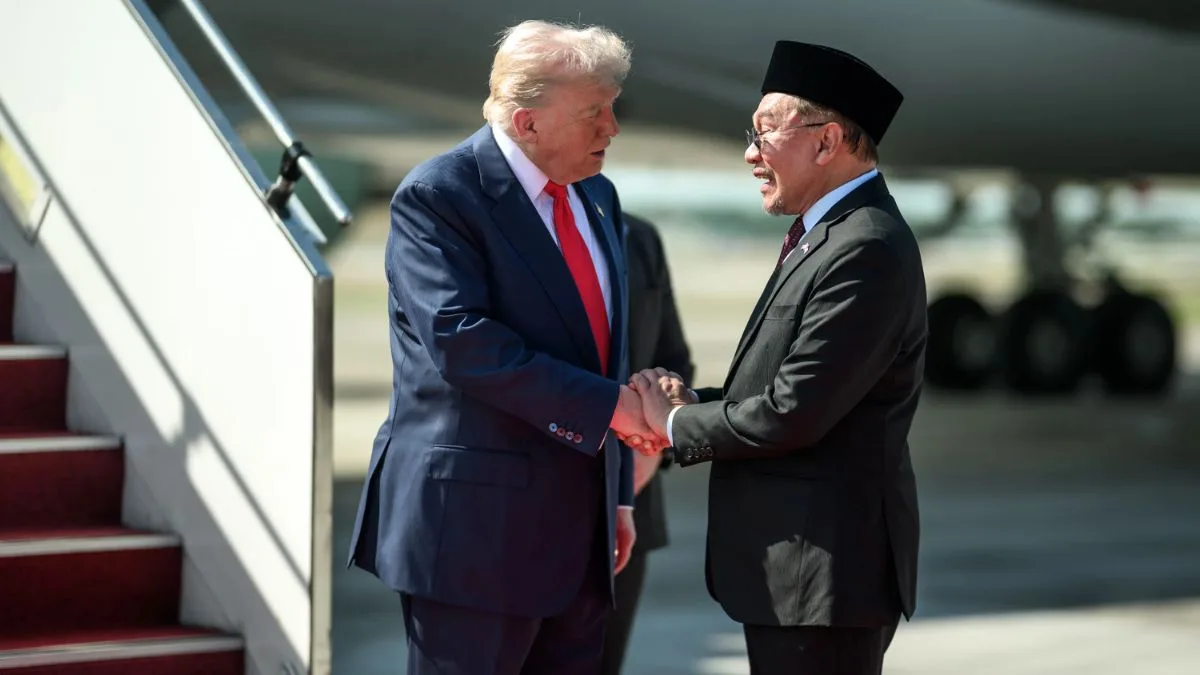
Malaysia’s government has found itself under pressure over its much-publicised tariff agreement with the United States, after a senior minister appeared to contradict the administration’s position on the deal’s status. The confusion began when a minister suggested that a recent ruling by the US Supreme Court had effectively cancelled the agreement, a remark that was later walked back by his own ministry.
The trade arrangement, signed in October by Prime Minister Anwar Ibrahim’s government, was presented as a major step to secure continued access to the US market. In return, Malaysia pledged investments and purchases of American goods worth about US$240 billion, including items such as beef and aircraft, while benefiting from a tariff rate of 19 per cent in the world’s largest consumer economy.
Advertisement
Minister’s remark triggers political backlash
Questions about the agreement intensified after the US Supreme Court ruled in February that President Donald Trump had exceeded his constitutional authority by invoking emergency powers to introduce his “Liberation Day” tariffs. That decision raised doubts about the legal basis of several trade arrangements built around those tariffs.
The issue escalated on Sunday when Trade Minister Johari Abdul Ghani told reporters that the court ruling meant the Malaysia-US deal was no longer valid. “It is not on hold. It is no longer there, it’s null and void,” he was quoted as saying.
Hours later, however, his ministry issued a clarification saying the minister had “misspoken”, without providing additional details.
The episode quickly drew criticism from the opposition. Takiyuddin Hassan, secretary general of the Perikatan Nasional coalition, said the minister’s remarks had only deepened uncertainty about the commitments Malaysia had made and their possible impact on the country’s export-driven economy, where overseas trade accounts for more than three-quarters of output.
“At a time of growing global trade uncertainty, clarity in policy direction and investor confidence in Malaysia are increasingly important,” Takiyuddin said while seeking a special parliamentary session to address the issue.
Deal already faced criticism at home
From the outset, the agreement had attracted scrutiny within Malaysia. It was signed during Donald Trump’s visit to Kuala Lumpur last October, a period marked by volatile US trade policies that were unsettling global supply chains.
Trump defended his tariff strategy as necessary to correct what he described as long-standing trade imbalances, accusing both allies and rivals of taking advantage of the United States.
For Malaysia’s leadership, entering into the deal was seen as a way to maintain stability in trade ties with Washington. Critics, however, argued that the arrangement was rushed and risked pushing Malaysia closer to US geopolitical positions, potentially straining relations with China, its largest trading partner.
On Monday, eight government lawmakers also called for greater transparency about the agreement. In a joint statement, they urged the administration to seek clarification from Washington and warned that unresolved questions could leave Malaysia stuck with less favourable terms than initially expected.
They also criticised the negotiation process, saying that advice to delay signing the agreement until after the US Supreme Court ruling had been overlooked. According to the lawmakers, the final deal appeared “one-sided” and raised concerns about its implications for national sovereignty.
Global trade landscape shifting
The court’s decision striking down Trump’s emergency tariffs has complicated several similar agreements the United States had reached with other countries, including Japan, South Korea, Vietnam, Bangladesh and Indonesia.
Following the ruling, the Trump administration replaced earlier arrangements with a blanket tariff of 10 per cent on all trading partners. At the same time, Washington launched investigations into alleged unfair trade practices involving nearly 60 countries, including Malaysia.