The AI Impact Summit 2026 is set to be formally launched in the capital later on Monday, with Prime Minister Narendra Modi scheduled to inaugurate the India AI Impact Expo at Bharat Mandapam. Delegates from more than 100 countries, including global technology leaders and policymakers, are converging in New Delhi for the five-day event that will run until February 20.
The scale and profile of the summit underline India’s effort to assert a stronger voice in shaping how artificial intelligence is governed and deployed worldwide, particularly at a time when countries are divided over regulation, access, and technological competition.
Advertisement
Also Read: India AI Impact Expo 2026: 10 things to know about the five-day event to be inaugurated by PM Modi today
Global tech leaders and policymakers to gather in Delhi
Over the next five days, Delhi will see an unusual mix of cabinet ministers, chief executives, researchers and startup founders sharing the same stage. The summit’s schedule is packed (more than 500 sessions and over 3,000 speakers) with halls filled with live demos, product showcases and working prototypes from global tech companies and homegrown innovators alike.
The conversations are being framed around three broad ideas: People, Planet and Progress. In simple terms, that means looking at how artificial intelligence can improve daily life, support sustainable development and drive economic growth.
Among those expected to participate are Google CEO Sundar Pichai and OpenAI chief Sam Altman. United Nations Secretary-General Antonio Guterres is also slated to attend. Microsoft co-founder Bill Gates is expected to be present, though officials have not specified his programme. NVIDIA CEO Jensen Huang, who had earlier been expected, will not attend due to unforeseen circumstances.
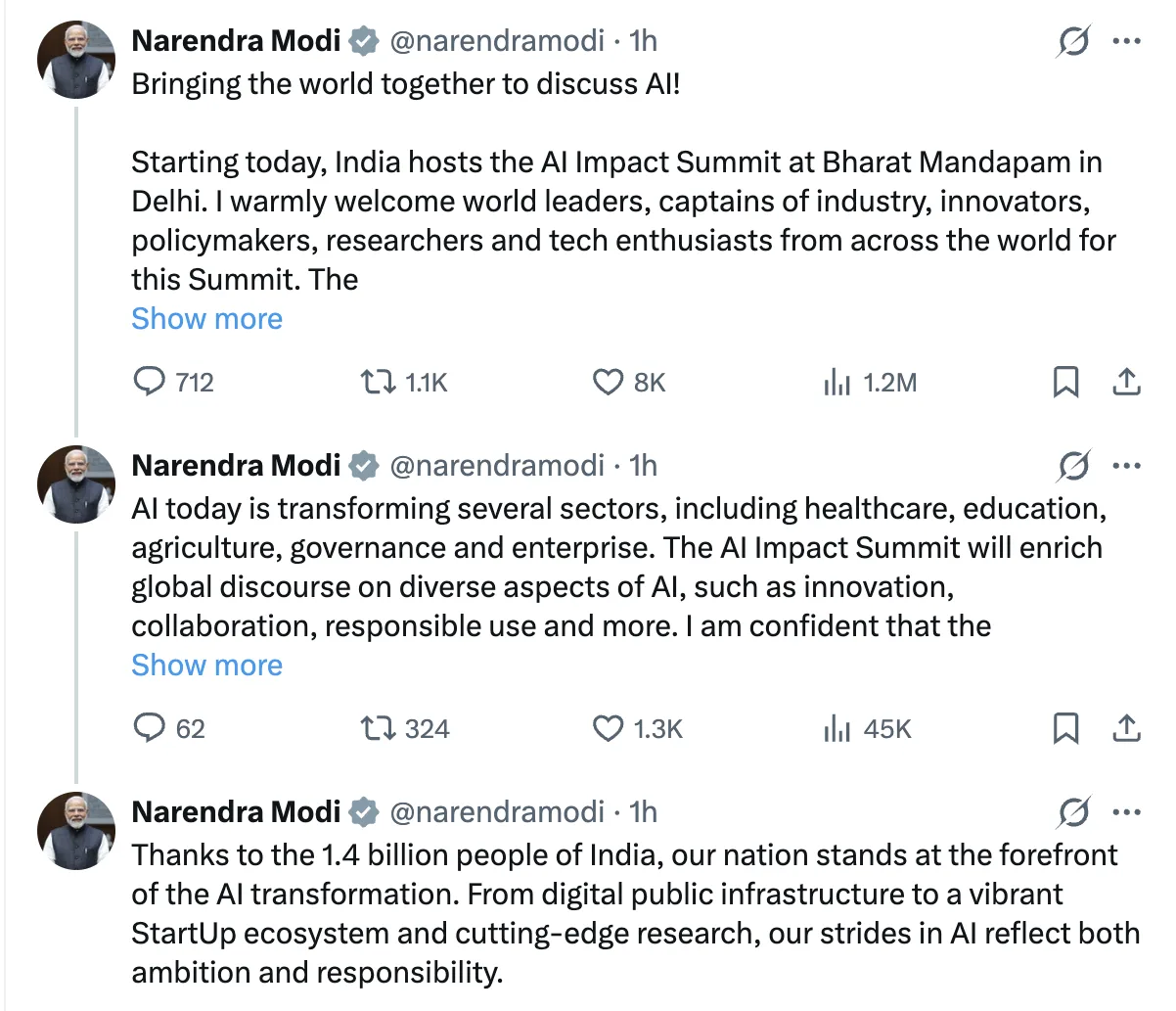
Ahead of the launch, Prime Minister Modi described the international turnout as a sign of India’s rising technological capacity and the strength of its young talent pool. In a post on X, he said the participation reflects the potential and capabilities of the country’s youth and highlighted India’s progress in science and technology.
Emphasis on responsible and inclusive AI
Senior officials associated with the summit have indicated that India intends to promote a model of artificial intelligence development focused on equitable access and responsible innovation, rather than heavy-handed regulatory approaches.
The Expo, spread across 10 arenas covering more than 70,000 square metres, will host over 600 startups and 13 country pavilions, including those from France, Germany, Russia, the United Kingdom, Australia, Japan, Italy, the Netherlands, Estonia, Tajikistan, Switzerland, Serbia, and Africa.
Many of the participating startups are expected to demonstrate AI tools already deployed in climate resilience, agriculture, healthcare, governance and digital infrastructure. Organisers estimate that more than 2.5 lakh visitors could attend over the course of the summit.
Diplomatic engagements planned alongside summit
Prime Minister Modi is scheduled to hold bilateral meetings with French President Emmanuel Macron and Brazilian President Luiz Inacio Lula da Silva during the event. A leaders’ roundtable and a meeting with technology CEOs are also planned.
With ongoing investments in artificial intelligence, semiconductors and quantum computing under initiatives such as Digital India, the summit offers India an opportunity to project itself not only as a large digital market, but also as a participant in shaping global norms around emerging technologies.