All eyes on NDA’s ‘Mangal Milan’ meeting on Tuesday
The National Democratic Alliance (NDA) Parliamentary Party meeting, now called 'Mangal Milan', will be held on Tuesday at Parliament House.
Finance Minister Nirmala Sitharaman on Sunday unveiled one of the most far-reaching tax reform packages in recent years, signalling a decisive shift towards simplified laws, lower litigation, easier compliance and a stronger alignment of India’s tax system with growth and global competitiveness.




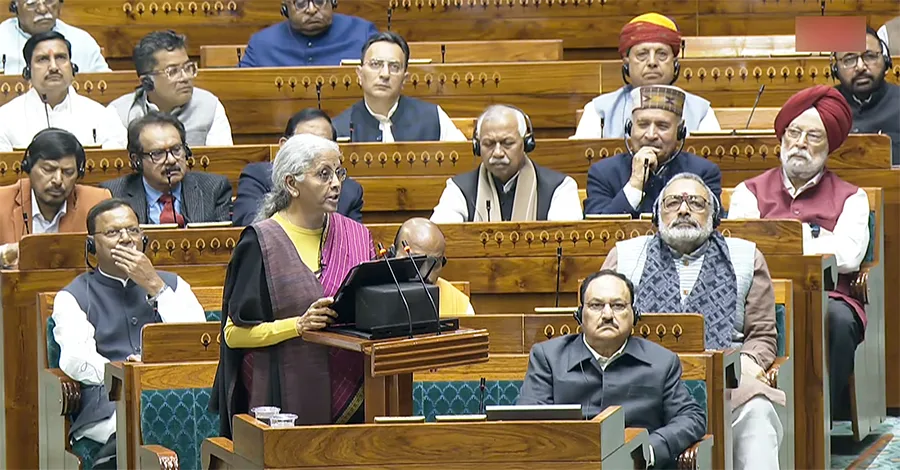
Union Finance Minister Nirmala Sitharaman addresses the Lok Sabha while presenting the Union Budget 2026–27 during the Budget Session of Parliament in New Delhi on Sunday.
Finance Minister Nirmala Sitharaman on Sunday unveiled one of the most far-reaching tax reform packages in recent years, signalling a decisive shift towards simplified laws, lower litigation, easier compliance and a stronger alignment of India’s tax system with growth and global competitiveness.
Presenting the Budget for 2026-27 in Parliament on Sunday, Sitharaman said the government’s taxation strategy rests on trust, transparency and technology-driven administration, while balancing revenue needs with ease of living and ease of doing business.
The centrepiece of the direct tax reforms is the replacement of the six-decade-old Income Tax Act. “The comprehensive review of the Income Tax Act, 1961 has been completed in record time and the Income Tax Act, 2025 will come into effect from April 1, 2026,” Sitharaman told Parliament.
Advertisement
She said simplified tax rules and redesigned forms would soon be notified, ensuring that “ordinary citizens can comply without difficulty.”
Several measures were announced to reduce taxpayer hardship. Interest awarded by Motor Accident Claims Tribunals to individuals will be fully exempt from income tax, and TDS on such payments will be removed.
Advertisement
TCS rates on overseas tour packages, education and medical remittances under the Liberalised Remittance Scheme have been sharply reduced to 2 per cent, easing cash flow pressure on families.
To remove ambiguity, manpower supply services will be treated as contractual payments for TDS purposes, attracting lower rates. Small taxpayers will be able to obtain lower or nil TDS certificates through a fully automated, rule-based system without approaching assessing officers.
The government also extended the timeline for revising income tax returns up to March 31 with a nominal fee, while filing deadlines will be staggered to give additional time to non-audit business cases and trusts.
Depositories will now accept Form 15G and 15H centrally, simplifying compliance for investors holding securities across multiple companies. For resident buyers purchasing property from non-residents, TDS will be deposited using PAN-based challans, eliminating the need for TAN.
Addressing long-standing concerns of students, young professionals and relocated NRIs, Sitharaman announced a one-time six-month window to disclose foreign income or assets below a specified threshold.
The scheme allows eligible taxpayers to regularise past omissions by paying due tax and an additional levy, with immunity from prosecution.
“This scheme is intended to address genuine hardships,” she said.
In a major structural change, Minimum Alternate Tax (MAT) will become a final tax from April 1, 2026, with the rate reduced to 14 per cent from 15 per cent.
Accumulated MAT credit up to March 31, 2026 will continue to be available for limited set-off. To curb misuse, buybacks will now be taxed as capital gains for all shareholders, with promoters paying an additional levy.
TCS rates on the sale of specific goods such as scrap, minerals and alcoholic liquor have been rationalised to 2 per cent, while securities transaction tax on futures and options has been raised to curb excessive speculation.
Turning to indirect taxes, Sitharaman said, “My proposals for Customs and Central Excise aim to further simplify the tariff structure, support domestic manufacturing, promote export competitiveness, and correct inversion in duty.”
As part of tariff rationalisation, long-standing customs duty exemptions on items now manufactured domestically or with negligible imports will be phased out.
Effective rates of duty will be incorporated directly into tariff schedules to reduce classification disputes. Export-oriented sectors received targeted support in the budget.
The limit for duty-free imports of inputs used in seafood processing for export has been increased to 3 per cent of previous year export turnover.
Duty-free input benefits available to leather and synthetic footwear exports have been extended to shoe uppers, while the export obligation period for leather and textile exporters has been doubled to one year.
To support energy transition, basic customs duty exemptions on capital goods for manufacturing lithium-ion cells have been extended to battery energy storage systems. Imports of sodium antimonate for solar glass manufacturing will be exempted, while duty exemptions for nuclear power projects have been extended till 2035 for all plants irrespective of capacity.
Critical mineral processing, civil and defence aviation, and consumer electronics manufacturing also received duty relief to strengthen domestic value addition.
Components for civilian and defence aircraft manufacturing and maintenance will be exempt from customs duty, while specified parts used in microwave ovens will receive similar relief.
In a green push, the value of biogas used in blended CNG will be excluded while calculating central excise duty, lowering costs and encouraging cleaner fuel adoption.
Customs procedures will see significant modernisation, with faster clearances for low-risk goods, expansion of AI-based container scanning and rollout of an integrated customs digital platform.
Duty-free treatment has been extended to fish caught by Indian vessels beyond territorial waters, while courier export value caps have been removed to support small exporters and e-commerce sellers.
For international travellers, baggage rules will be revised to reflect present-day travel realities, increasing duty-free allowances and providing greater clarity.
Taken together, the taxation proposals reflect a decisive attempt to modernise India’s tax system, reduce friction and align fiscal policy with growth ambitions.
As Sitharaman concluded, the thrust of the reforms is to move towards a predictable, technology-driven and taxpayer-friendly regime that supports domestic manufacturing, exports and investment while making compliance simpler for citizens and businesses alike.
Advertisement