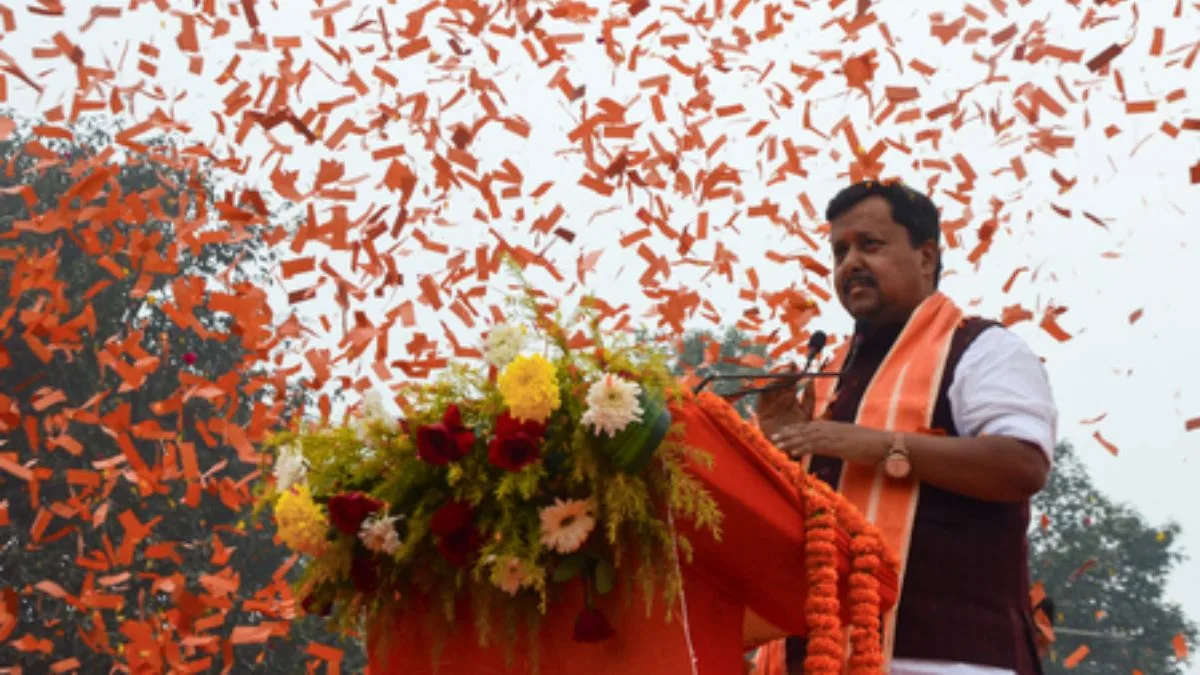
BJP national working president Nitin Nabin is expected to be elected as the party’s national president unopposed, with his name likely to be formally announced on January 20. With no other candidate expected in fray, the election is set to be a formality, party sources said after the saffron party on Friday released its schedule for electing the new chief.
According to the poll schedule, nominations for the post will be filed on January 19. Polling will be held if required on January 20, and the official announcement of the new BJP president will be made the same day, the party said.
Advertisement
The Statesman on December 19 had written that Nabin will be elevated following a formal electoral process after the ‘Khar Maas’ — the period considered inauspicious for major ceremonial events in Hindu traditions — that ended on January 14.
Set to succeed party president J P Nadda, Nabin will be the youngest BJP chief so far. Notably, Nadda too was first appointed as the BJP’s national working president in June 2019 before being elected unopposed as national president in January 2020, succeeding Union minister Amit Shah. Nabin enjoys the backing of the entire top leadership, including Prime Minister Narendra Modi and Home Minister Amit Shah and is regarded within the party as a dynamic, ideologically rooted leader with deep organisational commitment. Coming from an RSS background, his elevation is seen as part of a generational transition in the BJP’s leadership.
Still, it will be a tough run for the young leader who faces a mixed bag of challenges and opportunities with a capacity to significantly shape the party and national politics during his three-year tenure. The first and foremost will be preparing for the 2029 Lok Sabha elections for which Modi government has the agenda set — such as implementation of the women’s reservation in the Lok Sabha and state Assemblies, navigating the politically-sensitive delimitation exercise following the Census and caste count, and pushing forward the One Nation One Election (ONOE) initiative — tasks that require deft leadership, consensus-building skills and careful management of internal party dynamics. Delimitation has raised concerns, particularly in southern states, which fear a reduction in their relative representation due to faster population growth in northern states since the 1971 Census. If ONOE is implemented, it could further transform India’s political and electoral landscape.
This year, Nabin will be tested on the BJP’s ability to expand into its unconquered terrains— West Bengal, Tamil Nadu and Kerala—and holding on to Assam and Puducherry. Next year, it will be the urn of Uttar Pradesh, Manipur, Punjab, Goa, Himachal Pradesh, Uttarakhand and Gujarat. Amid all this, there may also be internal challenges, including the task of carrying everyone along, and especially those who may not be entirely happy with his elevation. Managing factional interests, balancing senior leaders’ expectations, and ensuring organisational cohesion will be critical, though not a difficult task given the complete control of PM Modi and Shah on the party.
“In today’s BJP, Modi and Shah are unquestionably the central pillars of power, major strategic, political, and electoral decisions flow from them. The party’s public messaging, governance model, and campaign are generally Modi-centric with Shah as the chief strategist and enforcer. Other leaders matter but largely in defined, delegated roles, operating within the broad strategic framework set by Modi–Shah, rather than as independent power centres. The BJP today functions more as a centralised, command-driven organisation where rising leaders are encouraged but primarily as implementers,” say observers.