Sea Change
India’s maritime ambitions cannot be measured by a ceremonial warship commissioning or ambitious infrastructure announcements alone.
A sanctions bill moving through the US Congress would, if enacted, authorise punitive “secondary” trade measures ~ potentially including tariffs as high as 500 per cent ~ against countries that continue to buy Russian oil, gas, petroleum products or uranium.





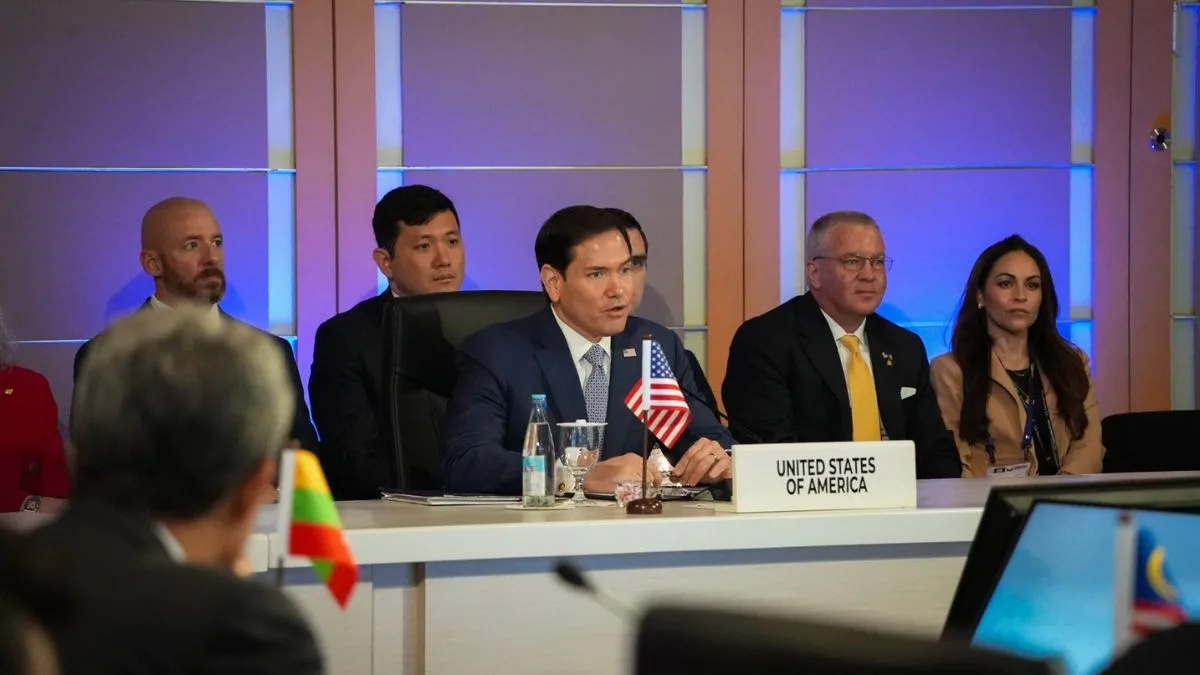
US Flag
A sanctions bill moving through the US Congress would, if enacted, authorise punitive “secondary” trade measures ~ potentially including tariffs as high as 500 per cent ~ against countries that continue to buy Russian oil, gas, petroleum products or uranium. In India, the headline number naturally grabs attention. But the story is bigger than India alone, and it deserves a more sober reading. First, Washington’s argument is not frivolous.
The US position ~ stated repeatedly across administrations ~ is that large-scale energy purchases from Russia help sustain state revenues that, directly or indirectly, underpin President Vladimir Putin’s Ukraine war effort. In principle, that is hard to dispute. And India’s Russia-linked energy exposure is not a timeless feature of our import basket. Before the Ukraine war and the subsequent disruption of traditional flows, Russia was not a dominant supplier for India. The post-2022 surge was driven by discounted barrels offered into a turbulent market, and by the practical need to secure affordable energy for a population of 1.4 billion. That leads to the second point: this bill is also a pressure tool aimed at any major buyer still providing Russia a large energy outlet.
Advertisement
From Washington’s perspective, the “target” is the revenue stream, not the flag on the buyer’s tanker. Yet, in practice, tariffs of the proposed magnitude would function less like sanctions and more like coercion ~ forcing third countries to recalibrate energy policy through trade pain. That is a delicate proposition in a world where energy security is inseparable from inflation control, welfare budgets, and political stability. Third, the politics in Washington matter. On paper, the bill’s breadth of co-sponsorship in the Senate signals serious momentum, and the Administration has publicly indicated support for moving the bill forward. The House picture is more complex: committee pathways, leadership scheduling, and the White House’s desire for flexibility will shape whether the bill becomes law in its toughest form or emerges softened.
Advertisement
If it does become law, the spill-over into trade negotiations will be immediate. A US-India trade agreement already carries unresolved friction ~ agriculture and market access among them. Adding a Russia-energy conditionality layer could turn a negotiable trade dispute into a structural standoff. With China, the stakes are larger still: a sanctions-tariff instrument tied to Russian energy would collide with an already fraught tariff-and-technology relationship, raising the risk of retaliation and a wider decoupling spiral. What options does India have?
A pragmatic menu exists: accelerate diversification of crude sourcing; expand longer-term contracts with multiple suppliers; increase strategic reserves; and, crucially, negotiate a credible glide path that acknowledges India’s energy constraints while demonstrating measurable reduction in Russian dependence. China’s response would likely be harsher, more reciprocal, and more explicitly geopolitical. India may find tactical alignment with Beijing. The test, ultimately, is whether this moment produces diplomacy or duress. If sanctions become a blunt instrument of compulsion, they may weaken the very coalitions they aim to build
Advertisement