For a safer ‘agarbatti’ — Centre flags potential impact on health, bans harmful chemicals
However, many insecticidal chemicals and synthetic fragrance substances pose risks to human health, indoor air quality and the environment.
The celebration will be graced by Shri Pralhad Joshi, Hon’ble Union Minister for Consumer Affairs, Food & Public Distribution, as the Chief Guest. Shri B.L. Verma, Hon’ble Minister of State for Consumer Affairs, Food & Public Distribution, will also attend as the Guest of Honour.




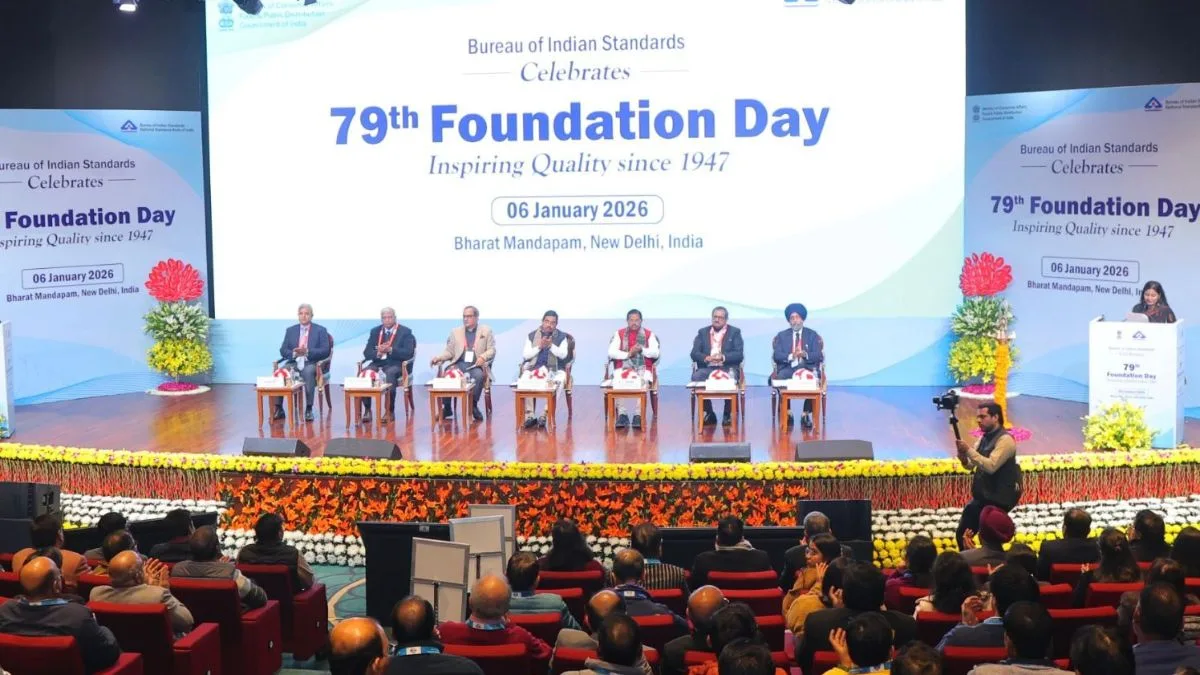
Photo: SNS
Bureau of Indian Standards (BIS), the National Standards Body of India, today celebrates its 79th Foundation Day at Bharat Mandapam, New Delhi. The event commemorates nearly eight decades of the Bureau’s contribution to India’s industrial backbone and economic sovereignty.
The celebration will be graced by Shri Pralhad Joshi, Hon’ble Union Minister for Consumer Affairs, Food & Public Distribution, as the Chief Guest. Shri B.L. Verma, Hon’ble Minister of State for Consumer Affairs, Food & Public Distribution, will also attend as the Guest of Honour.
Advertisement
Several key schemes and initiatives are scheduled to be launched on this occasion –
Advertisement
Beta Launch Of BIS Standardization Portal
Beta Version of the New BIS Standardization Portal, is a future-ready digital platform that integrates the entire standards development lifecycle into a single interface and streamlines the complete workflow — from proposal to publication — through specialised modules for Standards Formulation, Review, and Collaboration of Experts. By featuring advanced data-driven dashboards and role-based access, the portal ensures enhanced transparency, inclusivity, and speed for stakeholders of Standards Formulation.
Women Empowerment through sensitization of self help groups on Indian Standards
“SHINE- Standards Help Inform & Nurture Empowered Women”—is a new scheme of BIS that places women, at the center of India’s quality journey. Through structured training, grassroots partnerships with NGOs and SHGs, and practical, locally delivered programmes, the scheme empowers women with knowledge that protects families and strengthens livelihoods.
This initiative envisions women not merely as consumers, but as change agents, spreading awareness about standards, safety, and quality within households, self-help groups, and communities. By connecting everyday decisions—about food, toys, health products, kitchen safety, and digital tools—with Indian Standards, this campaign links household well-being with national quality consciousness.
BIS Education literature on Rashtriya e Piustakalay
To promote awareness about standards, quality, safety, and counterfeit products among children, BIS has developed engaging comic books in both print and 2D animated formats, as part of BIS Educational Series. Through simple language and visual storytelling, this initiative aims to build quality consciousness from an early age.
These books are now available for Free Reading on the Rashtriya E Pustakalay platform, a flagship digital library initiative by the Department of School Education and Literacy, Ministry of Education. Curated specifically for Children and adolescents, this national digital library has over 3.17 lakh registered users. This collaboration ensures that the “Science of Standards” becomes an accessible and integral part of every student’s learning journey
Signing of MoU with IIIT Dharwad, IIT Palakkad, NIT Arunachal Pradesh
BIS has entered into Memorandums of Understanding (MoUs) with many premier academic institutes of the country, to integrate Indian standards into academic curricula, expand pre standardisation R&D projects and transform Engineering students into Standards-Ready professional. To further expand reach to the academia, another 3 eminent institutes, IIIT Dharwad, IIT ve , NIT Arunachal Pradesh have joined the initiative as MoU partner. As MoU partner, BIS Students chapters initiative will also be expanded. Currently, over 21,000 young engineering students are enrolled across 400+ Students Chapters. BIS has worked closely with academia to integrate standardisation concepts directly into the curriculum of 27 institutes and has established 17 Standardisation Chairs.
About BIS –
Founded on 6 January 1947, as the Indian Standards Institution (ISI), BIS started laying foundation of industrialization for a sovereign nation Bharat with the development of Indian standards. It transitioned into Bureau of Indian Standards through the BIS Act, 1986 as a statutory body with a broader mandate—moving beyond simple product standards to full-scale quality certification. In 2016, BIS underwent another transformation. The BIS Act 2016 expanded our horizon to include not just goods, but also Services—which account for roughly 50% of our GDP—as well as processes and systems.
Today, BIS is no longer just standardising household items, it is developing standards for Artificial Intelligence, India’s indigenous navigation systems (NavIC), space exploration, and advanced defense equipment like bomb disposal systems. Simultaneously, it is taking Indian heritage to the world by leading global standards for Ayurveda and Yoga. It is developing an average of two new standards every single day. Last year alone, we created 649 new standards and updated over 1,000 others to keep pace with rapid technological shifts. It has linked standards development to the segments of national priority, with over 400 technical committees and 1500 working groups are working continuously working for developing standards for the emerging sectors and revising existing standards as per the contemporary technological requirements.
BIS has institutionalised this evidence-based strategy to underpin both the creation of new standards and the technical review of existing ones. It has sanctioned 172 R&D projects across premier academic institutions, focusing on pre-standardisation research in emerging technologies and evidence gathering. Further, 3144 Action Research Projects (ARPs) have been allocated to subject experts for the analytical, evidence-based review of existing Indian Standards. Further, it has established of 41 Standardisation Cells in Ministries and Government Departments, and 102 Cells within industry associations, which act as sector-level focal points to align standards with national missions
To support MSME segment, BIS provides substantial Financial Relief. The rationalised Minimum Marking Fee offers a substantial 80% concession for micro-enterprises and startups, and 50% for small-scale units. This tiered structure drastically lowers the entry cost for quality certification and promotes truly inclusive growth. Additional 10% concession is also being provided to units located in north-eastern states of India and women entrepreneur enterprises.
Further, the Ministry of Consumer Affairs, Food & Public Distribution through its screening committee has screened in proposals worth over ₹440 Crore for support to be provided by BIS for creating testing facilities in Government Laboratories across sectors such as Electrical, Electronics, Aerospace, Textiles, Food, Legal Metrology and Power Transmission & Distribution.
It has also simplified the certification process. Last year, 94% of our 5,745 domestic certifications under the simplified scheme were granted within just 30 days. Whether it is ISI mark, the CRS for electronics, or Hallmarking for jewelry, the process is now seamless. Over one crore pieces of jewelry every month are getting hallmarked. Mandatory hallmarking is expanded to 363 districts and introduced a pilot project on photography at hallmarking centers to ensure 100% transparency for the consumer.
BIS is also leading global standardisation initiatives in Electronics, Technology, Artificial Intelligence. The recently held IEC General Meeting – annual global summit attended by standardisation bodies of more than 150 countries recognised India’s effort in this direction and a secretariat for revolutionary ‘Low Voltage Direct Current and Low Voltage Direct Current for Electricity Access’ was set up at the Bureau of Indian Standards. BIS now hosts14 Global Standardisation Secretariat (ISO/IEC) for Technical Committees and subcommittees leading innovation and international cooperation in the areas of Software and systems engineering, Hydrometry, Security equipment for financial institutions and commercial organisations, Non-systemic contraceptives and STI barrier prophylactics, Terminology and symbols, Leather products, sediment transport etc. The standardisation efforts led by India in traditional Indian knowledge system like Ayurveda and Yoga provides a competitive advantage for small scale enterprises in India.
India’s standardisation cooperation is a key diplomatic tool, strengthening both international partnerships and domestic supply chain resilience. Under the ITEC (Indian Technical and Economic Cooperation) program, India has provided capacity building to 30 African nations and 10 Latin American countries, demonstrating its commitment to South-South cooperation. This “Standards Diplomacy” ensures India reduces technical barriers to trade, diversifies export markets for Indian goods and services, and secures more predictable access to critical supply chain components.
India’s journey toward becoming a developed economy (Viksit Bharat 2047) hinges on sustained improvements in quality, productivity, innovation, and global competitiveness, and Standards are the non-negotiable foundation of this transformation.
Through a holistic approach—from research-driven standardisation and strong academia linkages to simplified certification and consumer engagement—BIS as the national standards body of India is building an ecosystem where standards drive not just compliance, but true economic value.
Advertisement