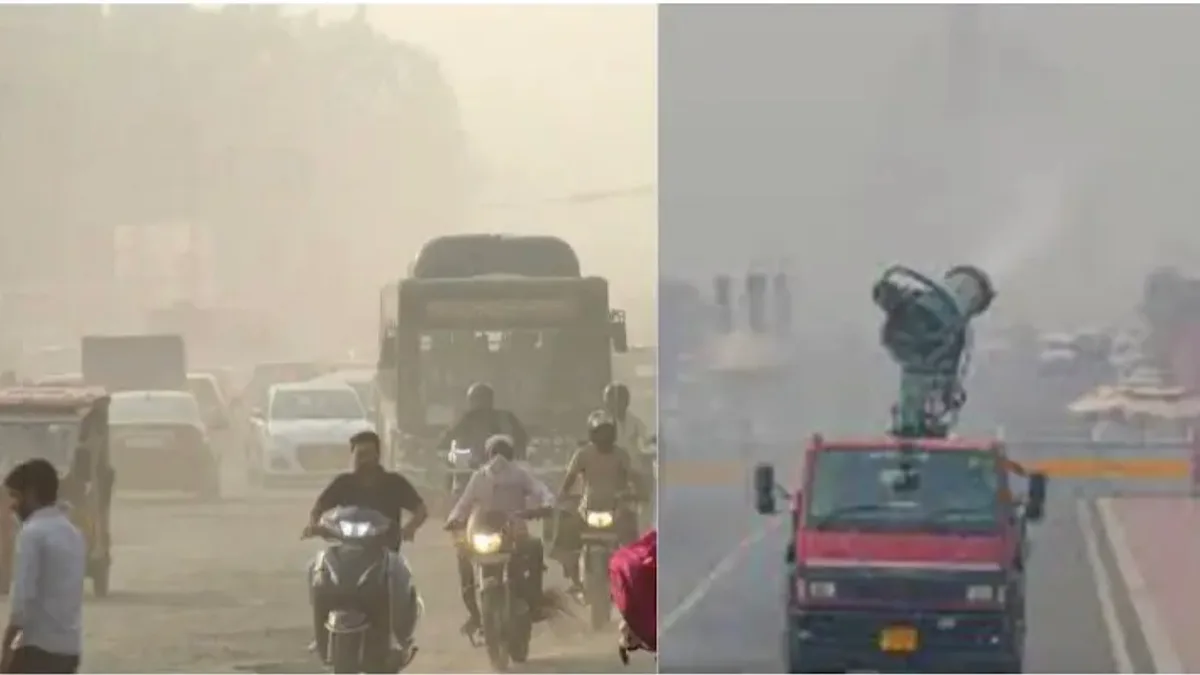
Delhi’s air pollution is no longer a temporary crisis. It has become a regular and predictable condition. What should have triggered sustained alarm has instead settled into what The Statesman aptly described as “choking normality”, where citizens adjust their lives while authorities attempt to manage the problem without much success. Quietly, the poisoned air has come to be accepted as part of urban existence. This article explains, in simple terms, what this pollution is, why it is so harmful, and why there is now no alternative but to act decisively and root it out before it irreversibly damages a city of beauty, heritage, and architectural vistas.
Air pollution in Delhi is not a single invisible enemy. It is a complex mixture of microscopic particles and harmful gases produced largely by human activity. The most dangerous components are fine Particulate Matter (PM) known as PM10 and PM2.5. PM10 particles are small enough to enter the nose and throat, while PM2.5 particles are even smaller, allowing them to penetrate deep into the lungs and pass into the bloodstream. These particles are produced by the emissions from automobiles, power plants, biomass burning, and forest fires. These particles are accompanied by harmful gases released mainly from vehicles, coal-based power generation, and incomplete combustion, including nitrogen oxides, sulphur dioxide, carbon monoxide, and ground-level ozone formed through chemical reactions under sunlight.
Advertisement
During winter, meteorology worsens the situation. As the surface cools rapidly, cold air near the ground becomes trapped beneath a layer of warmer air above, preventing vertical convection and mixing. Pollutants emitted day after day remain confined close to the surface, accumulating into dense smog ~ a combination of smoke and fog. The smoke arises primarily from the burning of coal, biomass, plastics, and other polluting fuels. With the air remaining steady and non-dispersive, pollution builds up cumulatively, making winter air in Delhi particularly oppressive. The health consequences are severe and operate on two timescales. In the short term, high pollution levels cause eye and throat irritation, coughing, breathlessness, headaches, and extreme fatigue. Hence hospitals see sharp increases in patients suffering from asthma attacks, respiratory infections, and cardiac distress. For the elderly, children, pregnant women, and those with existing heart or lung disease, even brief exposure can be dangerous.
These immediate effects, however, are only part of the damage. The long-term effects are far more alarming. Continuous exposure damages lung tissue, permanently reduces lung capacity in children, increases the risk of heart attacks and strokes, contributes to diabetes and metabolic isorders, and significantly raises the likelihood of lung cancer. Scientific evidence now also links air pollution to cognitive decline and neurological disorders. The burden does not fall equally: traffic police, street vendors, construction workers, and the urban poor breathe the worst air and pay the highest price. Air pollution, therefore, is not merely an environmental problem; it is a public health and social justice issue. Delhi’s predicament is often explained away by isolating individual causes like stubble burning in neighbouring states, Diwali fireworks, or unfavourable weather. This fragmentation of cause and effect obscures the real picture.
The city’s pollution arises from multiple sources acting together: an enormous and growing vehicle fleet operating in chronic congestion; relentless construction activity without effective dust control; coal-based power plants and industries in the wider region; routine burning of waste and biomass; and widespread use of diesel generators. What is striking is that these causes are well-known, as are their possible solutions. The real issue lies in the absence of sustained and structural action. Policies appear, often during pollution emergencies, but fade once public attention subsides. This pattern of reaction without reform has allowed toxic air to become routine.
That this trajectory can be reversed is not a matter of speculation. Cities like Beijing, once suffered pollution levels comparable to Delhi’s. Faced with mounting health and economic costs, China implemented a coordinated national clean-air strategy. Polluting industries were shut or relocated, coal use was sharply reduced, emission norms were enforced strictly, electric public transport expanded rapidly, and officials were held accountable for air-quality outcomes. Within a decade, particulate pollution fell dramatically. Similar recoveries have been recorded elsewhere. London, once choked by lethal smog, improved air quality through sustained regulation, cleaner fuels, and restrictions on vehicular emissions.
Los Angeles and Tokyo, long associated with severe urban pollution, achieved major reductions through stringent emission standards, technological innovation, and strict enforcement. Equally important in all these cases is creating public awareness, i.e. citizens are informed, educated, and encouraged to cooperate with authorities, accept temporary inconveniences, and adhere to policy guidelines in the larger interest of public health. A large number of scientists and engineers are attempting to develop AI, machine learning (ML) and deep learning methods for predicting air pollutant concentration. In order to improve the accuracy of these models, data from a denser network of surface level and satellite measurements of pollution constituents would be required.
The observations would show the locations with high pollution enabling to identify the root causes. Accordingly, suitable measures can be implemented to check such sources of pollution. Delhi now stands at a critical juncture. As the national capital, it is not merely another polluted city; it is a test case for urban India. There is no choice left but to acknowledge the gravity of the problem and address it at its roots through cleaner transport, strict control of construction dust, rapid transition away from coal and diesel, elimination of waste burning, and effective regional coordination across the entire airshed.
Addressing major contributors to air pollution requires infrastructure for electric vehicles, enhanced public transit networks, and prioritization of renewable energy sources year-round. If Delhi succeeds, it can set a powerful example. Bengaluru can prevent traffic emissions from spiralling into a crisis. Mumbai can adapt lessons for construction, port activity, and industrial clusters. Kolkata can address coal use, brick kilns, and winter stagnation before reaching the same tipping point. Clean air need not be a privilege of a few cities; it can become a shared urban standard. Pollution is not the unavoidable cost of development; it is the consequence of policy choices. Different choices can yield different outcomes. Delhi’s decisive and sustained action will shape not only its own future, but also that of India’s rapidly growing cities. The air we breathe today will determine how long and how well our cities survive tomorrow.
(The writer is ex-ISRO Brahma Prakash Professor, Bengaluru)