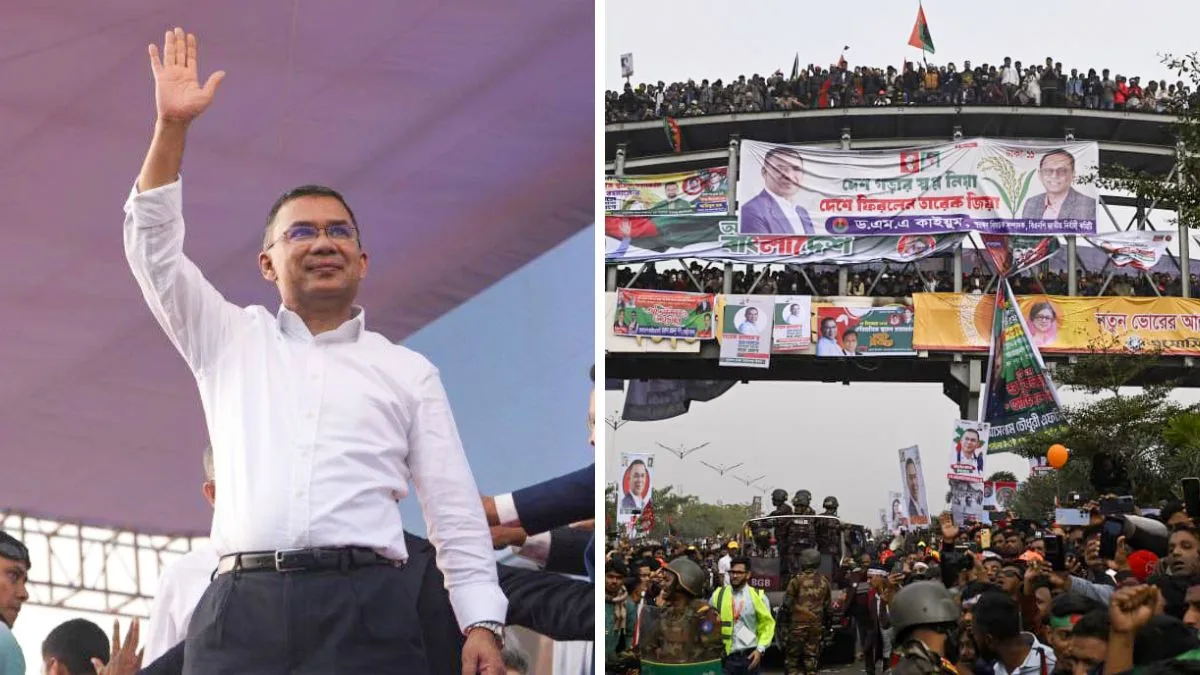
Bangladesh Nationalist Party (BNP) Acting Chairman Tarique Rahman visited the grave of his father and party founder, former military ruler Gen Ziaur Rahman, on Friday. This was his first major public engagement since returning to Bangladesh after spending 17 years in exile.
Local media reports said Rahman travelled to Zia Udyan in a red-and-green bulletproof bus and offered floral tributes at the grave. He also offered ‘dua’ and ‘munajat’ for his father’s soul’s eternal peace.
Advertisement
Rahman was also due to visit the National Martyrs’ Memorial in Savar to lay wreaths in memory of those who died in the 1971 Liberation War.
Symbolic move at a tense political moment
The visit comes at a sensitive time in Bangladesh’s politics. Rahman’s return from London on Thursday drew huge crowds and sparked widespread discussion, with many viewing him as a key political figure at a time when the country’s leadership space remains uncertain.
With the Awami League currently banned and other parties such as the National Citizens’ Party (NCP) and Jamaat-i-Islami lacking strong nationwide support, the BNP has emerged as the largest political force. Against this backdrop, Rahman’s decision to begin his public activities by paying tribute to his father and the martyrs of 1971 is being seen within the party as a signal of political continuity and national unity.
Massive welcome after long exile
Rahman, the son of former prime minister Khaleda Zia, arrived in Dhaka on Thursday morning to a massive show of support, with lakhs of party workers and supporters lining the streets. Ending his long stay in the UK, he travelled in a bulletproof vehicle as part of a heavily secured convoy to attend a large BNP rally at Purbachal in Dhaka.
At the rally, Rahman repeatedly spoke about peace, telling the crowd that his goal was to ensure stability in the country. He appealed to people from all sections of society to come together to build a democratic and economically strong Bangladesh.
Referring to recent political developments, he credited young people for playing a role in the fall of the Awami League government, saying the country had once again seen a movement for change.
Call for unity and shared future
During his address, Rahman spoke about key chapters in Bangladesh’s history, including the 1971 Liberation War, the events of 1975, and the mass movement of the 1990s. He also mentioned the developments of August 5, 2024, saying people from across society, including farmers, students, workers, and madrasa students, had come together to protect the nation.
He described Bangladesh as a country of diverse communities and stressed the importance of building a society where every citizen feels safe. Senior BNP leaders, including Secretary General Mirza Fakhrul Islam Alamgir, Amir Khasru Mahmud Chowdhury, Mirza Abbas and Salahuddin Ahmed, were present at the rally.
‘This country belongs to Muslims, Hindus, Buddhists and Christians’: Tarique Rehman’s big unity message on Bangladesh return
Elections ahead, risks and challenges
Rahman’s return is being closely watched as the country prepares for general elections expected in February. Political observers say his absence had earlier raised concerns within the BNP that Jamaat-i-Islami could gain an advantage if he stayed away from active politics.
Although the interim administration led by Mohammad Yunus withdrew all cases against him, Rahman had delayed his return due to security worries, especially amid reports of extremist activity and attacks on political workers.
For decades, Bangladesh’s electoral arena has largely been shaped by the Awami League and the BNP, each typically securing between a quarter and two-fifths of the vote, while Jamaat-i-Islami has remained a smaller but steady player. With Tarique Rahman back in the fray, political alignments within the opposition are likely to shift, sharpening the contest as the country heads toward the next polls.