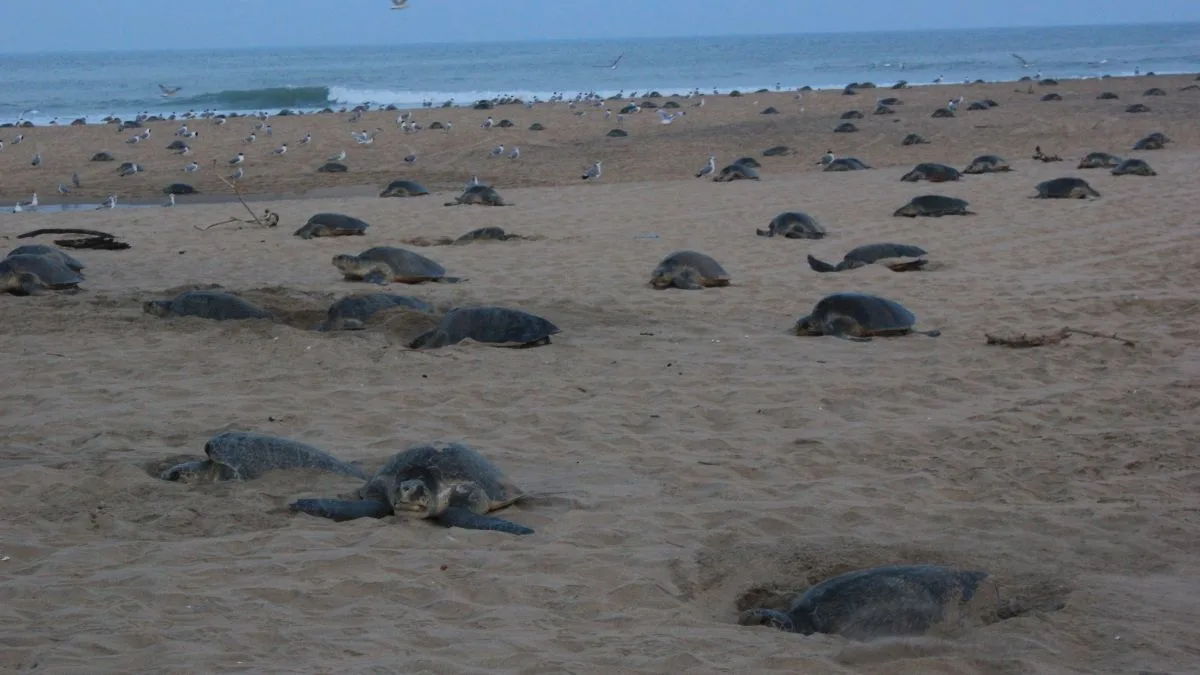
With the behavioural and migration patterns of endangered Olive Ridley sea turtles still shrouded in the realm of scientific study, the Odisha forest department has reinitiated the satellite tagging of these iconic marine animals ahead of their mass nesting.
These turtles turn up in millions for mass nesting along the Odisha coast every year. Gahirmatha Beach off the Bay of Bengal coast in Kendrapara district is incidentally acclaimed as the world’s largest known nesting ground of these animals. Apart from Gahirmatha, these threatened aquatic animals turn up at the Rushikulya river mouth and the Devi river mouth for mass nesting, otherwise called an arribada.
Advertisement
The tagging programme was undertaken for three days from 21 December, and six turtles were satellite tagged in Gahirmatha. Later, three more turtles will be tagged in the Rushikulya river mouth.
The tagging programme is expected to provide vital information on near-shore movement patterns and would help the government in bringing policies for the conservation of turtles as well as the betterment of all stakeholders, including the local fishing communities, said senior forest officials.
There is the need to know more about Olive Ridley turtle movement patterns to identify critical habitats, reduce threats like fishing bycatch, design effective Marine Protected Areas (MPAs) that follow their wide-ranging movements, understand their life cycle (feeding, breeding), and inform policies to protect them from human activities such as coastal development and plastic pollution, especially since they are highly migratory and use vast, often international, ocean areas, they added.
Odisha has led the country in Olive Ridley Sea Turtle conservation, with satellite telemetry studies on turtles in Odisha commencing in early 2001, marking a significant advancement from beach-based monitoring to ocean-scale ecological research to know the long-distance movement pattern.
These studies were undertaken by the Wildlife Institute of India, in collaboration with the Odisha Forest Department.
In the year 2024, as per the decisions taken in the High Power Committee under the chairmanship of the Odisha Chief Secretary, it was decided to re-initiate the satellite telemetry programme on Olive Ridley sea turtles on the Odisha coast to know the near-shore movement pattern and beach dynamics.
Accordingly, as per the tripartite MoU executed between the PCCF (Wildlife) & CWLW, Odisha, the Wildlife Institute of India, Dehradun, and the Dhamra Port Co Ltd (DPCL), two turtles were tagged with satellite tags to study the movement & nesting habitat dynamics.
One of the tagged turtles was spotted near shore movements around Wheeler Island, Babubali Island, and the adjacent spit before moving north of the rookery. The satellite tag was detached and later found within the mangrove habitat of Bhitarkanika, with the last location on 1 April 2025.
The 2nd tagged turtle undertook a long-distance migratory journey. It initially moved eastward into the open ocean, subsequently approached nearshore waters off Tamil Nadu, and later travelled southward towards waters east of Sri Lanka.