Nationalism and Secularism
Nationalism and secularism are the two basic constituents of modern India.
At a time when nationalism is once again hardening into moral certainty, and violence is routinely justified in the name of history, identity, or destiny, Rabindranath Tagore’s global vision speaks with unsettling clarity.




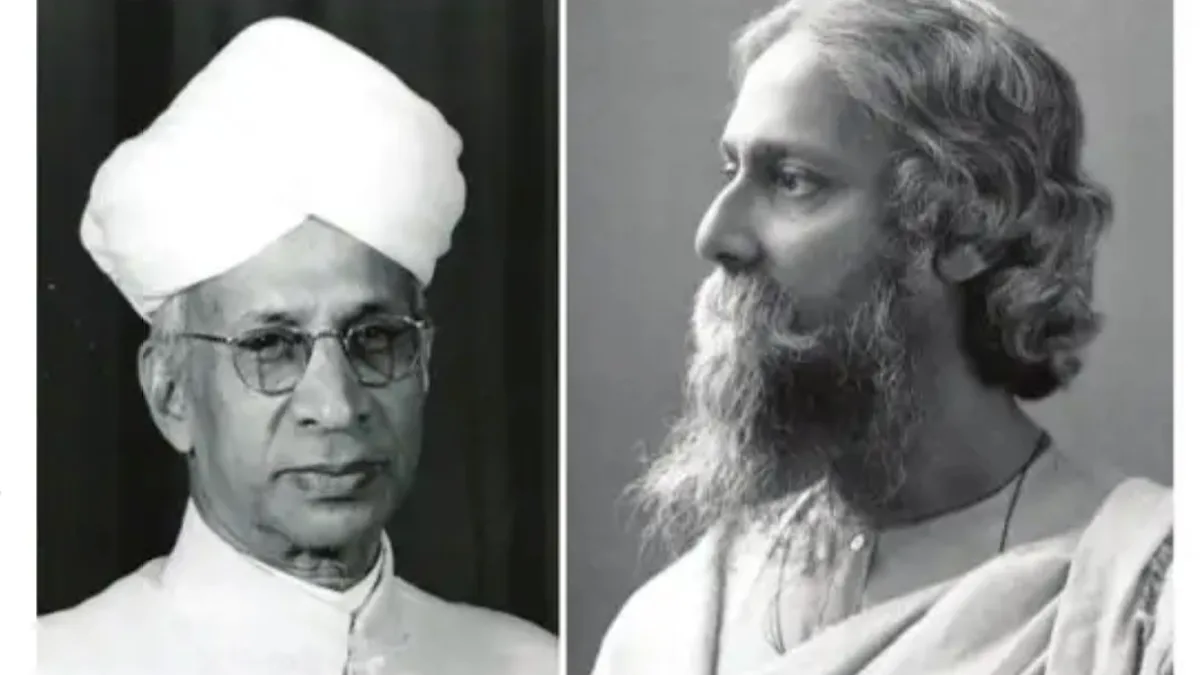
Photo:SNS
At a time when nationalism is once again hardening into moral certainty, and violence is routinely justified in the name of history, identity, or destiny, Rabindranath Tagore’s global vision speaks with unsettling clarity. More than a century after he articulated it, scholars across disciplines and generations continue to return to Tagore not as a nostalgic figure of the past, but as a thinker whose ethical warnings, educational experiments, and civilizational imagination remain urgently relevant. What is striking in serious Tagore scholarship today is not disagreement about his global vision, but a remarkable convergence around its core principles.
Thinkers such as Amartya Sen, Bashabi Fraser, Sarvepalli Radhakrishnan, Uma Das Gupta, William Radice, and Saranindranath Tagore ~ alongside biographers who situate Tagore in lived historical context ~ arrive at a shared understanding of Tagore as a moral universalist who placed responsibility to humanity above loyalty to nation, religion, or power. The scholars are discussed here not alphabetically, but in a conceptual sequence ~ moving from ethical and philosophical foundations, through educational and institutional practice, to modern reinterpretations and lived cosmopolitanism ~ in order to reflect how Tagore’s global vision unfolds from moral principle to everyday life.
Advertisement
Across these interpretations, Tagore’s critique of aggressive nationalism stands as a central point of agreement. Scholars consistently emphasize that Tagore did not reject cultural rootedness or love of one’s homeland; rather, he feared the transformation of national identity into a moral absolute. Nationalism, when fused with collective egoism and political power, threatened to eclipse ethical responsibility and normalize cruelty. This concern, articulated during the age of empire and world wars, now appears tragically prescient. Amartya Sen, one of the most influential modern interpreters of Tagore, has repeatedly highlighted the centrality of intellectual freedom, open reasoning, and ethical reflection in Tagore’s worldview.
Advertisement
Sen reads Tagore as a thinker who understood that political freedom without moral reasoning easily collapses into dogma, and that independence without openness risks reproducing new forms of domination. For Sen, Tagore’s global vision was inseparable from the cultivation of fearless minds ~ capable of questioning authority, resisting prejudice, and engaging the world without fear or resentment. A complementary perspective is offered by Bashabi Fraser, a highly respected contemporary scholar of Tagore. Fraser firmly establishes Tagore as a transnational thinker whose universalism was ethical rather than geopolitical or imperial. She stresses that Tagore rejected both aggressive nationalism and Western-dominated cosmopolitanism, insisting instead on moral responsibility, reciprocity, and dialogue across cultural difference.
In Fraser’s reading, Tagore’s global vision rests on humility and ethical accountability, not on abstract internationalism or cultural hierarchy. Dialogue, rather than domination or assimilation, forms the moral core of his global humanism. Where many scholars converge most clearly is in recognizing education as the practical heart of Tagore’s global vision. Tagore did not treat universalism as a philosophical abstraction; he sought to institutionalize it. Uma Das Gupta has shown how Tagore’s founding of Visva-Bharati was conceived as a living experiment rather than a symbolic gesture ~ a space where international cooperation, cultural exchange, and spiritual unity could be cultivated without nationalist pride or civilizational rivalry.
Her work also highlights Sriniketan, where Tagore linked rural reconstruction with global ethics, insisting that world-mindedness must remain grounded in social responsibility and everyday life. William Radice significantly reshaped modern understanding of Tagore by challenging the persistent caricature of him as a mystical “Eastern sage.” Radice restored Tagore as a rigorous, modern intellectual deeply engaged with questions of culture, inequality, education, and global responsibility. He emphasized that Tagore’s vision was not about bridging a simplistic East-West divide, but about transcending such binaries altogether. In Radice’s interpretation, Tagore’s educational and cultural experiments were forward-looking responses to global injustice and ecological imbalance, not retreats into spiritual idealism.
Long before these contemporary readings, Sarvepalli Radhakrishnan identified Tagore as a modern interpreter of India’s spiritual inheritance rather than its guardian. He understood Tagore’s global vision not as a closed metaphysical system, but as a living moral orientation ~ grounded in sympathy, truth, and love. Radhakrishnan emphasized Tagore’s faith in the unity of humanity and his refusal to lose confidence in human possibility even amid civilizational crisis. For him, Tagore’s internationalism expressed a spiritual conviction that ethical renewal remained possible through service, sacrifice, and responsibility toward all existence.
A particularly illuminating contemporary contribution comes from Saranindranath Tagore, who reconstructs Rabindranath Tagore’s cosmopolitanism as a form of rooted universalism. He rejects the idea that Tagore advocated a vague or placeless global citizenship, arguing instead that his vision was deeply embedded in local culture and everyday life while remaining genuinely open to the world. Saranindranath understands Tagore’s cosmopolitanism as an existential orientation ~ a way of being marked by humility, attentiveness, and awareness of human limits in the face of cultural diversity. In this view, rootedness is not an obstacle to global openness but its necessary foundation. Biographers such as Andrew J. Robinson and Krishna Dutta reinforce this scholarly consensus by situating Tagore’s global vision within the lived realities of his time.
Their work shows that Tagore’s critique of nationalism and insistence on dialogue were forged through concrete encounters with war, empire, cultural misunderstanding, and personal experience. By tracing how Tagore consistently resisted narrow political loyalties while remaining deeply rooted in his own cultural world, they confirm what philosophical interpreters have argued: that Tagore’s universalism was neither naïve nor detached, but ethically earned. While these scholars differ in emphasis – some foregrounding spirituality, others ethics, education, modernity, or everyday practice ~ they do not differ on the substance of Tagore’s global vision. Together, they present a remarkably coherent thinker: spiritually grounded yet rational, culturally rooted yet globally open, critical of power yet committed to institution-building. Global education emerges as the point where these strands converge most clearly, revealing Tagore’s conviction that ethical citizenship must be cultivated, not imposed.
This convergence becomes especially significant when Tagore’s thought is brought into dialogue with the Jewish philosopher Martin Buber. As I have argued in my essay on Tagore and Buber published in The Statesman a decade ago, Tagore expressed grave concerns about the rise of political Zionism ~ not out of hostility toward Jewish culture, which he admired, but from a principled fear of any nationalist project that transformed historical suffering into moral entitlement. He warned that when sacred history, collective trauma, and political power converge, ethical restraint is often the first casualty. Seen through this lens, the continuing brutality and violence inflicted upon innocent Palestinians – especially women and children ~ stands as a devastating confirmation of Tagore’s warning.
What we are witnessing is not merely a geopolitical conflict, but a profound moral failure: the normalization of suffering through nationalist justification. Tagore feared precisely this outcome – when responsibility to the Other is eclipsed by claims of destiny or security, human life becomes expendable. Tagore did not offer policy blueprints or geopolitical solutions. What he offered was something more enduring: a moral compass. His global vision reminds us that education without humanity breeds domination, that freedom without ethics collapses into violence, and that identity without responsibility corrodes the soul of civilization. That so many of Tagore’s interpreters ~ across continents, disciplines, and generations ~ converge on this understanding is no coincidence. It suggests that Tagore was not merely responding to the crises of his time, but articulating a vision for ours. In a fractured world searching for ethical anchors, Rabindranath Tagore’s global vision remains not only relevant, but indispensable.
(The writer is Professor Emeritus at Loyola Marymount University, Los Angeles)
Advertisement