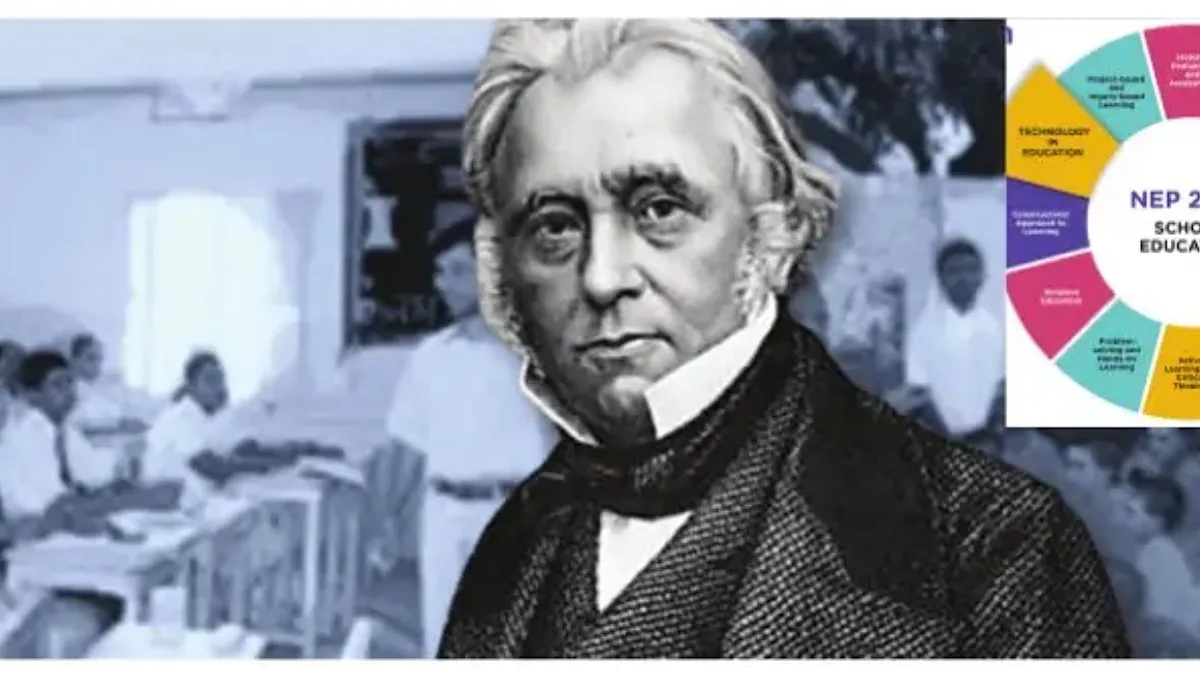
Thomas Babington Macaulay’s 1835 “Minute on Indian Education” is a short text that has cast a long shadow over debates about language, knowledge, and power in India. Read literally, it is an unapologetic statement of cultural preference: Macaulay argued that “a single shelf of a good European library” was worth more than the whole native literature of India and recommended that government patronage concentrate on creating an English-reading class to serve the needs of administration.
That text, available in full in contemporary archives, is the origin point for the critique that English colonial education displaced vernacular learning and produced a cultural inferiority that still haunts public life. But the story is more complicated than the caricature of Macaulay as a simple cultural vandal. Recent historiography and sober commentary stress that pre-colonial educational institutions were neither uniformly democratic nor uniformly comprehensive: centres such as Takshashila and Nalanda were once cosmopolitan hubs of learning, yet most local schooling before the Raj remained tightly bound by caste, religion and patronage and did not systematically provide the secular technical knowledge that was spreading across Europe.
Advertisement
Some scholars and contemporary analysts therefore treat Macaulay’s reforms not as a beneficent gift but as an administrative reordering that incidentally opened avenues, unevenly and imperfectly, to modern texts, scientific curricula, and bureaucratic employment for a wider swath of the population than had been reached before. That nuance must inform our politics because the current “Undoing Macaulay” rhetoric is doing political work beyond pure historical correction.
The recent thrust: evident in media coverage of renamings, curricular reframings and rhetorical assaults on “Macaulay’s children” ~ is part of a broader decolonisation agenda that combines cultural reclamation with state policy changes and political narratives. Journalistic accounts of the shift toward a “Bharat-centred” identity show how symbolic moves, new museum narratives and educational directives are being marshalled together to reconfigure what counts as legitimate knowledge in the public sphere. This is not mere nostalgia: it is a reallocation of prestige and institutional priority that has tangible administrative consequences.
At the policy level, the National Education Policy (NEP) 2020 is the clearest institutional expression of a more multilingual, mother-tongue-friendly approach. The NEP explicitly recommends that early schooling use the child’s home language as the medium of instruction and encourages multilingualism through a three-language formula; it also opens the door to higher-education instruction in Indian languages where feasible. These changes are presented as pedagogically sound: many cognitive-development studies support early-mother-tongue instruction, but translating theory into equitable practice is the real challenge, because infrastructure, teacher training and textbooks in regional languages remain patchy across states and disciplines.
The NEP itself sets the aspiration; its implementation will determine whether multilingualism becomes genuine pluralism or merely another set of uneven offerings. Implementation is already producing contentious, concrete interventions. The Central Board of Secondary Education and some state machineries have begun operationalising “mother-tongue first” norms and language learning initiatives; at the same time, critics warn that poorly resourced rollouts risk deepening disparities between urban, elite schools that can sustain bilingual instruction and rural or private institutions that cannot.
The fear that a policy framed as anti-colonial might, in practice, privilege one regional language or produce new gatekeepers is widely voiced, particularly in non-Hindi states where linguistic federalism remains a live political issue. These are not abstract anxieties: they reflect predictable asymmetries in fiscal capacity, textbook production, and the market value of different languages. Another critical dimension is social mobility. English in India and the broader world, despite its colonial pedigree, has functioned as a credential that opened doors to administration, law, higher education and global labour markets. For many historically marginalised groups, access to English education became a route into professions and public life; erasing that pathway without providing equivalent substitutes would be a policy error.
Thus, one important truth in the debate is that the colonial language regime had both exclusionary effects and emancipatory side-effects: it consolidated new elites but also, over time, created openings for others. Any reform that romanticises pre-colonial forms or that demonises English wholesale risks sacrificing those real, if partial, gains. The agendas behind the rhetoric matter. On one hand, linguistic and cultural revivalism can democratise knowledge, legitimise the study of indigenous epistemologies, enable students to learn in their mother tongues, and correct the oddity that a democracy’s elite debates sometimes happen in a language foreign to most citizens. On the other hand, when revivalism is instrumentalised for majoritarian cultural consolidation, it ceases to be pedagogic reform and becomes a project of identity politics.
The line between pluralist enrichment and centralising cultural politics is thin and often crossed not in manifestos but in administrative details: which languages receive funding for technical translation, which departments prioritise Sanskrit or classical studies over contemporary pedagogy, and how academic hiring and evaluation adapt to multilingual scholarship. These are bureaucratic fault lines where rhetoric becomes reality. Evidence for such shifts can be seen in the mix of symbolic and structural changes reported across states. A third problem is the scholarly method. Reclaiming indigenous knowledge must not lapse into a politics of assertion that treats classical texts as self-validating sources for modern science or public policy.
Genuine decolonisation of curricula demands careful philology, translation, critical editions and the difficult work of placing traditional insights in conversation with contemporary disciplines, not the uncritical elevation of antiquity as proof of national greatness. Academic standards and peer review cannot be optional in a decolonised academy; otherwise, the result will be the replacement of one orthodoxy with another, and Indian universities will suffer the twin maladies of parochialism and credential weakening. Finally, the politics of Macaulay in 2025 is a mirror: it reflects anxieties about class, caste, and cultural authority rather than simply an encapsulated judgment about a nineteenth-century bureaucrat. Answering whether Macaulay was a villain, a benefactor, or something in between is less important than the contemporary choices we make about institutional design. If language policy becomes a lever for widening access, funding regional research, and professionalising multilingual scholarship, then the corrective impulse will have been well spent.
If it becomes a slogan that substitutes symbolism for capacity building, Indian academia will lose years it cannot afford. The prudent course is neither to erase Macaulay from history nor to canonise him, but to use the debate he provokes to strengthen universities: invest in textbooks and teacher training in Indian languages, build rigorous translation programmes, protect spaces for English where it serves global engagement, and ensure that raising vernacular prestige does not lower methodological rigour. That synthesis ~ difficult, technical, and institutionally demanding ~ is the only historically honest and politically responsible way forward.
(The writer is an author, political analyst, and columnist)