Naidu defends civil aviation minister in IndiGo fiasco
Naidu also stated that it was Indigo that had faltered over the implementation of Flight Duty Time Limitation (FDTL) norms suggested by a Parliamentary Standing Committee.
Cancellation of around 5,000 flights in a week’s time in peak season, resulted in widespread chaos, with irate passengers venting their ire on hapless airline staff in impossibly crowded airport terminals, mountains of luggage clogging airports, airfares skyrocketing for flights that were taking off, tariffs of hotels going through the roof ~ leading to disruptions in wedding celebrations, concerts, meetings, conferences, sports events, and the like.




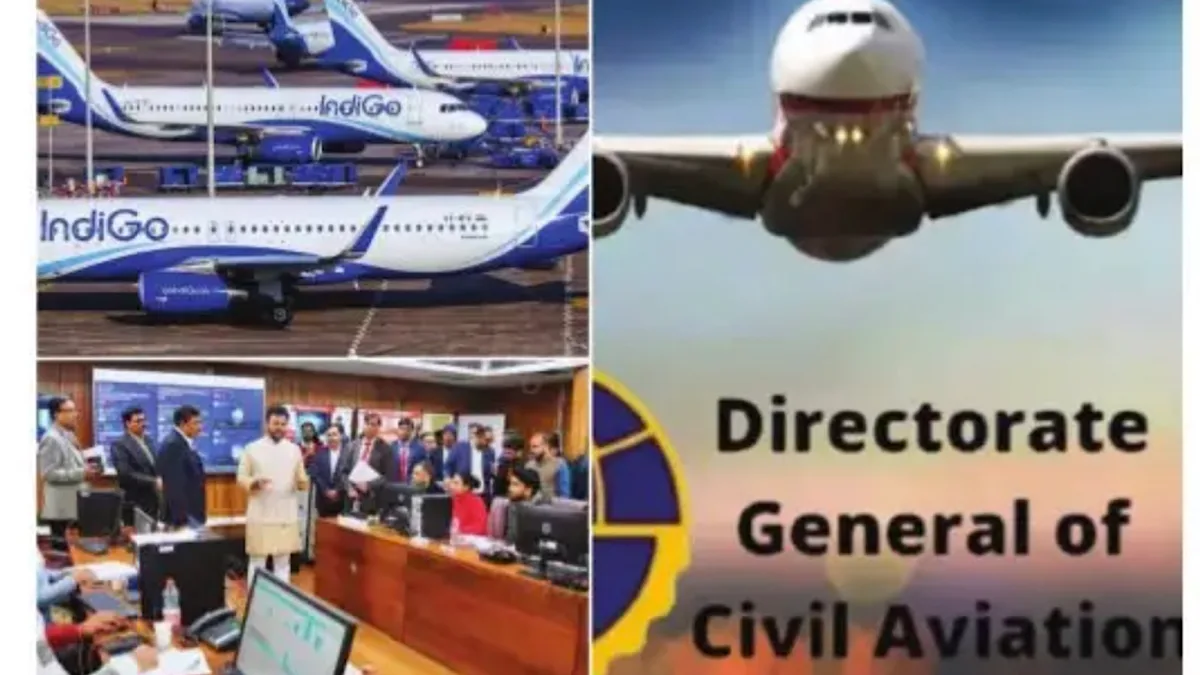
Photo:SNS
Cancellation of around 5,000 flights in a week’s time in peak season, resulted in widespread chaos, with irate passengers venting their ire on hapless airline staff in impossibly crowded airport terminals, mountains of luggage clogging airports, airfares skyrocketing for flights that were taking off, tariffs of hotels going through the roof ~ leading to disruptions in wedding celebrations, concerts, meetings, conferences, sports events, and the like.
Strange scenes unfolded, like a bride and groom attending their own wedding reception virtually, and glitterati, who would rather die but not travel by train, begging for train tickets. The fact that this nation-wide mayhem was caused by a minor change in pilot rest rules, and the cancelled flights were of only one airline, Indigo, points to a deeper malaise. To recount: the Directorate General for Civil Aviation (DGCA), the designated regulator for civil aviation sector, notified an amendment in Flight Duty Time Limitation (FDTL) rules in January 2024, that provided for more rest period for pilots. The amended rules were supposed to apply from 1 June 2024. All airlines opposed DGCA’s move, and it was decided that the new rules would be rolled out in two stages ~ partly on 1 July 2025, and the rest on 1 November 2025.
Advertisement
Again, an extension till December was given. It appears that during the last two years, Indigo had added more routes and aircraft, but instead of hiring more pilots to implement the new rules, Indigo lobbied to roll back implementation of the rules, or at least have them delayed. With no advance preparation, implementation of the new rules was not possible for Indigo; faced with a greatly reduced availability of pilots, Indigo had no option but to cancel thousands of flights. The corporate greed of Indigo ~ an attempt to operate more flights, with fewer pilots ~ can be easily understood, but the present crisis brought into sharp focus the failure of institutions, specifically designed to see that things ran smoothly. At the first stage, the star-studded Board of Directors of Indigo airlines, failed to provide proper guidance to its CEO, and other top executives, to implement regulatory directives.
Advertisement
However, this does not absolve DGCA of not monitoring the implementation of its own directions, that were issued in consequence of an order of the Delhi High Court. Because, long before the actual crisis, it should have been crystal clear to the DGCA that with no plans of hiring extra pilots, Indigo would not be able to maintain its schedule once the new FDTL rules kicked in. As the airline crisis grabbed headlines, many organisations, individuals and busybodies jumped into the fray. Parliament debated the issue, with the Aviation Minister promising strict action against Indigo; a Parliamentary panel reminded everyone that it had flagged this issue much earlier; the Competition Commission promised an anti-trust inquiry; a pilots’ body moved the Delhi High Court against DGCA; and someone approached the Supreme Court by way of a PIL.
Meanwhile, to buy peace, DGCA instructed Indigo to process refunds for cancelled flights expeditiously, and other airlines to cap fares; DGCA also exempted Indigo from the new FDTL rules till 10 February 2026. In what may provide a better understanding of the crisis, everyone in the aviation regulatory sphere, the aviation secretary, and the DGCA downwards ~ all are from a generalist, non-aviation background and the top management of Indigo is almost totally non-Indian. A similar lame duck regulatory regime turned a blind eye to non-observance of fire safety norms that precipitated the tragedy at Birch by Romeo Lane nightclub, in Goa, leading to the death of 25 people.
This was a tragedy waiting to happen; the club’s structure was largely built of wood with a thatched roof, which caught fire when fireworks were set off inside the building. It emerged that the nightclub had been served with a demolition order by the local Arpora-Nagoa Village Panchayat for violation of multiple rules several months before the tragedy. The demolition order had been stayed by the Deputy Director of Panchayats, allowing the club to continue its operations. Significantly, the local MLA had raised the issue of continued operation of the club, without mandatory permissions, and with multiple demolition orders against it, in the Goa Legislative Assembly in August 2025. Environmentalists had also petitioned the Goa Government, on similar lines. However, contrary to evidence, authorities claimed that only after the disaster, did they realise that the high-end nightclub was operating without licences and lacked mandatory safety infrastructure. Post-tragedy, along with the club’s staff, and the erstwhile Deputy Director of Panchayats, the police moved to arrest the Sarpanch of the Arpora-Nagoa Village Panchayat, who was rescued with difficulty by incensed villagers.
Meanwhile, owners of the nightclub went incommunicado, having boarded an Indigo flight to Phuket, which departed on time. It has also been reported, that the nightclub had been shielded from action against it by a former top officer of Goa police. Another example of poor regulation was pointed out by the Chief Economic Advisor, in the presence of the SEBI chief, namely that promoters of IPO-bound companies were making a killing by offloading their shares to the public at hundreds of times of their cost (Killing Fields, 25 November 2025). With a slight modification, the aforesaid con is still on. After the liberalisation of 1991, the Government replaced controllers with regulators in most sectors. They were expected to guide their respective sectors to accelerated growth by promoting competition ~ with the additional mandate of protecting the interests of all stakeholders.
Sadly, none of these goals has been realised, with virtual duopolies emerging in many sectors, including critical ones like telecom and aviation ~ in which Indigo, controls 64 per cent of the market. Seemingly, Indigo has become ‘too big to fail’ i.e., the aviation sector may crash if Indigo underperforms. Regulators have repeatedly let down the common man, the small guy, who is the biggest stakeholder in all enterprises. DGCA took steps to ameliorate the crisis only on the fourth day ~ after lakhs of passengers had been inconvenienced and many had paid close to a lakh of rupees for domestic travel of a thousand odd kilometres. Asked about a plan to compensate the fleeced passengers, the Aviation Minister cryptically replied that he would consider it.
Absolutely no compensation would be forthcoming, for passengers inconvenienced by flight delays, and cancellations. Contrast it with the SOP for cancelled or delayed flights in the EU; under Regulation 261 of 2004, a passenger is entitled to claim compensation, ranging between €250 and €600, for flight delays, cancellations, and overbooking on EU territory. Additionally, food and meals have to be provided for severe delays, and accommodation and transportation for overnight delays. Other sectoral regulators have similarly failed to protect the interests of consumers; the RBI started the Banking Ombudsman (BO) scheme with much fanfare, but it hardly takes cognisance of customer complaints; statistics show that in FY 2016-17, BO offices across the country received over 1,19,758 complaints, but there was an award in only 24 cases ~ that is only 0.02 per cent of complaints. The number of complaints increased to 2,90,567 in FY 2024-25, but the number of awards increased only to 36. Ombudsman posts in many other sectors, like insurance, suffer from vacancies.
Tribunals, established to provide quick and inexpensive justice, have withered away, with eight tribunals abolished at one go in 2021. Despite frequent directions by the Supreme Court, most tribunals continue to suffer from debilitating vacancies. Recently, in a scathing indictment, the Supreme Court struck down key provisions of the Tribunal Reforms Act, 2021 deeming them unconstitutional for giving the Union Government excessive control over tribunals, and thereby undermining judicial independence. In the coming days, the Indigo crisis will be discussed threadbare; solutions would emerge, but a lasting solution could be only one, that puts the interests of citizens first. Otherwise, similar crises would recur, and citizens would continue to suffer ~ caught between corporate greed, bureaucratic apathy and corruption.
Finally, what Edward Kennedy, US President John F Kennedy’s younger brother, and a US Senator from 1962 to 2009, had said about US regulators, appears to hold true about Indian regulators: “Regulation has gone astray. . . Either because they have become captives of regulated industries or captains of outmoded administrative agencies, regulators all too often encourage or approve unreasonably high prices, inadequate service, and anti-competitive behaviour. The cost of this regulation is always passed on to the consumer. And that cost is astronomical.”
(The writer is a retired Principal Chief Commissioner of Income-Tax)
Advertisement