A few days ago, I took a short train ride —barely 3 5 minutes—from Monopoli to Bari, the capital of Puglia. Though close in distance, Bari feels like another world entirely—larger, livelier, and layered with centuries of history. Bari’s story stretches back to the 4th millennium BC, when Greek settlers made their home here. In the 3rd century BC, the Romans arrived and transformed it into a thriving port.
Over the centuries, the city changed hands many times—Byzantines, Lombards, Saracens, Normans, and even the Holy Roman Empire—each leaving its mark upon Bari’s soul. For a brief period, it even stood as an independent Muslim emirate before the Normans reconquered it in 1071. Today, Bari is a fascinating blend of the ancient and the modern—a bustling port city that hums with life. The streets echo with many tongues—Italian, Arabic, English, and languages from Africa and Asia—a reflection of the city’s long embrace of travelers and traders from distant shores.
Advertisement
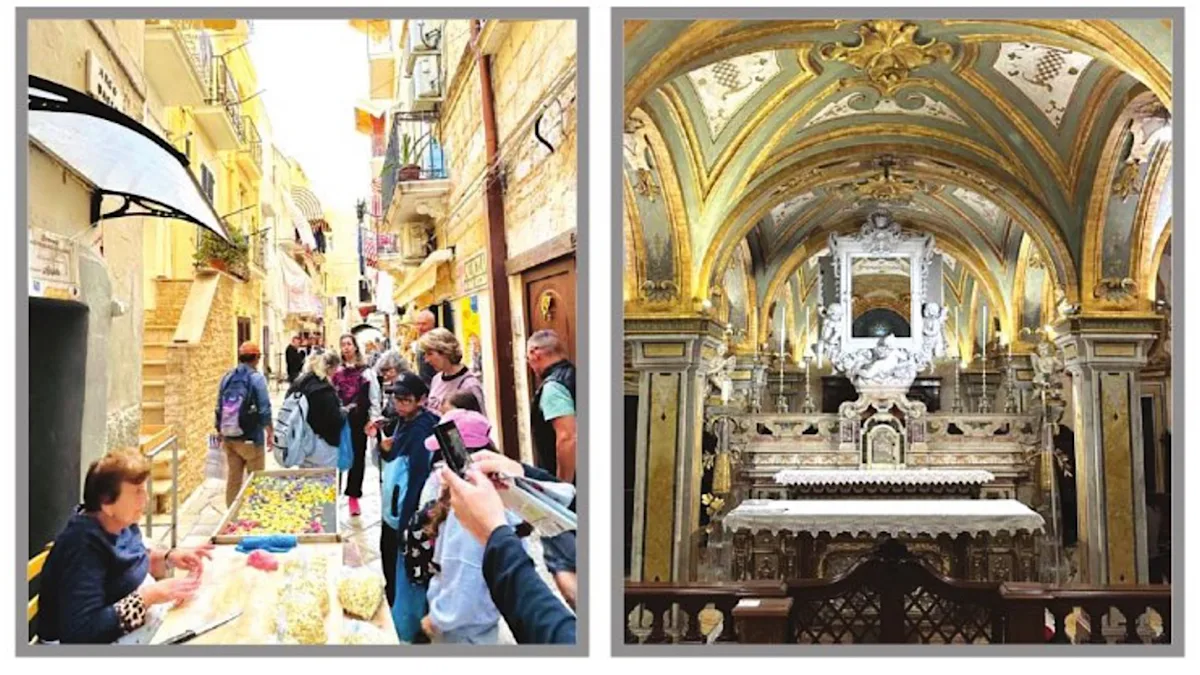
I wandered through Bari Vecchia, the old town—a maze of narrow lanes that seem untouched by time. Walking there, I felt as though I had stepped into another century, surrounded by echoes of lives once lived. Women sat outside their homes, their hands working with practiced rhythm as they rolled orecchiette—the signature, ear- shaped past a of Puglia—right on wooden tables by the street. Tourists gathered around them, cameras clicking, while the women smiled, chatted, and continued their work, the scent of semolina and sea air mingling in the breeze. Bari’s historical heart beats strongest in its magnificent landmarks. The Basilica di San Nicola, built in the 11th century, is a place of pilgrimage for both Catholics and Orthodox Christians.
Within its crypt lie the relics of Saint Nicholas—yes, the very figure who became the inspiration for Santa Claus. Not far away stands the Cattedrale di San Sabino, a gem of Romanesque architecture, and the Castello Svevo, the Swabian Castle built by Norman conquerors and later expanded by Emperor Frederick II. From its towers, one can gaze out over the Adriatic and imagine the ships that once carried crusaders, traders, and poets across its blue expanse. Beyond its churches and castles, Bari is also a city of learning. The University of Bari Aldo Moro, founded in 1925, is one of southern Italy’s most distinguished institutions. Though I didn’t step inside, its stately façade radiates the quiet grandeur of a place that has shaped generations of thinkers. And, of course, there is the food—that irresistible allure of southern Italian flavors.
Nowhere does orecchiette alle cime di rapa (ear-shaped pasta with turnip greens, garlic, and chili) taste more authentic than here, where nonnas (grandmas) have perfected the recipe for centuries. But Bari’s culinary world extends far beyond tradition: Chinese, Japanese, Middle Eastern, and African restaurants thrive here, reflecting the city’s growing diversity and cosmopolitan spirit. Curiously, Bari remains somewhat under the radar as a tourist destination. Perhaps it’s better that way. The city doesn’t try to dazzle; it invites you to linger—to explore its alleys, sip its coffee, and watch the afternoon light fall softly on its ancient stones. As I boarded the evening train back to Monopoli, I carried with me the taste of a delicious meal, the memory of old churches and quiet courtyards, and a renewed admiration for this city by the sea—timeless, vibrant, and unpretentious. Every town in Puglia tells a story—but Bari speaks in centuries.
The writer is Professor Emeritus, Loyola Marymount University, Los Angeles