Jammu and Kashmir: Army’s rescue operation in flood-hit Rajouri saves 11 civilians
Among the 11 rescued persons, five were children. They were stranded at different places in the flood-affected district following incessant rainfall.
Bearing the theme, ‘Reform to Transform: Sashakt, Surakshit aur Viksit Bharat, the CDD focused on India’s emerging security challenges, defence reforms, and technological transformations amid an increasingly complex global order.




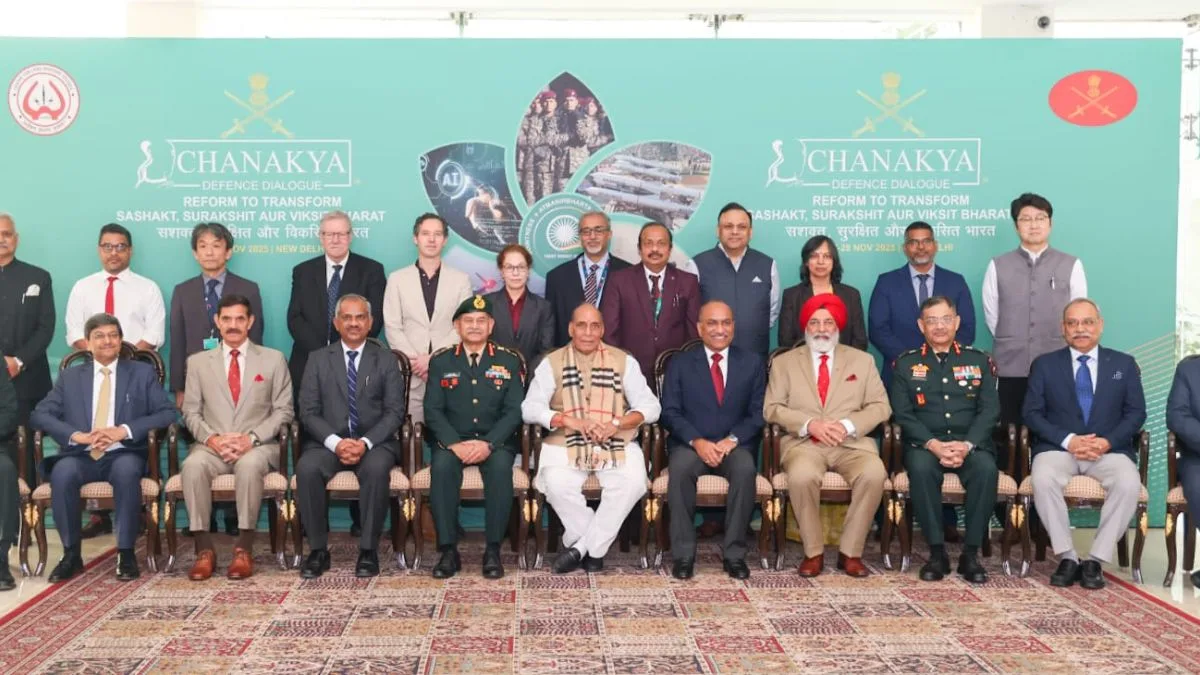
Photo: SNS
The two-day Chanakya Defence Dialogue 2025 conducted by the Indian Army in collaboration with the Centre for Land Warfare Studies concluded here on Friday.
Bearing the theme, ‘Reform to Transform: Sashakt, Surakshit aur Viksit Bharat, the CDD focused on India’s emerging security challenges, defence reforms, and technological transformations amid an increasingly complex global order.
Advertisement
In his special address at the conclave, Ambassador DB Venkatesh Verma, Member of the National Security Advisory Board, spoke about Resilient National Security @2047.
Advertisement
Stressing that strategic autonomy is meaningful only when India has the will and capability to think, act and fight independently, without allowing external engagements to turn into vulnerabilities, Verma emphasised the need for an operationally sound military doctrine that can be executed without external interference, supported by a resilient defence-industrial base, secure technology choices and reduced economic dependencies.
He noted that strategic autonomy also depends on societal factors such as national self-confidence, willingness to invest in defence and the ability to produce skilled manpower for modern warfare. Highlighting the importance of balancing productivity, security and welfare power, he called for faster reforms, higher defence spending, stronger R&D and integrated joint military structures.
Ambassador Pankaj Saran, Former Deputy NSA delivered a thematic address on Redefining Strategies in Conventional Wars through Technology, emphasising doctrinal shifts and technology-driven readiness. He highlighted the growing centrality of technology in national security, noting that its role in conventional warfare is now unquestionable and historically inseparable from the evolution of conflict.
The sessions on the concluding day dwelt upon Battlefield Equalisers, where global experts discussed disruptive technologies such as AI, autonomous systems, hypersonics and cyber capability, highlighting how these are reshaping the character of warfare. The sessions also examined the transformation required for India’s forces to become integrated, agile and modern. Distinguished military leaders and experts spoke on jointness, adaptive structures, island security perspectives and the growing role of information and cognitive security in modern conflict.
Lt Gen Pushpendra Pal Singh, Vice Chief of the Army Staff, delivered the Closing Address of the Dialogue, emphasising that India’s security environment demands forces that are agile, technologically empowered and operationally integrated. He noted that the insights generated during the two days, ranging from emerging technologies and battlefield equalisation to jointness, innovation and defence reforms, would serve as actionable inputs for the Army’s transformation roadmap.
Underscoring the importance of self-reliance, future-ready structures and mission-driven capability development, he reiterated the Indian Army’s commitment to accelerating reform and strengthening India’s preparedness across all domains of warfare.
Advertisement