Carice Witte, founder of Israel-based Signal Group, outrightly rejected suggestions that Israel had been forced to end its recent conflict, stating that the decision was taken on the basis of return of hostages and supported by the United States.
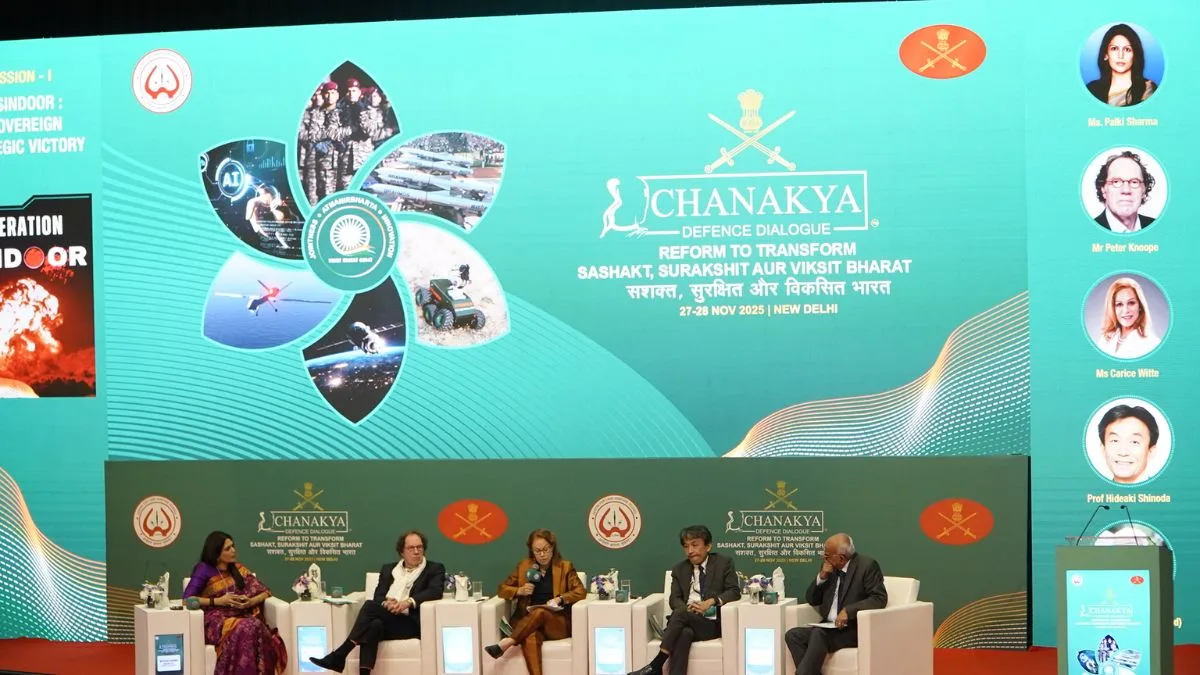
Speaking on the theme “Escalation Dominance: Setting Strategic Benchmarks” at the Chanakya Defence Dialogue 2025 on Thursday, Witte said, “It is not true that we were forced to end the war. It is not true that our government and our people did not want to end the war. That is deeply, deeply disturbing to hear.”
Advertisement
“We wanted the war to end as soon as the hostages were taken. And we wanted the war to end when the hostages were going to be returned. And that is when the war ended,” she said.
Crediting the US administration’s role in helping the release of hostages, Witte said, “When the US administration found the strength and fortitude to support our effort in getting our hostages back… all of the live hostages were returned and now all but one of the dead hostages were returned. So, that is why our work came to an end.”
Speaking on her topic, she said her focus was on the growing importance of non-kinetic escalation, especially with reference to China. While referring to the previous video played during the conclave, she said, “It usually refers to kinetic conflict… boom, boom, boom. But there is another focus, which is the critical role of escalation dominance in non-kinetic contexts regarding a country that presents the biggest challenge to both Israel and India.”
Highlighting that despite security concerns from countries including Pakistan, North Korea and Iran, she said it’s China that challenges her country’s strategic independence. She noted that while Chinese President Xi Jinping speaks of a community with a shared future, its visions involve China overseeing that community and not through war.
“China”, she added, despite the rhetoric, “prefers to avoid war, in part due to its problematic current domestic economy, its declining exports, and military purchase.”
Its growing global influence instead stems from “diplomacy and supply chain asymmetries,” which she believes will ensure Beijing avoids war “unless pushed by an extreme exogenous event like Taiwan declaring independence.”
Witte said lessons from recent wars have reinforced Beijing’s caution. “Ukraine showed China how even a nuclear superpower can be dragged into a grinding war of attrition with staggering casualties,” she said. “Gaza demonstrated something else. Even a highly trained military with advanced technology… faced devastating urban warfare. Taipei is urban. Beijing cannot afford Gaza-like images coming from Taiwan.”
Stating that China has mastered non-kinetic escalation through “technology, diplomacy, supply chains, influence operations, and regional alignment” she said that Israel, too, faces this challenge.
“In the arena of escalation dominance, it’s about setting strategic benchmarks but those that do not test the threshold that triggers confrontation. We see this from China in the South China Sea and on India’s borders.”
Pointing out that while China can tolerate friction with Europe, it is deeply sensitive to strengthening ties with countries that matter most to Beijing in what it considers its backyard including India, Japan, South Korea, UAE.
“Israel’s ties are now growing with all of these countries. A very effective tool in escalation dominance in the non-kinetic arena can also be the trilateral framework,” she added further.
Highlighting trilateral frameworks as especially effective, Witte said, “The Japan–South Korea–US Camp David convening caused more concern in Beijing than the Quad or AUKUS.”