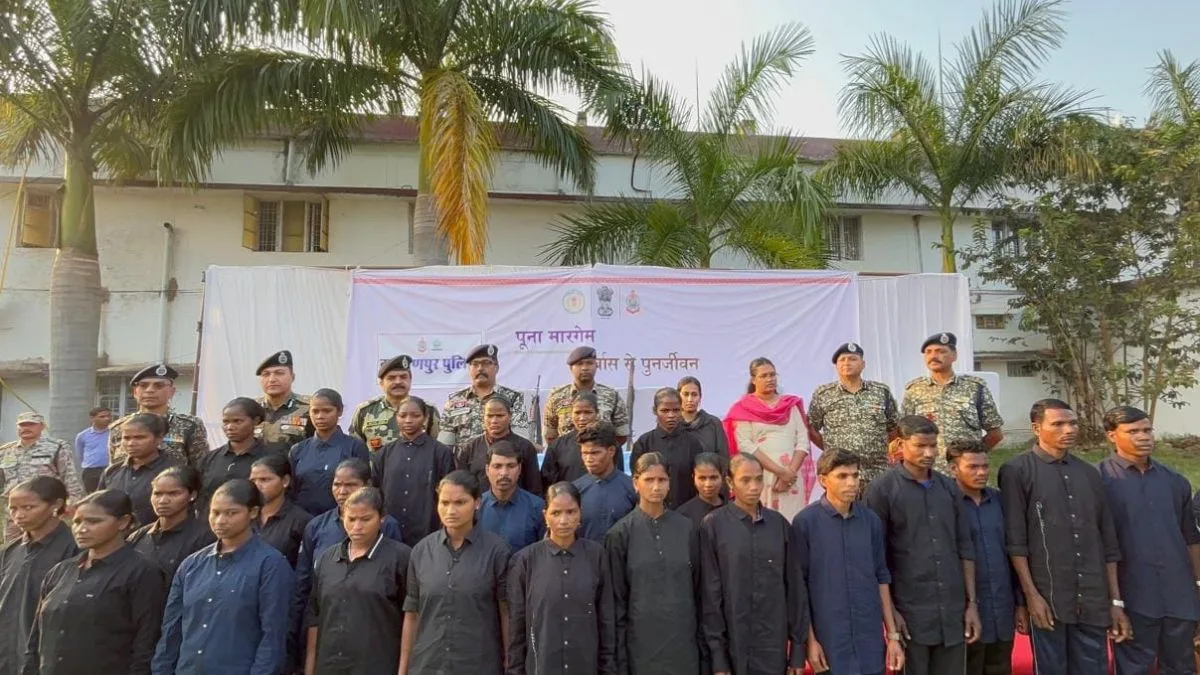
Twenty-eight Maoist cadres surrendered before the authorities in Narayanpur district on Tuesday, marking another significant step in Chhattisgarh’s ongoing efforts to restore stability in the Bastar region. The surrender took place under the “Puna Margem: From Rehabilitation to Renewal” initiative, which focuses on encouraging armed insurgents to abandon violence and return to the social mainstream.
Among those who laid down arms were 19 women, with several carrying substantial cash rewards collectively amounting to Rs 89 lakh. Officials said the group included members from multiple operational layers of the CPI (Maoist), ranging from PLGA Company No. 6 and the Mad Division to area committees, military platoons, technical units, and supply networks. Three cadres formally renounced violence by handing over firearms, including an SLR, an INSAS rifle, and a .303 rifle.
Advertisement
Narayanpur Superintendent of Police Robinson Guria described the development as a strong indication of growing faith in the state’s rehabilitation framework. He said that 287 Maoist cadres have surrendered in Narayanpur alone this year, reflecting a consistent pattern of disengagement from armed extremism.
Bastar Range Inspector General P Sundarraj said that more than 512 Maoist cadres have laid down arms across the region over the past 50 days. According to him, the rising numbers indicate not merely operational pressure but a visible erosion of organisational cohesion within the Maoist network, as members increasingly choose legal reintegration over prolonged conflict.
Senior officers from the district administration, ITBP, and BSF were present during the surrender programme, along with local community representatives. Officials emphasised that the initiative extends beyond disarmament, with structured support being provided for education, skill development, and employment to ensure sustainable reintegration.
Analysts view the development as a critical indicator of changing ground realities in Bastar, where the state’s approach is steadily transitioning from a predominantly security-centric operation to a more balanced model combining enforcement with socio-economic reconciliation.
Authorities maintained that the rehabilitation model now in place balances firm counterinsurgency measures with long-term social reconstruction, reinforcing the government’s objective of achieving lasting peace in Bastar through dialogue, opportunity, and institutional support.