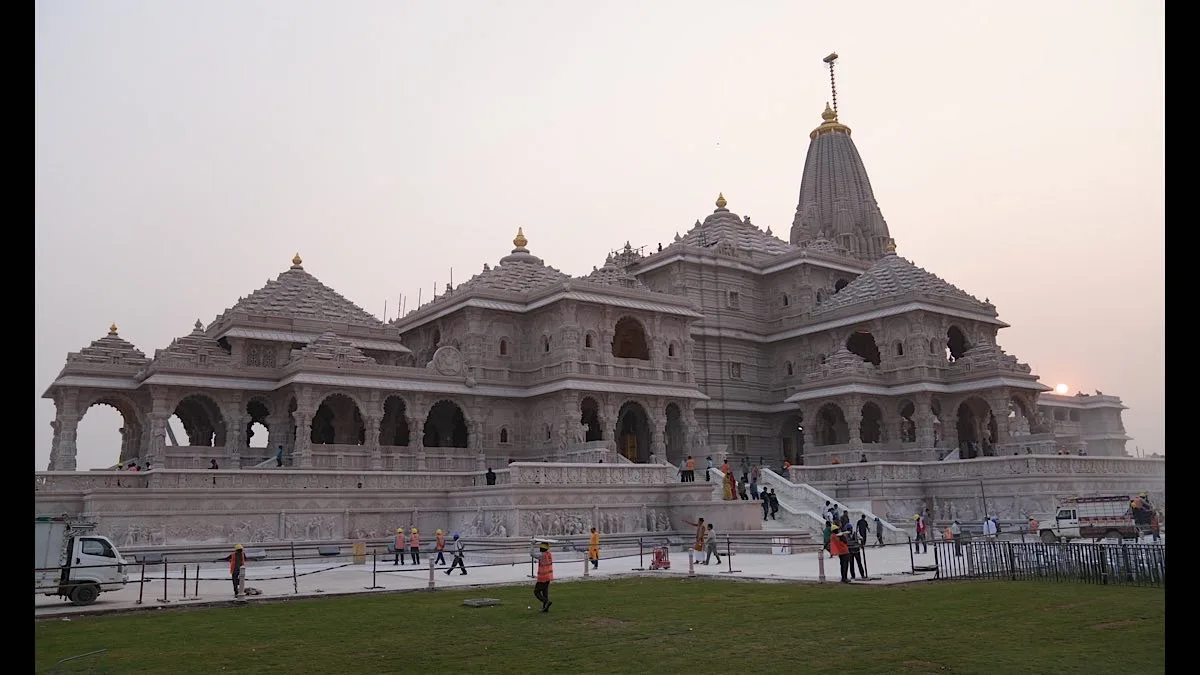
Prime Minister Narendra Modi is set to visit Ayodhya’s Shri Ram Janmbhoomi Mandir on November 25, marking a significant moment in India’s socio-cultural and spiritual landscape. The Prime Minister will ceremonially hoist a saffron flag on the temple’s Shikhar, symbolising the completion of the temple’s construction and ushering in a new chapter of cultural celebration and national unity.
PM Modi will arrive at Ayodhya’s Maharishi Valmiki International Airport on the auspicious occasion of Ram Vivah and for the Ram Mandir flag(Dharma Dhwaj) hoisting ceremony. The ceremony will be witnessed by over 6,000 guests, over 1,200 engineers and support staff engaged in the construction work, over 600 volunteers involved in the arrangements, and over 1,000 security personnel.
Advertisement
UP Chief Minister Yogi Adityanath will reach Ayodhya on Monday afternoon and participate in the Saryu Aarti there in the evening. He will also hold a meeting with officials regarding preparations ahead of Prime Minister Modi’s arrival in Ayodhya tomorrow.
Ayodhya is currently immersed in devotion to Lord Ram amid grand preparations for flag hoisting tomorrow. The city of Lord Ram is being decorated like a grand festival with colourful lights, floral decorations, and a clean atmosphere.
The PM is expected to arrive by a special flight at 9:35 a.m. at Ayodhya’s Maharishi Valmiki International Airport and depart for Delhi at 1:55 p.m. He will spend a total of four and a half hours in Ayodhya, marking the longest stay Prime Minister Narendra Modi has ever spent in the temple city.
From the airport, the Prime Minister will board a special Army helicopter and land at the helipad built on the Kamta Prasad Sunderlal Saket College campus, near the Ram Temple in Ayodhya. PM Modi’s convoy will depart the Saket college through Rampath for the Ram Temple, where Ayodhya’s saints, religious leaders, priests, businessmen, women, and BJP workers, positioned on both sides of the Rampath, will welcome the Prime Minister with the tricolour, saffron flag, blowing of conch shells, auspicious recitations, and showering of flowers.
The auspicious time for the Dharma Dhwaj is 11:55 am to noon. During the small window, the Prime Minister, along with RSS chief Mohan Bhagwat and others, will unfurl the flag at the top of the Ram Mandir in the presence of the army.
Following the flag-hoisting ceremony, he will address the guests from a platform adjacent to the main entrance of the temple.
According to officials, at around 10 am, the Prime Minister will visit Saptmandir, which houses temples related to Maharshi Vashishtha, Maharshi Vishwamitra, Maharshi Agastya, Maharshi Valmiki, Devi Ahilya, Nishadraj Guha and Mata Shabari. This will be followed by a visit to Sheshavtar Mandir.
At around 11 am, the Prime Minister will visit Mata Annapurna Mandir. After this, he will perform Darshan and Pooja at Ram Darbar Garbh Grah, which will be followed by Darshan at Ram Lalla Garbha Grah.
At around noon, PM Modi will ceremonially hoist a saffron flag on the Shikhar of the sacred Shri Ram Janmbhoomi Temple in Ayodhya, symbolising the completion of the temple’s construction and ushering in a new chapter of cultural celebration and national unity. The Prime Minister will also address the gathering on this historic occasion.
The programme will take place on the auspicious Panchami of the Shukla Paksha in the month of Margashirsha, coinciding with the Abhijit Muhurat of Shri Ram and Maa Sita’s Vivah Panchami, a day symbolising divine union. This date also marks the martyrdom day of Guru Tegh Bahadur Ji, the ninth Sikh Guru, who meditated in Ayodhya for 48 uninterrupted hours in the 17th century, further enhancing the spiritual significance of the day.
The right-angled triangular flag, measuring ten feet in height and 20 feet in length, bears the image of a radiant Sun symbolising the brilliance and valour of Bhagwan Shri Ram, with an ‘Om’ inscribed on it along with the image of the Kovidara tree. The sacred saffron flag will convey a message of dignity, unity, and cultural continuity, embodying the ideals of Ram Rajya.
The flag will rise atop a Shikhar constructed in the traditional North Indian Nagara architectural style, while the surrounding 800-metre Parkota, a circumambulatory enclosure built around the temple, designed in the South Indian architectural tradition, showcases the temple’s architectural diversity.
The temple complex features 87 intricately carved stone episodes from the life of Bhagwan Shri Ram based on the Valmiki Ramayana on the outer walls of the main temple, and 79 bronze-cast episodes from Indian culture placed along the enclosure walls. Together, these elements provide a meaningful and educational experience to all visitors, offering deep insight into Bhagwan Shri Ram’s life and the cultural heritage of India.