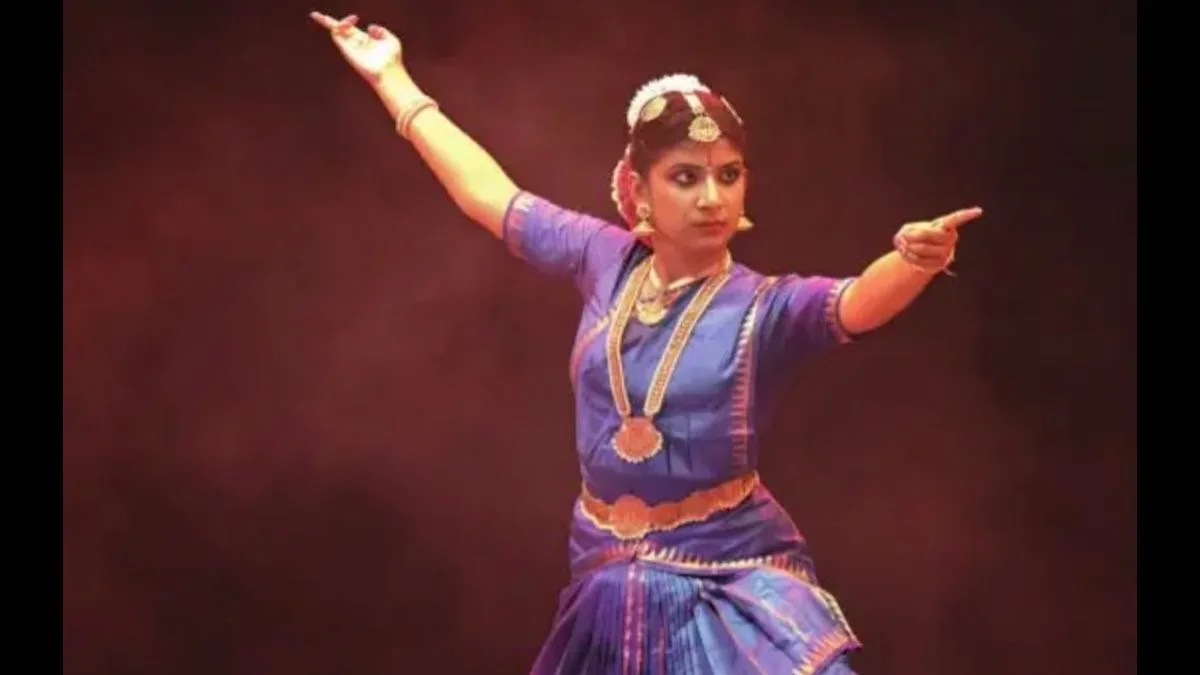
My visit to Guwahati to see Oiendrilla Das’s Bharatanatyam recital was a well-made decision. It was a reward to see a good dancer in the making. Thanks to the technical advancements of the era, Oeindrilla Das, living in Guwahati, is able to pursue learning Bharatanatyam under Vaibhav Arekar, a resident of Pune, Artistic Director of Leela Dance Company and founder of Sankhya Dance Company. Arekar has the vision of promoting and projecting Bharatanatyam dance as an evolving, contemporary art form.
He investigates and interrogates concepts and performance techniques to find the contemporary within our Sastriya folds. Returning to Oiendrilla’s story, she has shown signs of her passion for dance, particularly Bharatanatyam. She has been a student of Bharatnatyam at her mother’s knee. And that has been her first love. A distinction holder in Sattriya Dance, Oendrilla has undergone rigorous training under Sattriya Guru Ghanakanta Bora. Her unsatiated hunger for Bharatanatyam made her find a Guru like Vaibhav Arekar, whose boundless humility shies away from using the term Guru before his name.
Advertisement
To continue with the story of Oiendrilla Das, a student of class XI, who is the topper in her class, she wishes to take up the science stream for her academics. Be that as it may, presently she takes dance lessons online and offline from Vaibhav Arekar, when she visits Pune during her long vacations or when he comes to Guwahati to mentor her. For a respectful beginning, Oiendrilla performed Guru-Puja, with washing of the guru’s feet. In the ancient tradition of our vast land, few practices hold as much significance as Guru Pooja. This sacred act of reverence and devotion towards the Guru is a sacred tradition of the land. Vaibhav Arekar blessed her profusely for her journey.
With her talent, coupled with hard work and perseverance, he said, she will reach great heights. What was especially admirable about Oeindrilla’s performance is that she was accompanied by a live orchestra, which is quite rare in present-day performances. An array of veterans accompanied the young artiste. The very talented Karthik Hebbar was the vocalist. His singing was absolutely spot on. Every nuance and emotions were conveyed clearly. Mridangam artiste Shankar Narayanaswamy was like a wizard, matchless in keeping the rhythm. Nattuvangam by Vaibhav’s disciple Ruta Gokhale provided confidence to the performer.
Anand R Jayaram’s strains on his violin soothed nerves and enriched the dance pieces. The evening started off with the rhythmic creation of a great maestro who created a complex pattern, which is a stuti in praise of Ganapathi. It is actually a rhythmic structure which he taught his nattuvangam students. Arekar has created it as a dance piece, helped by the maestro’s son. Pullaiyar, or the beloved son of Parbati and Shiva. The Stuti and Sri Vighna Rajam Bhaje, written by Oothukadu Venkata Kavi in praise of the elephant-headed god, who is most approachable among the gods capable of removing all obstacles, followed soon after. Right from the start, there was novelty in the way the recital was planned. Young Oiendrilla established herself as a dancer with a mission to excel.
Vigna Raja, who is worshipped by even Indra and devas, was invoked to focus on internal peace to overcome vigna, or disturbances. The next piece, Dasavatar, was a story within a story that gave substance to the performance. A long piece about the ten incarnations of Vishnu, nine of whom have already come down to the earth for redeeming mankind, waiting for Kalki, who is predicted to be the last avatar to appear before dissolution. In the introduction to Dasavatar, Vaibhav schooled the audience with the story of his journey and how he had learnt the piece from his guru in 1990 for a dance competition and how gradually like any other dancer he grew to be a carrier of the idea and was passing it onto the generation next adding his own ideas to the frame work he imbibed from his guru.
The story ab out the incarnations of Purna Avatar Krishna in the form of Matsya, Kurma, Varaha, Narasimha, Vamana , Parashurama , Rama, Balarama, Buddha and Kalki Avatars was told in rag Malika and taal Adi. The composition was taken from Jayadeva’s Gita Govind. The disciple danced what had been passed down to her. The story of the ten Avatars was gripping, and the audience watched with attention. ‘Sankara Srigiri’, which followed, was from the works of Swati Tirunal. It was about the dance of Lord Sankara, the god of the mountains, who danced in Citrasabha. The lyric described the lord and his dance with the Bhuta Ganas, to the musical composition of the celestials, which was translated into the language of Bharatanatyam.
It was an adulation of Shiva by the ardent follower of Lord Padmanabha. Next came an abhang in Marathi, Rusli Radha rusla Madhav rusle Gokul sare. Abhangs are known for their deep spiritual meaning and rhythmic beauty. The piece was a sort of teasing between Radha and Krishna. It provided mirth, which is always appreciated. When Oendrilla started her Ahir Bhairav Tillana, I was mistaken in thinking that the recital had ended, but there were more surprises. The last piece was a Bengali devo tional song Patitouddharini Gange by Dwijendralal Roy, a renaissance poet of Bengal. The song was a direct praise of the River Ganga, a support for all during distressful times. Oendrilla Das is the future of Bharatanatyam, should she continue with her toil.
(THE WRITER IS A SENIOR DANCE CRITIC)