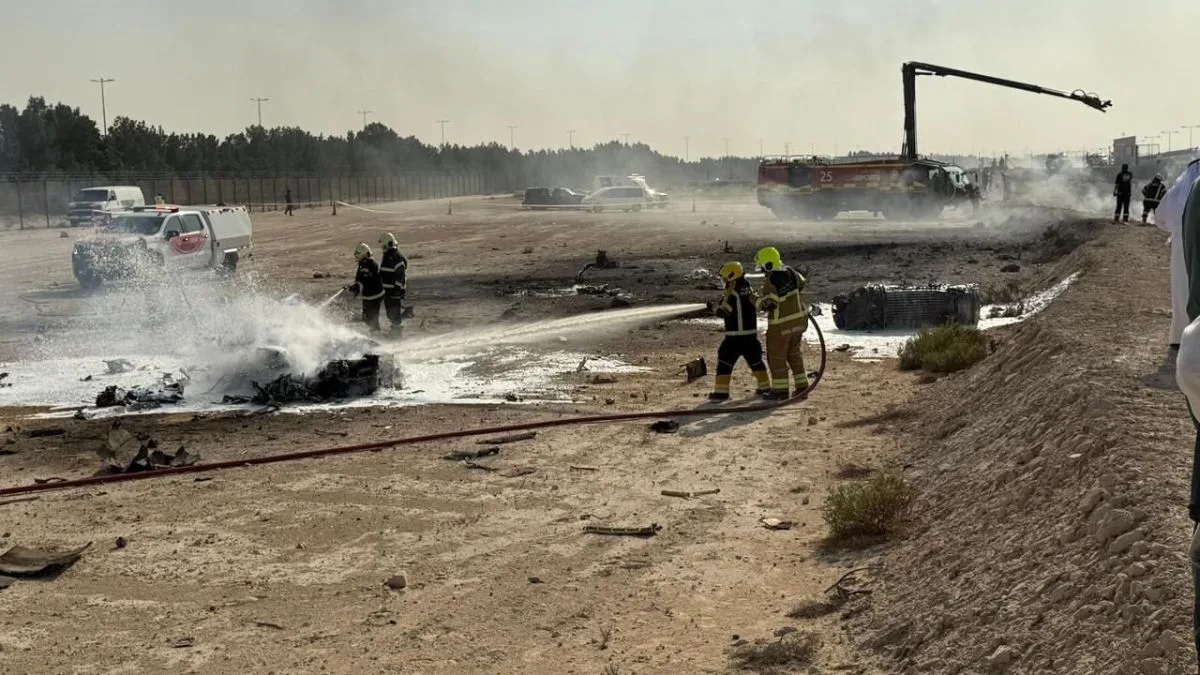
With India’s Tejas light combat aircraft crashing spectacularly during an aerobatic display at the Dubai Airshow on Friday, the air force’s indigenous fighter programme has suffered a setback at a time when the project had been steadily earning global respect as one of the developing world’s most ambitious and successful aerospace ventures.
The incident will undoubtedly trigger questions about safety and airworthiness, but it comes after years in which Tejas, along with a clutch of defence programmes, quietly reshaped India’s defence capabilities and improved the country’s defence innovation standing.
Advertisement
Besides Tejas, India successfully tested BrahMos supersonic cruise missiles, akash, Akash-Ng series missiles, which proved effective in the strikes against Pakistan during Operation Sindoor, Arjun Mainbattle tanks and advanced artillery ATAGS guns, the k9 Vajr-T howitzer and the Tata-Airbus C295 project. And these added heft to India’s reputation as a leading defence manufacturing nation.
The Tejas setback should be seen in the light of the entire gamut of defence innovation and manufacturing successes that India has notched up and the setbacks that many of the world’s successful aircraft programmes have suffered during their own journey.
The Tejas programme has had a long and complex journey. However, the milestones it has achieved are remarkable for a developing nation that began with almost no indigenous fighter design experience.
A breakthrough came in March 2024 when the Tejas Mk1A completed its first flight.
This version carries an advanced AESA radar, an electronic warfare suite, better maintainability, and expanded combat capabilities. Despite global supply chain disruptions affecting even Western manufacturers, India managed to achieve this technological upgrade on schedule, showcasing a growing maturity in fighter aircraft engineering.
The momentum continued this year, when India signed a deal for 97 more Mk1A aircraft, taking the Indian Air Force’s total Tejas orders to over 200.
This pushed the programme into the league of the world’s biggest single-engine fighter fleets outside the United States and China. HAL’s production lines in Bengaluru, Nashik, and Coimbatore are being upgraded to deliver this expanded fleet within six years, signalling India’s rapid growth in industrial capacity and aerospace infrastructure.
A new third production line for the Tejas Mk1A was inaugurated at the Nashik facility, increasing overall production capacity to 24 aircraft per year and significantly speeding up delivery times.
Operationally too, the aircraft has matured. Tejas has been integrated into India’s multi-layered air defence network, freeing the more expensive Su-30MKI and Rafale jets for specialist missions and enhancing India’s overall deterrence.
During Exercise Tarang Shakti in 2024, it flew alongside Rafales and Eurofighter Typhoons, impressing foreign air chiefs with its performance. For many international observers, this was the clearest demonstration yet that Tejas had evolved beyond its reputation as a domestic experiment and entered the realm of credible frontline fighters.
International interest has followed. Countries such as Argentina, Egypt and the Philippines have evaluated Tejas, with Argentina shortlisting it against competitors like the JF-17 and FA-50.
For many Third World nations seeking an affordable, modern fighter that is not tied to the geopolitical strings of great-power suppliers, Tejas represents a ideally-priced and attractive option.
Any export breakthrough would help lower per-unit costs for India’s own fleet and speed up development of the next-generation Tejas Mk2 and the AMCA stealth fighter.
The technological strides behind the programme are as significant as the aircraft itself. Tejas boasts an indigenously developed quadruplex digital fly-by-wire control system, advanced mission avionics, and high-temperature composite materials that few nations have mastered.
Successful test-firings of Astra BVR missiles, mid-air refuelling capability, and even a ski-jump takeoff for the naval version reflect a level of technological sophistication that India could only dream of two decades ago. The programme has also generated a domestic supply chain, with companies like BEL receiving some of their biggest avionics orders ever.
This broader context is essential in understanding the implications of Friday’s Dubai crash. No modern fighter programme anywhere in the world, from the F-16 to the Mirage 2000, has been free of accidents in its early years or during aerobatic demonstrations.
Such incidents, while serious, are part of the long, iterative process of building and validating a combat aircraft. What will matter now is the transparency of the investigation and the speed with which India addresses findings and reassures both domestic stakeholders and potential export customers.
The crash in Dubai is a setback, but it does not diminish the structural progress India has made. Tejas remains a symbol of India’s determination to innovate, manufacture, and compete in one of the world’s most demanding technological arenas.