Explainer: Why is India making it harder for ISRO scientists to resign?
The memorandum, issued on July 14, was signed by SR Rajashekar, Joint Secretary (Personnel), Department of Space.
NASA and ISRO have captured stunning images of 3I/ATLAS, a rare interstellar comet passing through our solar system. Learn more about its icy core, glowing tail, and what it reveals about distant worlds.




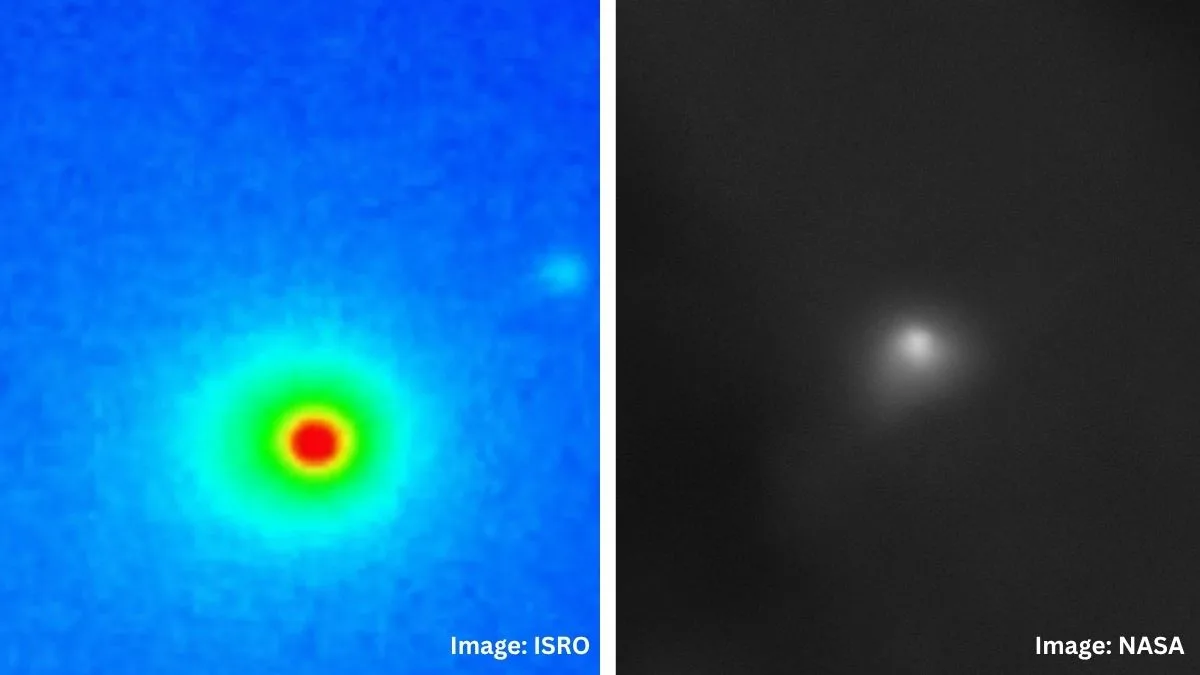
Images: ISRO, NASA
It is not often that NASA and ISRO find themselves staring at the same mysterious traveller drifting through our solar system. But this month, telescopes from Earth to Mars turned toward a cold wanderer from deep space, Comet 3I/ATLAS, only the third confirmed interstellar object ever seen by humanity.
The moment felt almost cinematic: two space agencies thousands of kilometres apart watching the same glowing stranger who does not belong to our Sun, our planets or our cosmic neighbourhood.
Advertisement
And because this comet will never return, scientists everywhere know this is a chance that comes once in a lifetime.
Advertisement
Far away from the noise of cities, at Mount Abu, ISRO-affiliated scientists at India’s Physical Research Laboratory pointed their 1.2-metre telescope at the faint dot racing across the sky.
Between November 12 and 15, 2025, they captured detailed images that surprised even seasoned researchers.
Their observations showed a neat, bright coma: a round, glowing cloud of gas and dust wrapped around the hidden solid nucleus. Using false-colour imaging, scientists made this delicate halo stand out more clearly. They even spotted signs of the comet’s ion tail which is a thin streak of charged particles pushed away by the solar wind.
For India’s scientific community, this is a major achievement. Just a few years ago, the idea of Indian observatories tracking an interstellar comet sounded like distant science fiction. Now, it is documented reality.
While India captured the comet from the ground, NASA turned the entire solar system into a coordinated observation grid.
Twelve NASA spacecraft and telescopes have already photographed 3I/ATLAS since its discovery on July 1, 2025, and several more instruments are preparing to follow it as it drifts outward.
We’ve just released the latest images of the interstellar comet 3I/ATLAS, as observed by eight different spacecraft, satellites, and telescopes.
Here’s what we’ve learned about the comet — and how we’re studying it across the solar system: https://t.co/ZIt1Qq6DSp pic.x.com/ITD6BqVlGn
— NASA (@NASA) November 19, 2025
This is the first time NASA has used such a wide range of spacecraft from Mars orbiters to Sun-watching probes to study an object from another star system.
Scientists want to understand one big question: how different is an interstellar comet from the ones that formed around our own Sun?
Comet 3I/ATLAS is special for a simple reason. It does not belong here. It is moving on a hyperbolic path which is the cosmic signature of an object that came from outside our solar system and will not stay.
Its ices may be 3,500 years old, untouched and frozen since a time long before modern civilisation existed.
Its chemicals unusually rich in carbon dioxide, with traces of water ice, water vapour, carbon monoxide, cyanide and even atomic nickel tell scientists that its birthplace may have been a very different kind of star system.
Some models suggest it came from the Milky Way’s thick disk, which means this comet could be older than the Sun itself.
The closest NASA views came not from Earth but from Mars. Earlier this year, the comet passed the Red Planet from a distance of 19 million miles. NASA’s Mars Reconnaissance Orbiter captured some of the sharpest photographs ever taken of an interstellar comet.
The MAVEN orbiter recorded ultraviolet light from the comet, helping scientists identify the gases escaping from the nucleus.
Even the Perseverance rover, sitting quietly in Jezero Crater, managed to glimpse it from the Martian surface.
As 3I/ATLAS moved behind the Sun from Earth’s perspective, ground telescopes went blind. But this is exactly where NASA’s heliophysics missions stepped in.
STEREO tracked the comet from September 11 to October 2. SOHO observed it from October 15 to 26. NASA’s new PUNCH mission captured the tail as it streamed across space.
In all the decades that solar-watching spacecraft have been operating, this is the first time these missions purposely studied an object that came from another star system. It is a historic first in heliophysics.
NASA’s asteroid explorers, Psyche and Lucy, also turned their cameras toward 3I/ATLAS during their interplanetary travels.
Psyche captured four sets of images over eight hours, helping refine the comet’s trajectory. Lucy took long-distance photos that, when stacked together, revealed fine details of the coma and tail.
These spacecraft were never designed to study comets from another galaxy, yet here they are contributing crucial data.
The comet was first spotted on July 1, 2025, by the ATLAS survey telescope in Chile. Soon after, NASA’s most famous eyes in space joined in.
The Hubble Space Telescope recorded early images. The James Webb Space Telescope analysed the comet’s chemistry, uncovering its rich carbon-dioxide signature.
NASA’s SPHEREx mission, made for studying ice and cosmic history, also captured it in August.
Together, these telescopes are giving scientists the most complete picture ever made of an interstellar comet.
Comet 3I/ATLAS will make its closest approach to Earth on December 19, 2025, but even then, it will remain 170 million miles away, almost twice the distance between Earth and the Sun. So, there is no threat of impact.
After that, it will drift past the orbit of Jupiter in the spring of 2026 and continue its lonely journey back into deep space, never to return.
Because its nucleus is buried inside the bright coma, scientists cannot clearly see its actual size.
Hubble’s earliest estimates suggest a diameter somewhere between 0.32 and 5.6 kilometres, with less than 1 kilometre being the most likely.
Webb’s instruments revealed the unusual chemical mix.
The Very Large Telescope confirmed the presence of cyanide gas and atomic nickel vapour, similar to what we see in our own comets.
Every comet from our solar system carries the fingerprints of the Sun’s birthplace.
But an interstellar comet brings an entirely different story, a story of another star, another era, and possibly another type of planet-forming region.
By comparing 3I/ATLAS with known comets, scientists hope to learn how other solar systems formed. NASA and ISRO’s combined observations will help answer questions such as: how do comets evolve in other galaxies? What materials exist around distant stars? What can this tell us about the early universe?
NASA’s spacecraft scattered across the solar system, ISRO’s instruments perched on Indian hills, Mars orbiters, Sun-watchers, asteroid explorers and giant telescopes all turned toward the same icy visitor.
Comet 3I/ATLAS arrived from far beyond our Sun, and for a brief time, it quietly connected worlds, agencies and scientists everywhere.
Advertisement