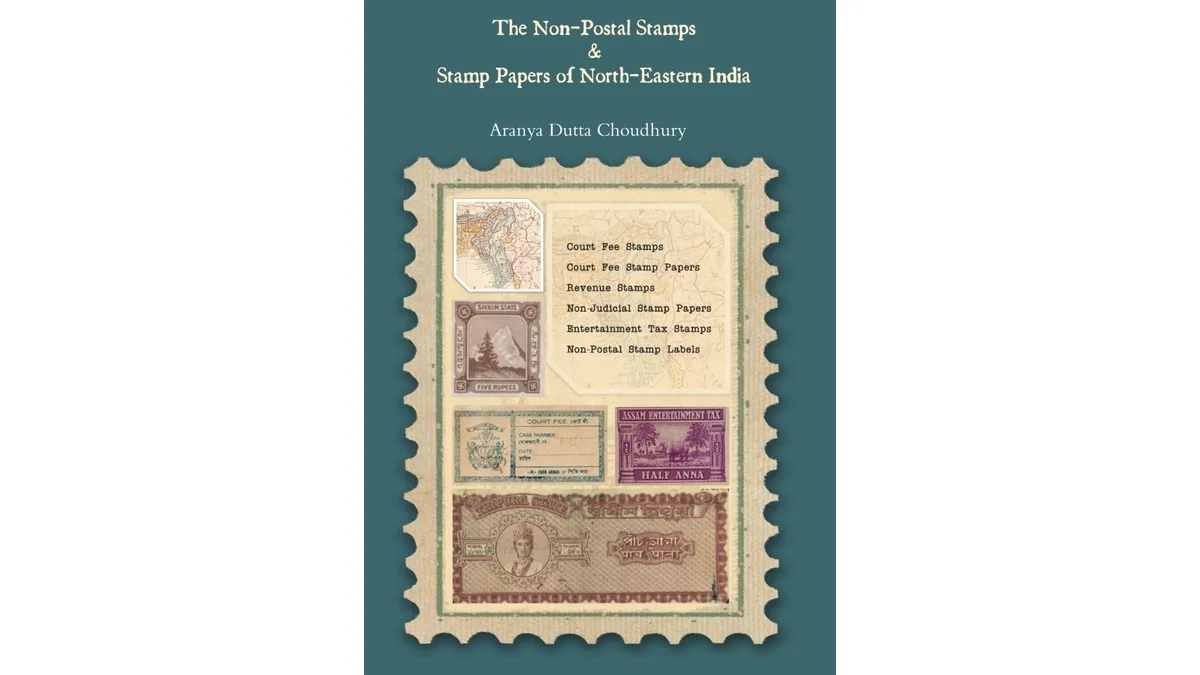
Aranya Dutta Choudhury’s book on non-postal stamps and historical stamp papers of North East India bridges philately, governance, and history to illuminate a region whose administrative imprints have long remained unseen. Amit Dixit interviews the author.
What inspired you to write The Non-Postal Stamps & Stamp Papers of North-Eastern India?
Advertisement
I have been travelling across the North Eastern states for the last 25 years, having also stayed in Guwahati for some time early in my corporate career. I had a passion for stamp collecting from childhood, and I gradually blended my corporate travels and analytical rigour to evolve into a serious philatelist.
Traveling across the North East I started discovering new artifacts like coins, tea tokens and, of course, stamps. It is well understood in collectible circles that the North East is one of the most difficult geographical areas to collect because of the lack of preservation and knowledge about these artifacts. My travels led me to several discoveries where I started collecting the fiscal and revenue stamps of Tripura and Sikkim.
I also started looking for online resources like eBay and searched for stamps and labels of Assam and other states of the North East. This book aims to provide a detailed exploration of these non-postal issues, shedding light on their role in governance and legal documentation. From the early hand-stamped papers of Manipur to the elaborate printed stamp papers of Tripura, these documents serve as tangible records of the history of the region.
How did you go about it?
This was a work spread into two activities—one, collecting over 10 years various stamps, stamp papers and covers related to the North Eastern region. Post that, I started visiting archives (state as well as national), several state departments, libraries, collectors, and as well as websites which had information that could be authenticated and verified. It was a meticulous and difficult research journey for the last five years as nothing has been written on this subject before. I was encouraged by the PCI (Philatelic Society of India) Philatelic Trust to write the book, which took around seven months.
What are non-postal stamps exactly?
The world of philately extends far beyond traditional postage stamps, encompassing a diverse range of non-postal issues such as revenue and fiscal stamps, court fee stamps, and stamp papers. Among these, the fiscal and revenue stamps of North Eastern India— particularly those from the princely states of Manipur, Tripura, and Sikkim, as well as the British-administered province of Assam— hold a unique historical and administrative significance.
Why isn’t there much awareness on the non-postal stamps of the North East among collectors?
Despite their significance, the non-postal stamps and stamp papers of North Eastern India have received relatively little scholarly attention. This book seeks to fill that gap by documenting their historical context, classification, and usage, supported by archival research, official records, and contributions from collectors. Special emphasis has been given to rare varieties, and the evolution of these fiscal instruments over time. This work is intended for philatelists, historians, and collectors who appreciate the depth and diversity of Indian fiscal and revenue issues.
Do you have any of these stamps and stamp papers in your collection?
Yes, I have collected them over many years, sifting through various old collections, leftover materials from various dealers who thought nothing about these, and then have also paid hefty sums for certain well-known items (from web portals and dealers). So it’s been a mix of frugality and a bit of extravagance.
What is the social and cultural significance of these stamps and stamp papers?
This book studies the fiscal, judicial, and administrative heritage of the North East through its non-postal stamps and stamp papers. The book delves into the evolution of legal and revenue systems in the princely states of Manipur, Tripura, and Sikkim, as well as the province of Assam, tracing their transition from independent kingdoms to integration into the Indian Union.
Through detailed research, it explores how each state’s distinctive fiscal instruments—such as court fee stamps, revenue stamps, and non-judicial stamp papers—reflected their political sovereignty, legal administration, and cultural identity. The historical background of each state is meticulously outlined. For instance, Manipur’s judicial evolution from the Cheirap courts to British colonial and post-merger systems; Tripura’s unique dual identity as “Independent or Swadhin Tripura,” balancing British oversight and royal autonomy; Assam’s transformation from a British commissioner’s province to a modern Indian state; and Sikkim’s journey from a Buddhist monarchy to becoming India’s 22nd state in 1975.
The book positions non-postal stamps as tangible evidence of the administrative and constitutional history of the region. It stands as the first comprehensive compilation of the non-postal philatelic heritage of North Eastern India, bridging the domains of history, law, and philately.
The interviewer is an editor and journalist
Spotlight:
The Non-Postal Stamps & Stamp Papers of North-Eastern India
By Aranya Dutta Choudhury
Sayantan Publication
Rs 1,495; 148 pages