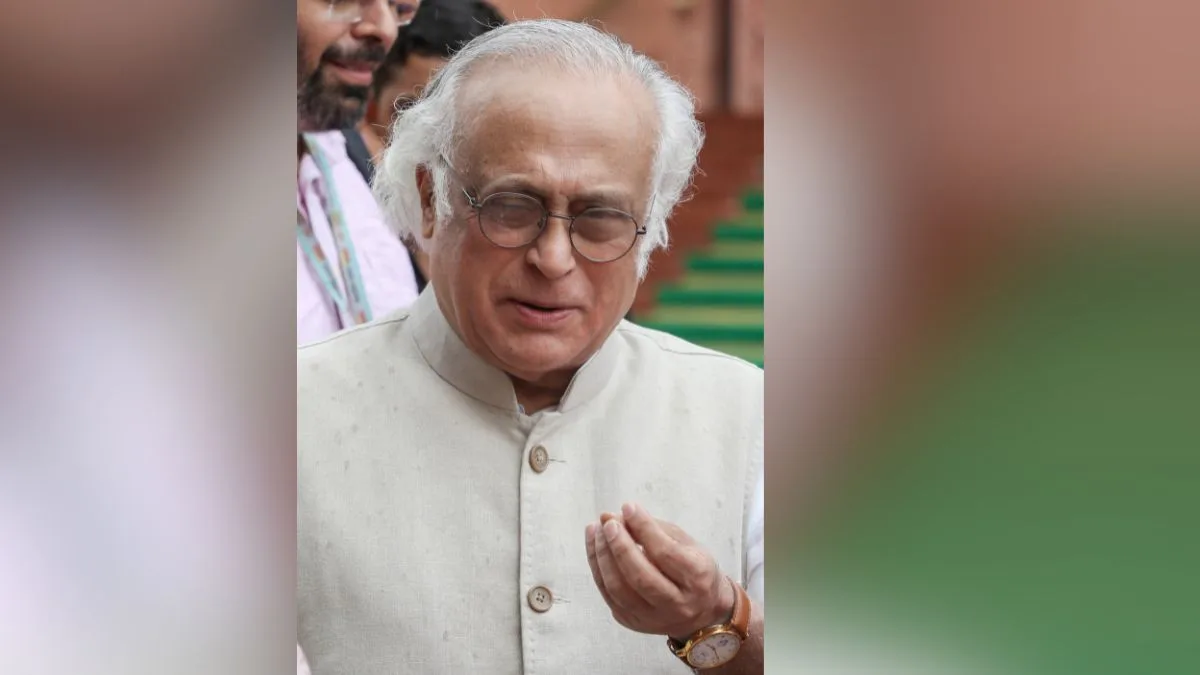
In a powerful rebuttal to recent political accusations, senior Congress leader Jairam Ramesh Friday highlighted the profound historical and cultural significance of the national song Vande Mataram, urging for respect and an unconditional apology over the alleged mischaracterization of its legacy.
Drawing on authoritative historical insights, Ramesh pointed to excerpts from Sabyasachi Bhattacharya’s definitive 2003 biography of Vande Mataram—the iconic song penned by Bankimchandra Chattopadhyay that played a pivotal role in India’s freedom struggle.
Advertisement
Bhattacharya’s work sheds light on the Congress Working Committee’s (CWC) resolution on October 29, 1937, which officially adopted Vande Mataram as a national symbol.
“Three days before the CWC meeting, on October 26, 1937, Rabindranath Tagore himself wrote to Jawaharlal Nehru on this very issue,” Ramesh revealed.
“It was the Gurudev—Tagore—who, with his unique relationship to Vande Mataram, suggested adopting the first two stanzas of the song. His letter deeply influenced the resolution in its entirety,” Ramesh said in a post on handle X.
His statement comes in response to the Prime Minister’s recent accusation that Gurudev harbored a ‘divisive ideology.’ “This is a shameful statement from a man whose lies and distortions have no limits,” Ramesh said. “The people of India demand an unconditional apology.”
Prime Minister Modi on Friday stated that the removal of certain significant verses from the song Vande Mataram in 1937, a decision reportedly influenced by Rabindranath Tagore’s advice to the Congress party, “sowed the seeds of partition” and was based on a “divisive ideology”.
Though the Prime Minister did not directly accuse Tagore of harboring a divisive ideology himself, but rather framed the decision to alter the song, which he attributed to Tagore’s input, as an action stemming from a “divisive ideology” (implicitly, that of the Congress leadership at the time) that sought to appease certain communities.
Ramesh further pointed out that the historic significance of Vande Mataram was formally enshrined on January 24, 1950, during the Constituent Assembly session chaired by Dr Rajendra Prasad. In his remarks, Dr Prasad declared, “The composition of the words and music known as Jana Gana Mana is the National Anthem of India… and the song Vande Mataram, which has played a historic part in the struggle for Indian freedom, shall be honoured equally with Jana Gana Mana and shall have equal status with it.”
Ramesh further pointed out that Tagore first performed Vande Mataram at the Indian National Congress session in Kolkata in December 1896, marking the beginning of its journey as a symbol of national pride and unity.
Historian Rudrangshu Mukherjee recently provided an authoritative account on Jana Gana Mana, dispelling misconceptions propagated by certain political factions.
In addition to Vande Mataram’s legacy, Ramesh highlighted Bankimchandra Chattopadhyay’s progressive voice on social equality.
Between 1872 and 1876, Chattopadhyay authored five essays titled Samya, fiercely criticizing caste-based inequalities. These essays were translated into English as Equality by Bibek Debroy in 2002, underscoring the visionary ethos behind the national song.
As debates over national symbols intensify, Jairam Ramesh’s call for historical accuracy and respect for India’s shared heritage resonates amid a politically charged atmosphere.
The enduring legacy of Vande Mataram, enriched by contributions from towering figures like Bankimchandra Chattopadhyay and Rabindranath Tagore, remains a testament to India’s pluralistic spirit and quest for freedom.