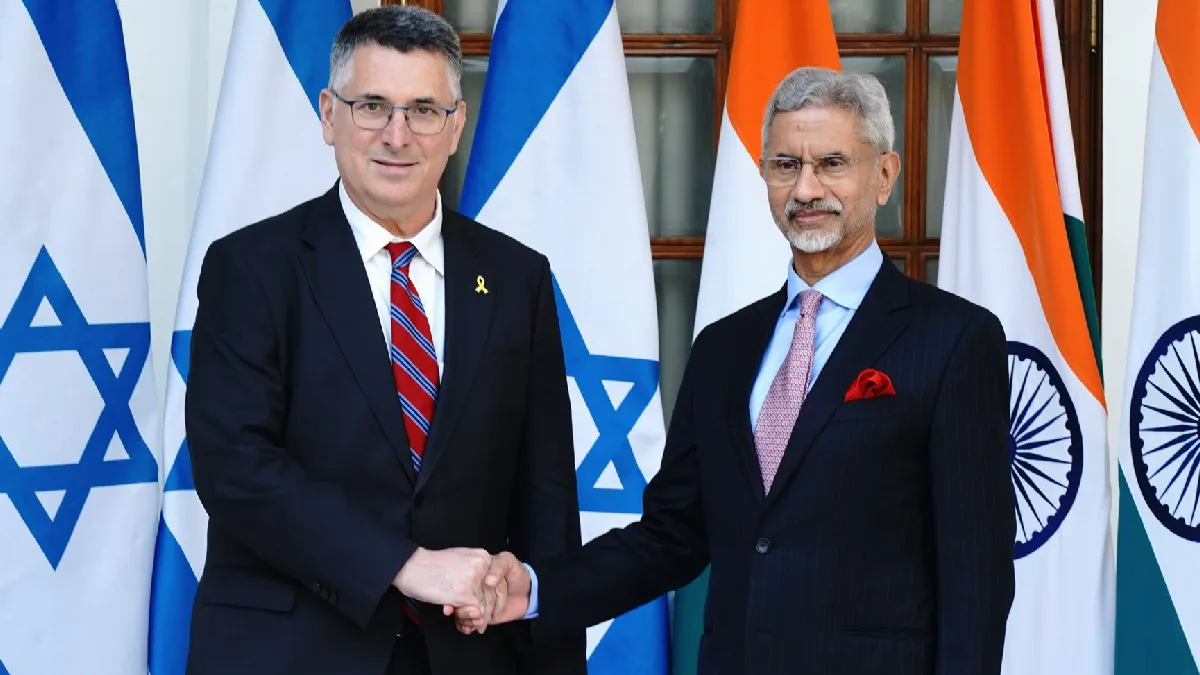
India and Israel on Tuesday reaffirmed their bilateral partnership, stating it has withstood “testing times” and shares a common goal of eliminating terrorism. The two sides met here today and also discussed other aspects of the bilateral ties.
Visiting Israeli Foreign Minister Gideon Sa’ar, during delegation-level talks with External Affairs Minister S Jaishankar in New Delhi, described India as “the future” and a “global superpower”.
Advertisement
“I believe that India is the future… India is the world’s largest democracy and the fastest-growing economy. India is a global superpower. Israel is a regional powerhouse. Our nations already share a warm friendship. Our goal is to build a long-term strategic partnership between Israel and India,” FM Gideon Sa’ar said during the talks.
The minister recalled the immediate aftermath of the October 7, 2023, Hamas attack on Israel that killed thousands, saying Prime Minister Narendra Modi was the first world leader to call Israeli PM Benjamin Netanyahu post the dastardly strike. “We won’t forget it,” he stated.
“I believe that the future for regional partnerships is bright. Israel supports regional connectivity projects such as I2U2 (India-Israel-UAE-USA) and IMEC (India-Middle East-Europe Economic Corridor). We want to promote connectivity between South Asia, West Asia, and Europe,” Gideon Sa’ar stated further.
On his part, EAM Jaishankar reiterated New Delhi’s stand on terrorism, stating both India and Israel face a common challenge. “Our two nations face a particular challenge from terrorism. It is essential that we work towards ensuring a global approach of zero tolerance towards terrorism in all its forms and manifestations,” he asserted.
Jaishankar further reaffirmed India’s support for the Gaza Peace Plan and expressed hope that it will pave the way for a durable and lasting solution in the region.
Gideon Sa’ar, on his part, condemned this year’s Pahalgam terror attack and described “radical terror” as a mutual threat to Israel and India.
“We strongly condemn the horrific terror attack in Pahalgam… Israel faces a unique phenomenon, which I call terror states. The radical terror states of Hamas in Gaza, Hezbollah in Lebanon, and Houthis in Yemen have established themselves over the past decades. Uprooting them is necessary for the security and stability of our region. The eradication of Hamas terror state is at the heart of President Trump’s Plan. Hamas must be disarmed, Gaza must be demilitarised. We will not compromise on it,” the Israeli minister stressed.
Speaking on bilateral issues, Jaishankar noted that the Israeli minister’s visit presents an opportunity to review bilateral cooperation and further possibilities.
“The recent conclusion of our Bilateral Investment Agreement is a notable step in that direction. It is noteworthy that your ministerial colleagues dealing with agriculture, economy, tourism, and finance have all visited us recently. In recent times, India has developed many new capabilities, especially in rail, road, and port infrastructure, in renewable energy, and in health. Our businesses are very keen to explore opportunities in Israel, and we would certainly like to give that more attention. We also have a very strong record of working together in agriculture and in innovation. Taking that forward is very much in our mutual interest,” the EAM said.
“There is a history of cooperation in semiconductors and in cyber. That has become more relevant now. We are hosting the AI Impact Summit next year in February in India. We look forward very much to Israel’s presence,” he added.
Jaishankar noted that there are some concerns with regard to Indian workers who are working in Israel and added, “They have some issues that need attention, and I hope that we can take that dimension of our ties forward.”







![‘Beginning of accountability’: Sonam Wangchuk reveals 3 written assurances from Centre before ending fast [VIDEO]](https://www.thestatesman.com/wp-content/uploads/2026/07/Sonam-Wangchuk-1-1-300x200.webp)
![‘Beginning of accountability’: Sonam Wangchuk reveals 3 written assurances from Centre before ending fast [VIDEO]](https://www.thestatesman.com/wp-content/uploads/2026/07/Sonam-Wangchuk-1-1.webp)