Extraction of minerals from the Indian offshore: Opportunities and challenges
The mineral economy of India is at a crucial moment of structural transition.
India’s youth are often hailed as the nation’s greatest asset ~ brimming with energy, ambition, and promise. But behind this hopeful narrative lies a stark truth: only a fraction are meaningfully contributing to national progress.




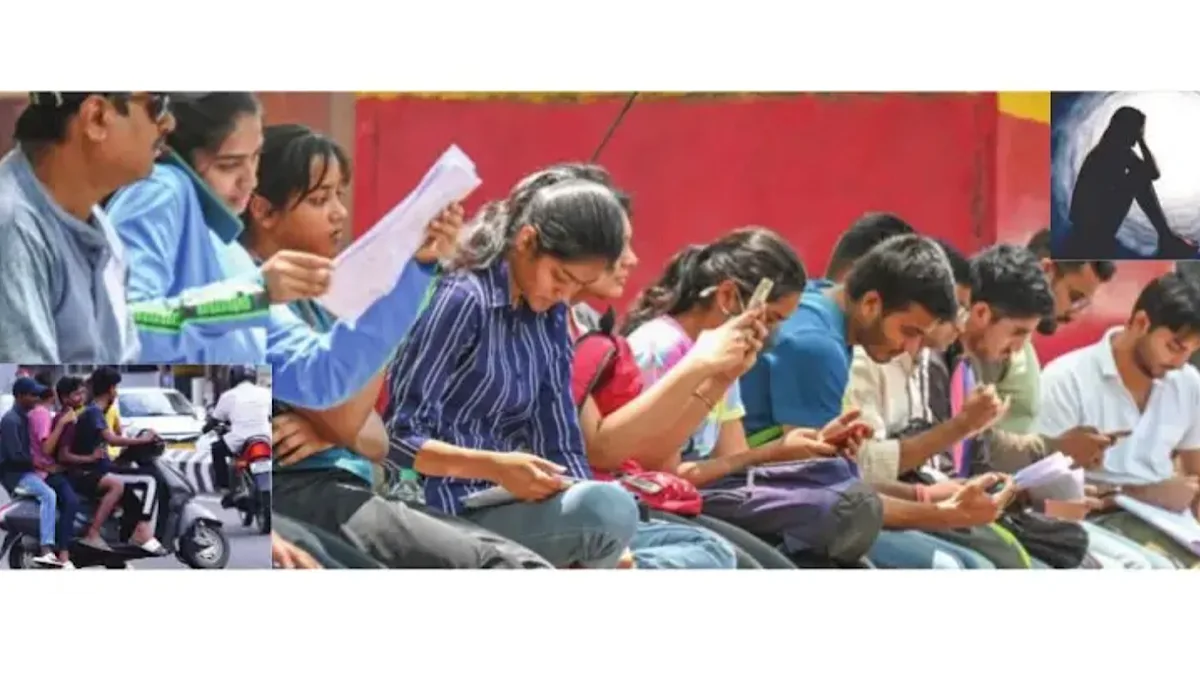
Photo:SNS
India’s youth are often hailed as the nation’s greatest asset ~ brimming with energy, ambition, and promise. But behind this hopeful narrative lies a stark truth: only a fraction are meaningfully contributing to national progress. The rest remain emotionally adrift, professionally underutilized, and socially undisciplined. Our much-celebrated demographic dividend risks becoming a demographic liability unless we confront this reality with urgency and resolve. The symptoms are most visible in urban India, but rural regions are not untouched ~ thanks to the instant reach of electronic media and digital platforms. Aggression, impatience, and civic indiscipline have become routine.
Reckless driving ~ on expressways, city roads, and even on the wrong lane ~ along with foul language, queue-jumping, and public confrontations reflect a deeper malaise. Helmets are ignored, traffic rules flouted, and civility eroded. It is not uncommon to hear abusive language in public spaces, revealing a disturbing collapse of basic politeness and respect. This behavioural drift is not confined to the uneducated or economically marginalized. It has seeped into the psyche of even the well-off and well-schooled. The rise of nuclear families, helicopter parenting, and instant digital gratification has shaped a generation emotionally unprepared for adversity. Shielded from discomfort and fast-tracked to rewards, many adolescents now lack the resilience to face failure, rejection, or uncertainty.
Advertisement
When pressure mounts, escape often feels easier than endurance ~ manifesting in aggression, addiction, or apathy. Emotional volatility, sleeplessness, and even suicidal ideation are no longer rare ~ they are warning signs of a deeper disconnect. Based on NCRB data for 2022, 41 per cent of all suicides in India were committed by people under the age of 30 ~ a staggering 70,000 young lives lost in a single year. Substance abuse among adolescents is rising alarmingly. In December 2022, the Centre informed the Supreme Court that more than 1.5 crore children aged 10-17 were addicted to substances ~ alcohol, cannabis, and opioids being the most common. Simultaneously, the digital space, especially platforms like YouTube, has become a breeding ground for vulgarity, perversion, and foul language. Despite community guidelines, algorithmic incentives and cultural shifts allow such content to thrive, shaping impressionable minds in troubling ways.
Advertisement
Even basic courtesies, like greeting elders, now require parental prompting, a disturbing shift in cultural values. A common driving courtesy, such as dipping headlights to avoid glare, has disappeared. Instead, LED lights are kept on full beam, blinding oncoming drivers. Pressure horns, illegal and prohibited, are used with impunity. Double-decker buses blaze through traffic with flashing lights, intimidating sensible drivers, especially women. The rule of law appears absent, and the long arm of enforcement rarely reaches these offenders. Educational institutions are struggling to manage and inculcate civic values. While data on expulsions for indiscipline is scarce, anecdotal evidence suggests a growing inability to enforce behavioural norms.
Schools, stripped of authority, are unable to instil discipline. Parents, often indulgent or absent, fail to set boundaries. Psychiatric analysis has replaced moral guidance, and emotional entitlement has replaced resilience. Meanwhile, India’s employment crisis deepens. Despite a growing working-age population, the employment rate has stagnated. According to estimates from Santosh Mehrotra and Jajati Parida’s forthcoming book “India Out of Work”, only about 330 million of the 610 million work-force were engaged in non-farm sector jobs in 2023-2024. Nearly 280 million remain tied to agriculture, much of it unpaid family labour. Another 28 million educated youth are actively seeking jobs, while 100 million ~ mostly women ~ have exited the job market, discouraged by limited opportunities or systemic barriers.
The rest are still in education, but many will emerge unemployable due to a mismatch between academic training and industry needs. The structural reversals in manufacturing and the breakdown of the Lewisian transition, which envisioned surplus rural labour moving into higher-productivity industrial jobs, have compounded the crisis. In India’s context, this transition has faltered. Instead of absorbing rural workers into formal manufacturing, we have seen stagnation in industrial job creation and a rise in informal, low-wage urban employment. Many youth, especially in towns and city outskirts, remain stuck in agriculture or drift into unregulated sectors like gig work, street vending, or idle urban roaming – none of which offer long-term stability, skill development, or dignity. Despite campaigns like “Make in India,” manufacturing’s share in employment and GDP has declined.
To match China’s productivity levels, India must urgently address the behavioural drift among youth. Roaming aimlessly, wasting time, and resisting discipline are not just personal failings, they are national setbacks. It is well-nigh impossible to expect youth with such a mindset to perform professionally in any activity, office, or industry. Their work culture too reflects the same casual, arrogant, and shortcut-driven attitude ~ with negligible care for quality, accountability, or performance. We rarely speak of the 80 crore citizens dependent on free ration, the growing unemployment, the downward trend in exports, the slide of the rupee, or the lack of affordable healthcare and education. Instead, we celebrate “India Shining” and “Viksit Bharat” while ignoring the realities of overcrowded cities, unaffordable schooling, and a very large numbers of youth population remaining unfit to meet the challenges of a competitive world.
India’s leaders must lead by example. Austerity, punctuality, and integrity must be lived ~ not just preached. When public figures glamorize aggression or indulge in theatrical bravado and unsocial language, they normalize incivility. Loudness is mistaken for leadership, and restraint for weakness. Youth mirror what they see. If leaders model discipline and dignity, young citizens will follow with purpose. Before asking them to build the nation, we must show them how ~ through character, not charisma; through listening, not lecturing; and by proving that respect is earned through conduct, not status. India’s youth are not inherently flawed. They are simply adrift in a system that has failed to guide them. The solution is not punishment, but reform.
Not nostalgia, but renewal. We must reconnect our urban youth to their roots, their communities, and their conscience. We must offer them not just jobs, but meaning. Not just education, but values. Not just freedom, but responsibility. But reform must come with resolve. It must be executed with fairness, but also firmness. Democratic freedom cannot be a shield for indiscipline, nor can every wrong be excused in the name of youthful exuberance. Accountability must walk hand in hand with empathy. Recent glaring examples are the gruesome killing and injuries caused by rash driving under the influence of alcohol in Prayagraj, followed by a similar case in Delhi.
It is time the leadership, bureaucracy, and police shun the “all is well” posture, stop publicity slogans, face reality, and take conscious, stern action to instil discipline, civic responsibility, and respect for law across all layers of society. This must begin with visible, consistent enforcement, not selective crackdowns or token gestures. The message must be clear: indiscipline is not freedom, and public spaces are not arenas for reckless self-expression. We must move beyond slogans and symbolism. Real transformation demands institutional reform, leadership by example, and a national ethos of accountability. The youth must be guided, not indulged. They must be trained, not merely taught. They must be inspired, not distracted.
And above all, they must be reminded that nation-building is not a spectator sport, it is a disciplined, collective pursuit. India stands at a historic juncture. The demographic dividend that began around 2013 will begin to taper by 2046. That leaves us with just two decades to harness this energy, channel it into productivity, and elevate our national standing. Disciplining a massive youth population requires stern action, committed leadership, and extensive common training based on a uniform syllabus and language. Further delay in addressing these critical areas will squander golden opportunities to enrich the nation and elevate the quality of life for all citizens.
Let us not wait for another tragedy, another missed chance, or another hollow celebration. Let us begin the hard work of disciplining the nation, dignifying our youth, and directing our future, before the crossroads become a dead end. As Martin Luther King, Jr. aptly said, “We are now faced with the fact, my friends, that tomorrow is today. We are confronted with the fierce urgency of now.
(The writer is a retired Air Commodore, VSM, of the Indian Air Force)
Advertisement