No End
Wars often end long before the shooting stops. They end when one side concludes it cannot win, when both sides accept the limits of military power, or when external actors impose a framework that neither can ignore.
The devastation across Ukraine on Tuesday night, where a kindergarten was struck, homes burned, and families torn apart, illustrates a grim paradox of this long war: pauses in diplomacy often trigger surges in violence.




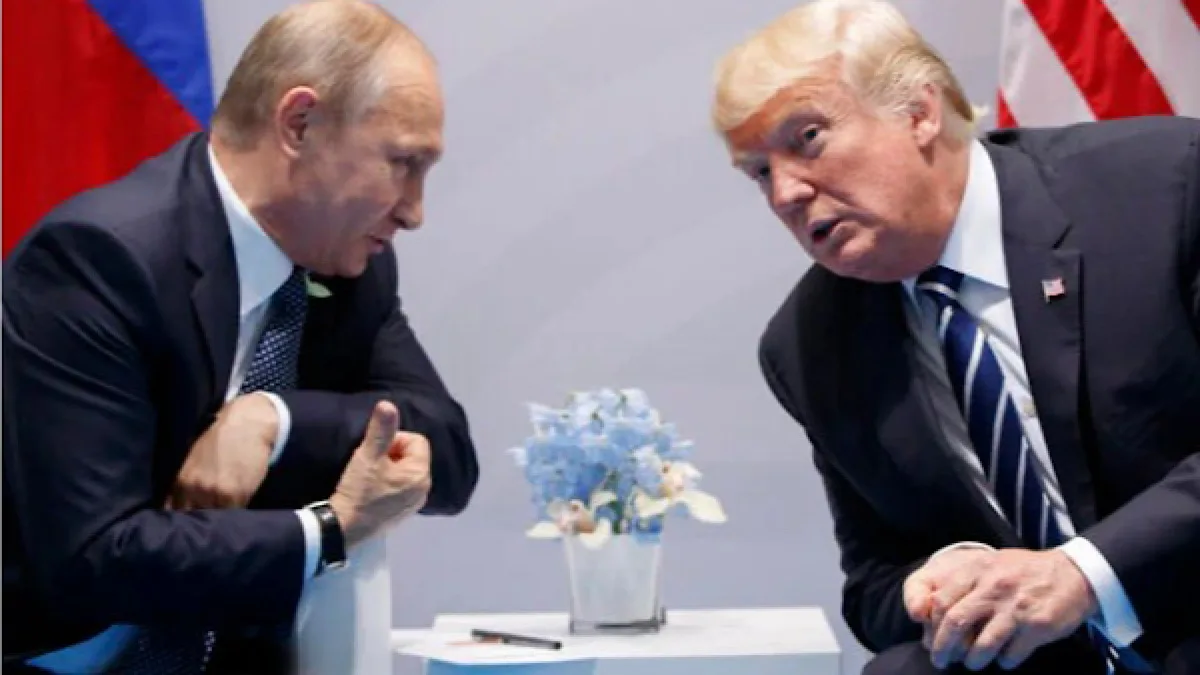
Donald Trump and Vladimir Putin (Photo:IANS)
The devastation across Ukraine on Tuesday night, where a kindergarten was struck, homes burned, and families torn apart, illustrates a grim paradox of this long war: pauses in diplomacy often trigger surges in violence. The latest Russian barrage, coming within hours of a planned Trump-Putin summit being postponed, underscores how every diplomatic hesitation becomes a battlefield opportunity for Moscow. Russia’s strikes were no random act of cruelty. They were a deliberate signal that no lull in dialogue will translate into restraint on the ground. For the Kremlin, force remains the principal language of negotiation. When diplomatic channels close, missiles speak louder.
Moscow has learned to exploit moments of political uncertainty to reassert its relevance and test Western resolve. Ukraine’s President, Volodymer Zelenskky, traveling through Europe in search of security assurances and long-range missile systems, has made no secret of his frustration. His observation that Russia loses interest in diplomacy whenever Western military support falters is not merely a lament, it is a diagnosis of a war now defined by perceptions of strength. Every hesitation in arms delivery, every ambiguous signal from Washington or Brussels, recalibrates the Kremlin’s sense of how far it can go. Every lull in negotiation becomes an invitation for renewed assault. The longer leaders debate terms of peace, the more civilians pay the price for diplomatic hesitation and strategic ambiguity.
Advertisement
The proposed “frontline freeze” may have offered a temporary reprieve, but it was never a genuine ceasefire. For Kyiv, freezing the war means legitimising occupation. For Moscow, it offers the chance to regroup, rearm, and resume from a more favourable position. Both sides know this, which is why each new proposal collapses under the weight of mistrust before it can even be tested. The tragedy in Kharkiv – where children were among the wounded in an attack on a kindergarten – speaks to the moral exhaustion of this conflict. Russia’s choice of targets increasingly blends military calculation with psychological warfare. The destruction of schools, homes, and power infrastructure aims to break Ukraine’s resilience from within, to make survival itself the battlefield. Meanwhile, Western powers remain caught in their own dilemma: how to pressure Russia without cornering it, and how to aid Ukraine without expanding the war.
Advertisement
Diplomacy is being stretched between deterrence and restraint, while the ground reality leaves little room for either. What the latest strikes reveal is not just Moscow’s defiance, but the absence of credible enforcement mechanisms behind peace proposals. Until a framework emerges that can compel compliance through diplomatic isolation, economic leverage, or credible deterrence peace will remain a slogan recited between explosions. In the end, it is not the postponement of summits but the absence of consequences that deepens wars. When diplomacy retreats without deterrence, the vacuum fills with smoke, debris, and the cries of children who were never part of anyone’s strategy.
Advertisement