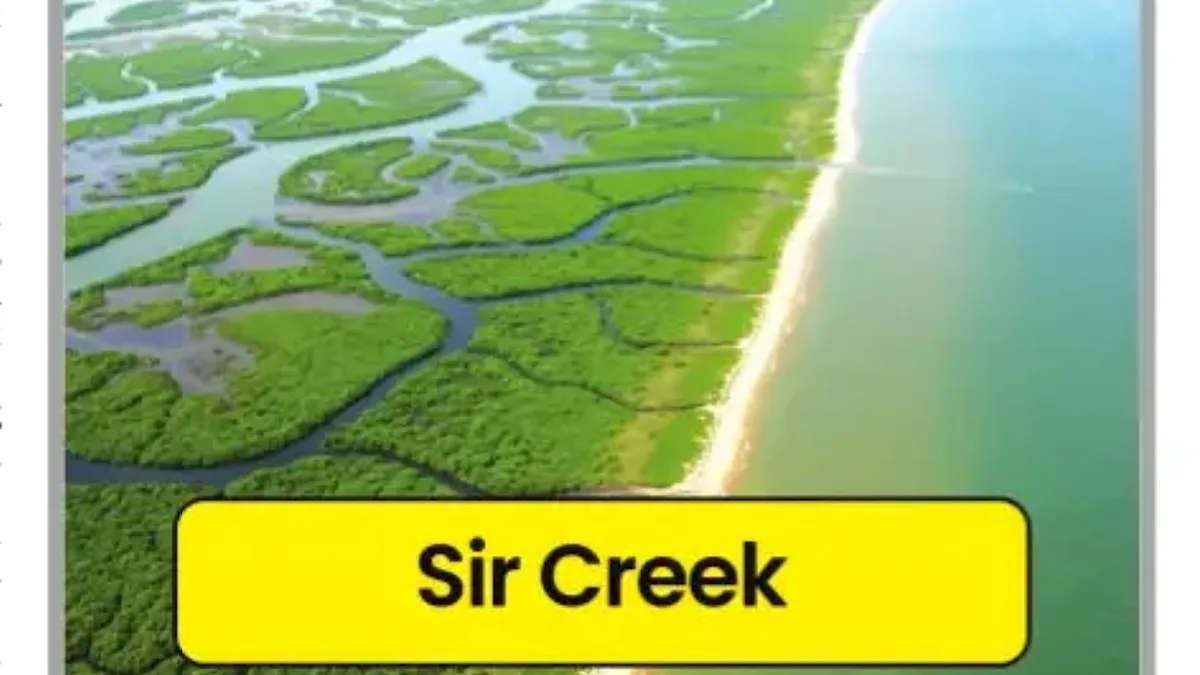
At first glance, Sir Creek appears to be nothing more than a remote sliver of swamp – a 96-kilometre-long strip of tidal estuary where the Arabian Sea meets the marshy landmass of the Rann of Kutch. Yet beneath its murky waters lies a geopolitical riddle that has defied resolution for decades. Between India and Pakistan, this disputed creek is not just a boundary line – it is a symbol of how geography, history, and strategic interests entwine in South Asia’s most sensitive frontier. Sir Creek, located between Gujarat’s Kutch region and Pakistan’s Sindh province, looks deceptively insignificant on the map.
But as every strategist knows, appearances in geopolitics can mislead. “In border disputes,” Lt. Gen. Satish Nambiar once observed, “even a patch of sand or swamp can define the perimeter of national pride and security.” His words perfectly capture the essence of this marshland that continues to shape the maritime imagination of both nations. The origin of the Sir Creek dispute dates back to the colonial era. In 1914, the then Government of Bombay attempted to demarcate the boundary between the princely state of Kutch and the province of Sindh, then part of British India. The dispute arises from two contradictory maps and administrative resolutions – one from 1914 and another from 1925.
Advertisement
India bases its claim on the latter, arguing that the entire creek lies on its side, while Pakistan maintains that the boundary runs along the mid-channel, based on the 1914 version. This may sound like an arcane cartographic debate, but the stakes could not be higher. The point where the land boundary ends and the sea boundary begins determines the exact line from which territorial waters, the Exclusive Economic Zone (EEZ), and continental shelf rights are measured. Control over Sir Creek could extend India’s EEZ deeper into the Arabian Sea – a zone rich in potential oil, gas, and marine resources. For Pakistan, conceding India’s claim would mean losing access to parts of these lucrative waters. Thus, a seemingly minor dispute over a marshy estuary translates into thousands of square kilometres of oceanic territory and billions in potential energy wealth. Geoeconomically, Sir Creek is a treasure map disguised as a tidal swamp. Under the 1982 United Nations Convention on the Law of the Sea (UNCLOS), every coastal nation enjoys rights to resources up to 200 nautical miles from its baseline. That baseline – the starting point – depends on where the land boundary meets the sea. In Sir Creek, that single cartographic line could redefine the shape of India’s western maritime frontier and open access to unexplored hydrocarbon reserves under the Arabian seabed. The region also matters enormously for local livelihoods. Fishermen from Gujarat’s Kutch coast and Pakistan’s Sindh routinely venture into the area’s rich fishing grounds. Because the maritime boundary is disputed, both sides accuse the other’s fishermen of crossing into foreign waters. Hundreds of fishermen are arrested every year, their boats seized, and families left in limbo. The unresolved dispute thus has a deeply human dimension – a story of livelihoods caught in the crosshairs of geopolitics. Ecologically too, Sir Creek is vital. It forms part of the vast Indus Delta-Rann of Kutch ecosystem – a fragile expanse of mangroves, salt flats, and tidal creeks that sustain diverse marine and bird life. Rising sea levels, sedimentation changes, and the discharge of saline water from Pakistan’s Left Bank Outfall Drain have altered its hydrology. Both India and Pakistan, despite their hostilities, share a common environmental interest in protecting this delicate ecosystem that shields coastal communities from cyclones and erosion. Yet, it is the geostrategic significance of Sir Creek that makes it a permanent fixture on the radar of both militaries. The marshy terrain and tidal channels make infiltration possible but difficult to monitor, especially during high tide. Over the years, India has fortified its presence through border outposts, radar stations, and naval coordination networks in the Kutch sector. Control over Sir Creek strengthens coastal surveillance and plugs a potential route for smuggling or infiltration by sea. From a defence perspective, the area is not just a disputed border – it is a security buffer. If India’s boundary interpretation prevails, its coastal control would extend closer to Pakistan’s key ports, including Karachi. For Pakistan, this raises alarms over maritime vulnerability. Hence, any talk of “misadventure” in the creek zone, as Defence Minister Rajnath Singh recently warned, carries a pointed message: India views the creek not as a trivial marshland but as a linchpin of its western maritime flank. Kutch, the adjoining region, provides the geographic depth to this security architecture. Once a barren salt desert, Kutch today hosts critical infrastructure – airstrips, naval posts, and roads that connect directly to the coast. Development projects under the Coastal Security Scheme and the Sagarmala initiative have transformed this frontier into a stronghold of India’s coastal defence grid. Sir Creek, therefore, is the final frontier of that geography – a watery boundary that completes India’s control over its western littoral. The unresolved status of Sir Creek has persisted for decades despite several rounds of dialogue. The 1965 Indo-Pak tribunal settled parts of the Rann of Kutch boundary, awarding 90 per cent of the disputed land to India but specifically excluding Sir Creek from its jurisdiction. Later, in the post-Simla Agreement period, both sides agreed that the matter could only be resolved bilaterally, ruling out third-party arbitration. Since then, technical talks between hydrographic experts and surveyors have taken place intermittently, with little political breakthrough. Despite these deadlocks, Sir Creek remains central to future diplomacy. In a world where maritime boundaries are increasingly tied to energy security, blue economy prospects, and climate resilience, a settlement here could serve as a model for pragmatic cooperation. Both India and Pakistan have much to gain – from coordinated fisheries management to joint environmental monitoring. Conversely, continued hostility only hardens positions and militarises a zone that could otherwise become a symbol of shared stewardship. In the larger sweep of Indian maritime strategy, Sir Creek is the starting line of the country’s western oceanic presence. It connects to the Arabian Sea, to vital sea lanes of communication, and to the broader Indo-Pacific canvas where India seeks to project influence. Securing its rightful claim here thus goes beyond bilateral rivalry – it is part of India’s aspiration to emerge as a major maritime power capable of defending its interests from the Gulf of Aden to the Malacca Strait. Ultimately, Sir Creek is a reminder that geography continues to dictate destiny. For India, the narrow strip of marshland in Gujarat’s far west may well hold the key to its maritime future – shaping not just maps, but the strategic imagination of a nation. (The writer is Professor, Centre for South Asian Studies, Pondicherry Central University.)