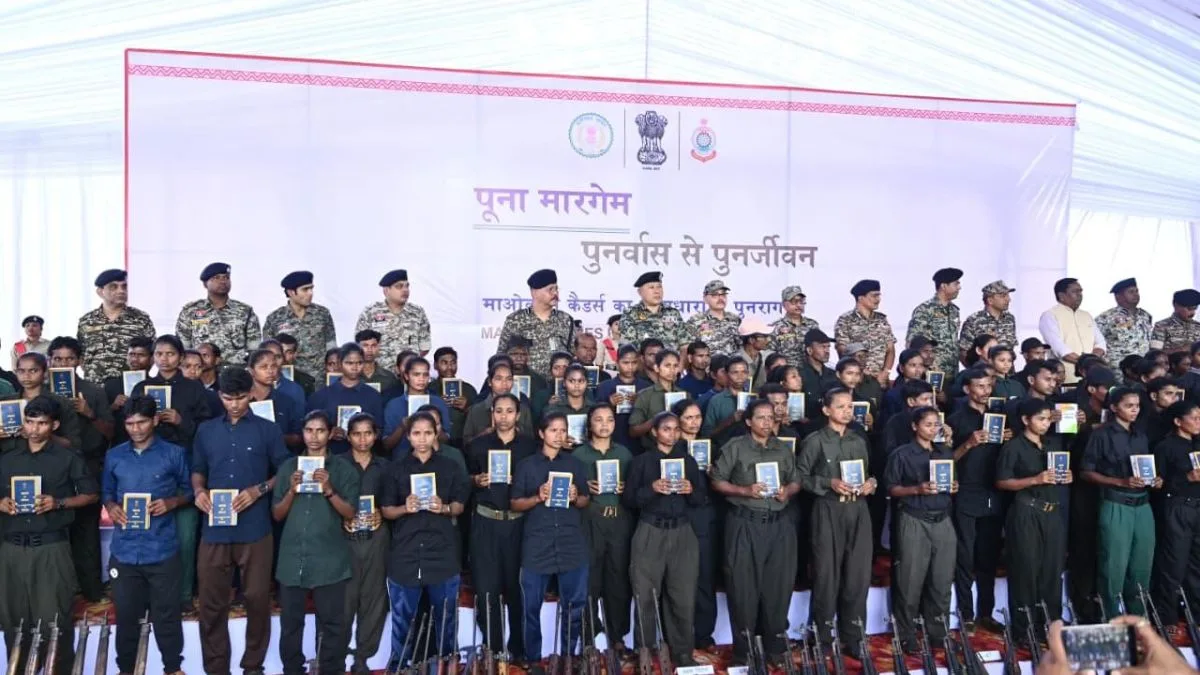
A total of 208 Maoist cadres, including several senior leaders, surrendered before Chhattisgarh Director General of Police Arun Dev Gautam in Jagdalpur on Friday, marking one of the largest coordinated surrender in the history of the Maoist insurgency in India. The event, which was initially scheduled to be attended by Chief Minister Vishnu Deo Sai and Deputy Chief Minister Arun Sao, was instead overseen by the state’s top police officials following last-minute changes in the leaders’ itinerary.
Among those who surrendered were prominent Maoist leaders Rupesh, Ranita, Raju Salam, and Ratan, marking final blow to the armed insurgency that has gripped South Chhattisgarh for decades. Each of the cadres received a copy of the Constitution, an emblem of their reintegration into democratic life. The ceremony was attended by tribal elders and community representatives, who welcomed the former Maoists with red roses, a gesture seen as a bridge between the insurgents and the society they once opposed.
Advertisement
According to police sources, the surrendering group included one Central Committee member, four DKSZC members, one Regional Committee member, twenty-one Divisional Committee members, sixty-one Area Committee members, 98 party members, and 22 from the People’s Liberation Guerrilla Army (PLGA) and allied groups. The group comprised 110 women and 98 men, reflecting the scale and gender reach of the Maoist network in the region.
Officials confirmed the cadres surrendered 153 weapons, including 19 AK-47 rifles, 17 SLRs, 23 INSAS rifles, one INSAS light machine gun, 36 .303 rifles, four carbines, 11 BGL launchers, 41 12-bore and single-shot guns, and one pistol. While details about individual bounty amounts were not released, police described the event as “historic in scale and significance,” noting that Abujhmad and North Bastar have now been largely cleared of Maoist influence. Only a few pockets of South Bastar remain active.
Chief Minister Vishnu Deo Sai called the surrender “a decisive step towards lasting peace” and announced that the government would expedite rehabilitation for jailed Maoists willing to renounce violence. “Those who killed and those who were killed were both tribals, this reality has always been painful. Today, when so many have chosen the path of peace, there is a sense of relief,” he said.
Home Minister Vijay Sharma told that the government views the development not as a surrender but as a collective act of reconciliation. “The word surrender is not appropriate. These are our own people who wished to start anew. Our government has only helped them realise that dream,” Sharma said. He added that Maoists currently in custody who formally reject the ideology of violence would also be offered rehabilitation. “Both sides wanted dialogue. Both wanted peace and development. Now we will work together, democratically, to achieve it,” he said.
Under the state’s revised rehabilitation plan, the surrendering Maoists will be provided housing under the Pradhan Mantri Awas Yojana, medical assistance, and agricultural land for livelihood. The government has also agreed in principle to review the cases of imprisoned Maoists who express genuine willingness to return to the mainstream.
Officials believe the surrender signals a turning point in Chhattisgarh’s long battle against left-wing extremism. With the once impenetrable strongholds of Abujhmad and North Bastar now pacified, the government hopes to bring similar stability to the remaining pockets through a mix of security, development, and dialogue.