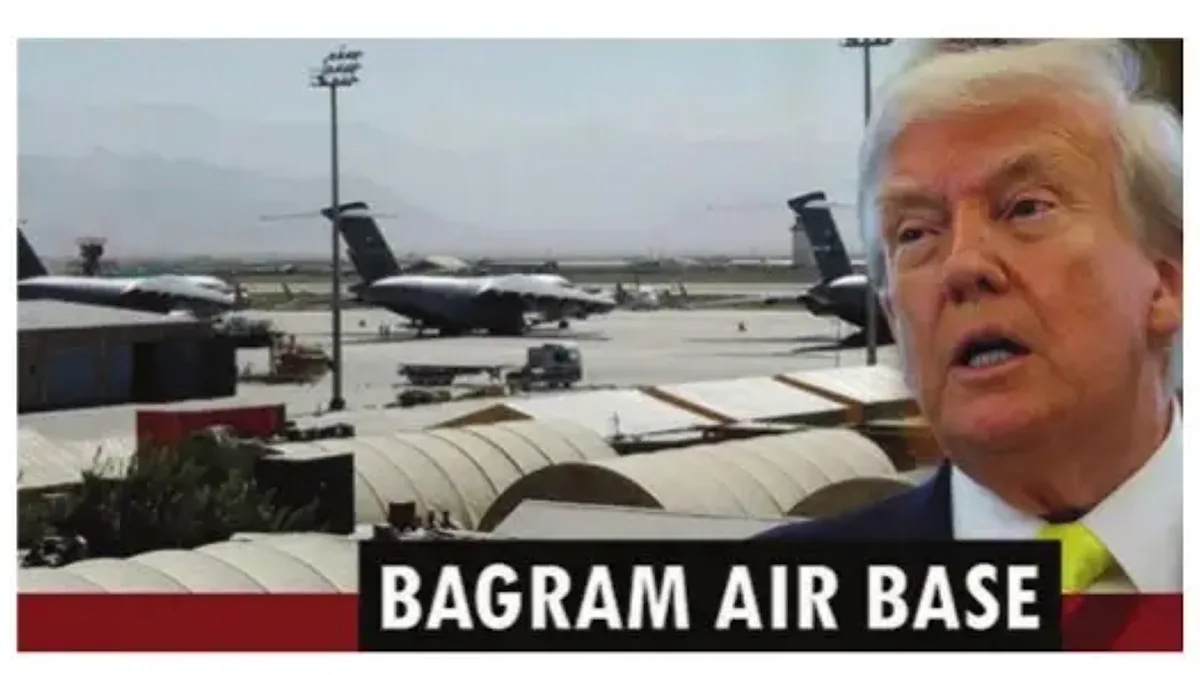
The debate over the Bagram Airbase has once again placed Afghanistan at the centre of global strategic calculations. U.S. President Donald Trump’s renewed demand to regain control of the base, which the country abandoned during its hurried withdrawal in 2021, has triggered widespread concern and opposition across the region. What might appear at first glance as an isolated assertion of American military ambition is, in fact, deeply tied to Washington’s broader strategy of containing China and reasserting U.S. influence in a region where its presence has sharply declined.
Yet, for most regional powers ~ India, China, Russia, Iran, and even Pakistan ~ Trump’s move is seen as a destabilizing proposition that risks reopening old wounds and creating new strategic uncertainties. When the U.S. signed the Doha Agreement with the Taliban in 2020, it marked a turning point in its long and costly engagement in Afghanistan. Trump himself, who negotiated the deal, hailed it as a path to ending America’s “forever wars.” However, following his election defeat, the actual withdrawal was overseen by President Joe Biden, who completed the exit in 2021.
Advertisement
The departure not only symbolized the end of two decades of American military intervention but also left behind a vacuum in Afghanistan’s security architecture. Among the many consequences of that withdrawal was the loss of Bagram Airbase, a sprawling military complex that had served as the nerve centre of U.S. operations during the “war on terror.” Now, four years later, Trump’s repeated calls to “get Bagram back” have reignited strategic anxieties. On several occasions in 2025, he has publicly expressed regret over giving up the base “for nothing,” insisting that the U.S. wants it returned.
His statements have gone beyond rhetoric. In one of his posts on Truth Social, he warned that “bad things are going to happen” if Afghanistan does not hand over Bagram. The Taliban’s response was swift and categorical ~ they declared that not an inch of Afghan soil would be given to foreign forces under any circumstances, reminding the world that their resistance to foreign occupation is the cornerstone of their political legitimacy. The renewed focus on Bagram reflects not just nostalgia for lost power but also a recalibrated U.S. strategic outlook.
The base’s location gives it immense geopolitical value ~ it lies only about 50 kilometers north of Kabul and roughly an hour’s flight from China’s western provinces, including Xinjiang, where Beijing maintains sensitive nuclear and defense installations. From an American perspective, regaining access to Bagram would re-establish a forward-operating position from which it could monitor Chinese activities, project influence across Central Asia, and maintain a foothold in a region now dominated by rival powers.
For the Pentagon and Trump’s strategic advisers, Bagram could serve as a critical component of a revived containment strategy ~ one reminiscent of the Cold War approach used against the Soviet Union. However, the regional environment today is vastly different from that of the Cold War. Pakistan, once a key facilitator of U.S. operations during both the Soviet-Afghan war and the post-9/11 interventions, now enjoys an intimate strategic partnership with China under the China-Pakistan Economic Corridor.
For Islamabad, allowing any American military presence targeting Beijing is politically and strategically unviable. The Central Asian republics, once seen as potential alternatives for U.S. basing, are now heavily influenced by both Russia and China and unlikely to risk their ties by accommodating an American request. The Gulf states, where the U.S. maintains large bases such as Al Udeid in Qatar, are simply too distant for forward operations near western China or Central Asia. Against this backdrop, Bagram appears to be the only viable option ~ at least in theory ~ for those within the U.S. establishment seeking to reassert military influence in Eurasia.
Yet, Trump’s ambition to regain Bagram has faced unprecedented pushback from almost all major regional actors. At the 7th Moscow Format Consultations on Afghanistan, held in October 2025, a rare consensus emerged among countries that seldom share a common view on security issues. India, China, Russia, Iran, Pakistan, and the Central Asian nations jointly declared that any attempt by foreign powers to deploy military infrastructure in Afghanistan or neighboring states was “unacceptable.” Though the statement did not name the United States or Bagram explicitly, its intent was unmistakable.
Remarkably, India ~ a country that has maintained close strategic ties with Washington in recent years ~ joined hands with the Taliban and China in opposing Trump’s proposal. This convergence reveals both the depth of regional apprehension and the evolving dynamics of security cooperation in post-American Afghanistan. India’s opposition stems from its longstanding belief that Afghanistan’s sovereignty must be preserved and that any foreign military presence would undermine regional stability. New Delhi has been consistent in advocating an Afghan-led, Afghan-owned, and Afghan-controlled peace process.
Moreover, India fears that renewed U.S. militarization of Afghan soil could once again turn the region into a theatre of great-power competition, with spill over effects on its own security. From India’s perspective, external interference risks empowering extremist groups, reigniting terrorism, and disrupting developmental and connectivity initiatives such as the Chabahar Port project and the International North-South Transport Corridor. China’s position, though driven by different motivations, aligns with India’s in this instance.
Beijing views any U.S. return to Bagram as a direct security threat. The base’s proximity to Xinjiang makes it ideal for surveillance and intelligence-gathering against Chinese military and nuclear assets. It could also potentially serve as a platform for supporting anti-China elements, including separatist or extremist groups in the region. For Russia and Iran, Trump’s ambition evokes memories of U.S. military encirclement and interventionist policies that have long destabilized their peripheries. Even Pakistan, despite its complex relationship with the Taliban, is unwilling to facilitate an American return that could jeopardize its strategic partnership with China or provoke internal backlash.
The U.S., of course, sees things differently. For Trump and his advisers, Bagram symbolizes not just a military asset but a lost opportunity for power projection. Its two long runways can accommodate large transport and bomber aircraft, its location provides surveillance reach across Central and South Asia, and its control could signal America’s return to a region it once dominated. But this desire overlooks a crucial fact: the geopolitical map has changed. Washington’s influence in South and Central Asia has diminished, while regional players have built new alignments that prioritize sovereignty, non-intervention, and regional stability over external military presence.
The U.S. withdrawal in 2021 was widely viewed as a failure of strategic patience, leaving behind both chaos and resentment. Attempting to reclaim Bagram now risks reinforcing perceptions of American inconsistency and disregard for the sovereignty of other nations. Moreover, such a move would only strengthen the anti-U.S. bloc in Eurasia, pushing countries like India ~ one of Washington’s key Indo-Pacific partners ~ into awkward diplomatic positions.
At a time when regional cooperation is being rebuilt on principles of development, connectivity, and non-alignment, the return of military coercion would be counterproductive. The Bagram controversy thus encapsulates a broader dilemma for U.S. strategy: the overreliance on military power in a world increasingly defined by economic, technological, and diplomatic competition. The real contest with China will not be won by bases or bombers but by innovation, alliances, and influence in trade, technology, and global governance.
Trump’s fixation on reclaiming a base in Afghanistan may appeal to his political constituency at home, but for the region, it represents an unwelcome attempt to revive the geopolitics of confrontation. In the end, the opposition to Trump’s Bagram plan reveals an emerging regional consensus rooted in pragmatism. For once, India, China, Russia, Pakistan, Iran, and the Taliban find themselves on the same side of a security issue ~ not because of shared ideology, but because of a shared understanding that stability in Afghanistan is essential for regional peace.
The U.S. desire to regain control of Bagram, therefore, is not just about a piece of land or a military base – it is a test of whether the lessons of the past two decades have been learned. If history is any guide, the path to peace in this region lies not through the runways of Bagram but through diplomacy, respect for sovereignty, and genuine regional cooperation.
(The writer is Associate Fellow, Manohar Parrikar Institute for Defence Studies and Analyses)