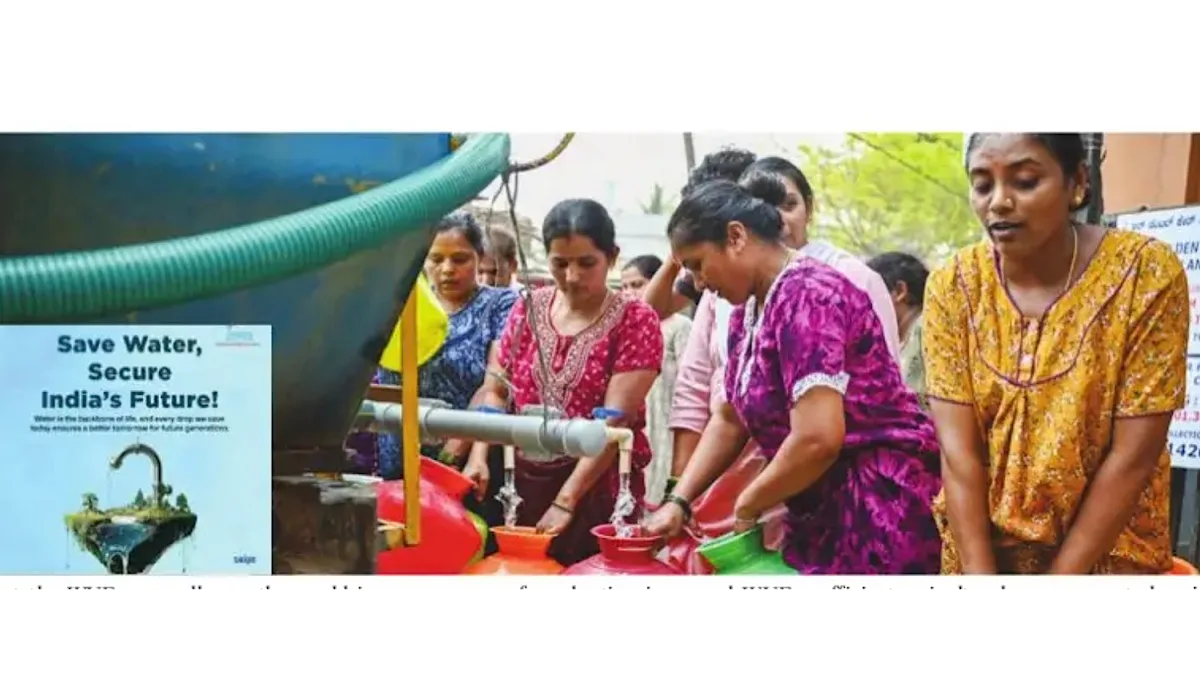
In India, achieving the UN Sustainable Development Goals (SDGs) is on the agenda of the Government. By 2030, India is mandated to substantially improve water use efficiency (WUE) across all sectors, and substantially, by saving water, reduce the number of people suffering from water scarcity. By 2050, India’s water demand (1180 Billion Cubic Meter (bcm) will exceed its water supply (1126 bcm). The per capita water supply has declined over the years, reached the water stressed level (1465 cu m) in 2024, and will be touching the water scarce level in the coming years.
India, moving towards Viksit Bharat 2047, will need more water for higher economic growth, and for meeting water demand of its increasing population. Unlike in higher income countries which use more water in industry, lower income countries use more water in agriculture irrigation. The UN World Water Development Report 2025 says that across countries, the agri sector dominates the total water withdrawal (72 per cent), followed by industry (15 per cent), and domestic use (13 per cent). This trend is also seen in India. To meet the increasing water demand, all countries are moving towards increasing WUE (Water Use Efficiency) measures to save water.
Advertisement
UN Water Report 2021 shows that the WUE score all over the world is US$21 per cu m while in India it is only US$3.13 per cu m. For the agri sector and service sector in India, this score is not satisfactory. In India, there is a need to improve WUE in all sectors, especially the agri sector whose contribution to economic growth and employment generation is substantial. The WUE in surface water irrigation in India is the lowest at 36 per cent (MoJS 2023). With full WUE in agriculture, a saving of 146 bcm water is estimated, and if the National Water Mission’s (NWM) goal of achieving 20 per cent WUE is followed in the agricultural sector, 112 bcm water resources could be saved across all sectors (CWC 2014). The major reason for low WUE in agriculture is over-irrigation and over-dependence on paddy which uses about 45 per cent of irrigation water withdrawal.
Other reasons are non-provision of lining in canal reaches and field channels; poor maintenance of canal and distribution networks; practice of time-based water supply instead of demand/need based; lack of awareness among farmers about modern irrigation practices, cropping pattern in accordance with agro-climatic zones, etc. The irrigation water used by a paddy growing average farm is about 980 mm against FAO standard of 400-700 mm. In Punjab, it is even higher, at about 1800 mm of water for paddy cultivation. In the irrigation sector, higher WUE can be achieved not only by taking measures at Project level but also at the Farm level. Measures to be taken, inter alia, should include use of less water-consuming varieties of seeds; adopting piped/micro irrigation system; irrigation scheduling and volumetric controls; conjunctive use of surface water and groundwater; planning cropping patterns as per soil conditions; having trees on the farm boundary to reduce evaporation due to weed management; recycling and reuse of water; use of Laser Leveler for field leveling to save water; intensive mass awareness programme for adopting improved WUE practices; incentivizing efficient use of water management, etc.
Generally, technological measures help in reducing evaporation and run off losses, seepages and deep percolation. Use of irrigation application instruments (eg. micro irrigation, precision irrigation etc.) should be targeted depending upon the location of losses of water efficiencies in conveyance, distribution or field application. A report of the MoJS (August 2023) shows that by using advanced methods such as oil moisture sensors, IOT-based irrigation using remote sensors, SCADA system, and using demand management, the government of Karnataka at Narayanpur Left Bank Canal system increased the irrigation WUE from 31 to 53 per cent. The Central government has constituted a Bureau of Water Use Efficiency (BWUE) under the NWM (National Water Mission) to achieve its goal of increasing WUE by 20 per cent in all sectors including agriculture.
Unfortunately, unlike the Bureau of Energy Efficiency in the electricity sector, the BWUE has no legal status. There is a need to give a legal status to BWUE by using provisions, say, under The Environmental (Protection) Act 1986 or any other Act. Till such time, the BWUE, in consultation with states and various stakeholders, should develop WUE benchmarks for the agriculture irrigation sector, draw up a time-bound action plan for achieving the benchmark by states, and oversee monitoring implementation of WUE benchmark. Second, water is a state subject. In a state, there are, inter alia, the irrigation department, groundwater agency, agricultural department and water resource department in addition to other agencies working in the water sector which are directly involved in dealing with WUE in the agriculture sector.
There are no efficient agricultural management plans in all states. The Centre’s role should be to prepare a WUE framework state wise, after adopting a consultative approach with stakeholders. Third, the role of the Water Regulatory Authority (WRA) has been recognized for improving WUE in all sectors including agriculture in the draft Model State Integrated Water Resource Management Bill 2024 of the Ministry of Jal Shakti. Only four states (Haryana, Punjab, J&K and Maharashtra) have positioned WRAs. WRAs should be positioned in all states and they should promote, facilitate, enforce WUE and incentivize users based on the framework designed by BWUE and the central Government. Fourth, volumetric water pricing of various water sources, groundwater or surface water, should be adopted after due consultation with stakeholders.
The bulk water pricing should be determined by WRA, and should be executed by various implementing agencies in the states. WRA should also frame principles for retail water pricing for its implementation in the states. Fifth, the BWUE and WRA should ensure that Third Party Water Auditing for irrigation projects is adopted in states. The guidelines for such water auditing should be framed by BWUE. Sixth, water user associations (WUAs) should be constituted in all states, and they should be encouraged for participatory irrigation management. They should also be incentivized for adopting this approach. Participatory WUAs should be the norm in the coming days. Finally, as indicated by various studies, developed nations have WUE in agriculture at 50-60 per cent.
With NWM norm of 20 per cent increase of WUE, the irrigation efficiency in India has been estimated at about 46 per cent. Thus, given the international standard and achieving goals of NWM, the achievable water use efficiency in agriculture should be taken as 50-60 per cent for its implementation by all states in India resulting in substantial amounts of water for use in other sectors.
(The writer is a Distinguished Fellow, TERI, New Delhi and a former Secretary, Ministry of Water Resources, Govt. of India)