Judicial Roulette
French far-right leader Marine Le Pen’s decision to enter France’s 2027 presidential race while simultaneously challenging her criminal conviction has transformed the election into a test of far more than electoral popularity.
When he was contributing to The Emerging World: Souvenir Volume commemorating the 75th birth anniversary of Pt. Jawaharlal Nehru on 14 November 1964, Dr S Radhakrishnan, President of India, wrote “A new world society is gradually emerging.




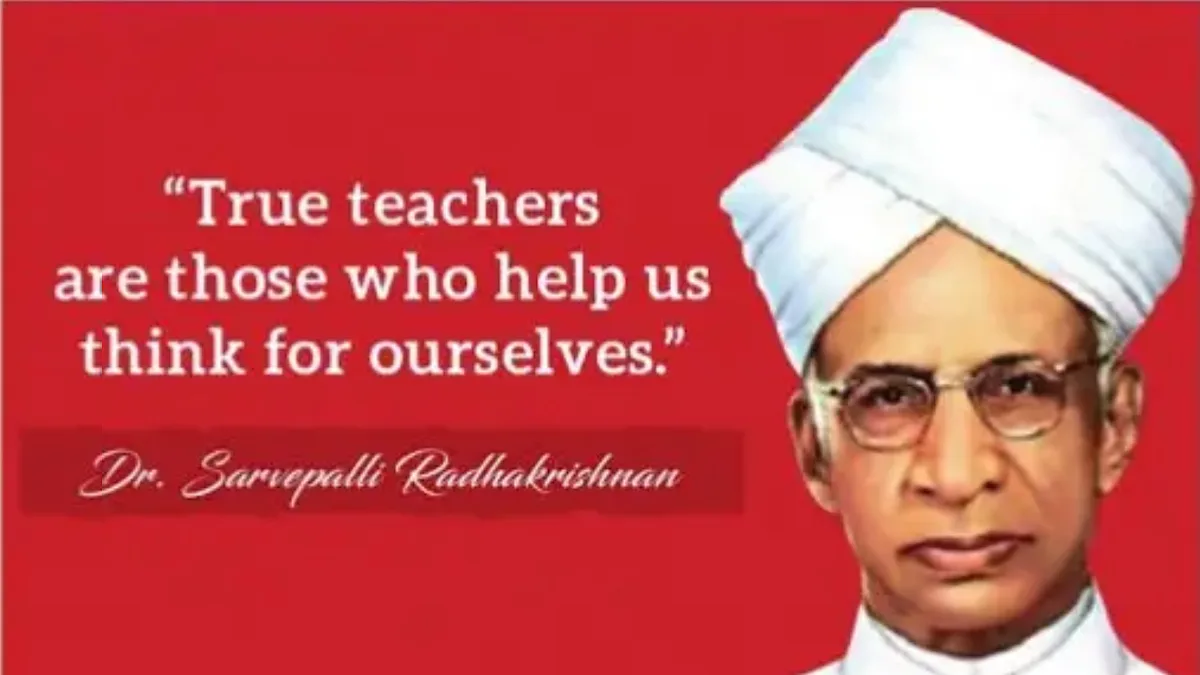
Photo:SNS
When he was contributing to The Emerging World: Souvenir Volume commemorating the 75th birth anniversary of Pt. Jawaharlal Nehru on 14 November 1964, Dr S Radhakrishnan, President of India, wrote “A new world society is gradually emerging. It is growing quietly, imperceptibly, in the minds and hearts of men. The tumult and the excitement, the anger and the violence, the perplexities of spirit and the ambiguities of expression are the pangs of the birth of something new: We of this generation are called upon to work for this new order with all the strength and capacity for suffering we possess.”
These words brim with sincerity, authenticity and the clarity of knowledge for which we remember Bharat Ratna Dr Radhakrishnan in 2025 on his 50th death anniversary, and on 5 September every year, his birth anniversary celebrated as Teachers’ Day. As our globalized world staggers from one crisis to another volatile one, Dr Radhakrishnan’s writings underline the unity and one-ness of the human race. He said, “When religious prophets and philosophers speak of our common humanity, of the natural kinship of human beings, it is a part of wisdom and a need of the enlightened spirit. There is a wider recognition of this act today than ever before in history. Man’s basic physical structure, his mental make-up, his moral needs, his spiritual aspirations are the same the world over.
Advertisement
The cycle of birth, growth, childhood and youth, of sickness, old age and death, of love and friendship, of sorrow and joy, are the same for all men. We share a common origin and a common destiny: Ekaiva manusijatih. The human race is one. This oneness of humanity is more than a phrase, it is not a mere vision. It is becoming a historic fact. With the speeding up of communications, ideas and tools now belong to man as man. The necessities of the historical process are making the world into one. We stand on the threshold of a new society, a single society. Those who are awake to the problems of the future adopt the ideal of the oneness of mankind as the guiding principle of their thought and action.” Not just a philosopher teaching comparative religion in prestigious universities, Dr Radhakrishnan’s sense of history was second to none.
Advertisement
He was deeply conscious of the visions of the world in the previous centuries. He said, “we had a limited vision of the world; of Asia, of Europe, of Africa. None of these large continents is the whole world. They have come together and cannot get away from one another. The sciences of archaeology and anthropology reveal ancient art of great achievement, of beauty and complexity which yet remained outside the traditional stream of Asian, European or African history. Facile generalisations are made by philosophers of history which are highly misleading.
Hegel, in his Lectures on the Philosophy of History, says that ‘Persia is the land of light, Greece the land of grace, India the land of dream, Rome the land of empire’. It is true of all cultures that the greatest gift of life is the dream of a higher life. The pursuit of perfection has been the dominating motive of human life. Man is essentially a re-maker. He is not content with patterns of the past. He knows that every morning brings a new day, and every pulse-beat a new life.”
Dr Radhakrishnan’s world-view was modern, progressive and inclusive. He said, “the world is drawn together by the inter-connectedness of the world economy. Nations in Asia and Africa are passing through what is called a revolution of rising and yet unfulfilled demand for more reasonable standards of life. They are treading the road to modernisation which is another name for industrialisation. We are all using the same language in science and employing the same tools for industrial development. As a result, new sets of values are springing up everywhere. Never before have men had the means of communication or the bonds of inter-dependence through which a world community is rendered possible. The world has become a unit and demands that it should be treated as one.”
Given his oceanic knowledge of the scriptures, and being a true Congressman and a Gandhian, he was unsparing when it came to taking an anti-war stance. “Today in view of the development of nuclear weapons of fantastic power, leaders of States talk of the development of inter-continental ballistic missiles, the incomparable fire power they possess and the eventual obliteration of any possible aggressor from the face of the earth. A nuclear arms race indicates the possibility, if not the probability, of putting an end to the human species in a nuclear war. It is not a question of who is the world’s strongest military power or who has the lead in inter-continental missiles.
Whoever may be the strong power, no one will survive a nuclear war. It is a dangerous illusion to believe that the use of these weapons will result in a decisive advantage to those who possess them. There is no such thing as military invincibility. Nuclear war will mean the ruin of all. The fate of all nations is inseparably tied up. Either we live together or die together. It is either one society or no society.” On the subject of nationalism and nation-states Dr Radhakrishnan’s brilliant understanding is unquestionable; he said, “Nation-states are too narrow for the modern world where we have conquered space and moved faster than sound. Gandhi, even when he was fighting for India’s independence, warned us against the reactionary character of nationalism.
He said: ‘A fallen and prostrate India cannot be of help to herself or the world. A free and enlightened India can be of help to herself and the world. I want my country to be free so that one day, if need be, she may die that humanity may live’. It is in self-surrender that we fortify ourselves. Nations are not immortal. They are not the permanent possessors of this planet. They are its temporary tenants. They will last long if they adhere to the moral law. “The doom of nations cannot be delayed so long as the cupidities of man persist.
Nations aim at permanence. We know, however, that all great societies perished leaving behind the great heritage of arts and skills, ideas and ideals on which we still build. No society dies in vain. All living things die but out of death comes life.” In line with great thinkers like Sri Aurobindo, Swami Vivekananda and Rabindranath Tagore, it was the inner voice of conscience which guided Dr Radhakrishnan. That is why he wrote, “Gandhi required us to be faithful to the inner voice of conscience, the divine law, not written by the hand of man but inflexible none-the-less, the eternal fountain source of all the codes that have ever been written in the course of ages.
It is this moral law that binds the members of the human family together and gives us a new sense of responsibility for the safety and happiness of the whole human family. Belief in co-existence is not the outcome of expediency or of weakness. It is the only way to rid the world of intolerance and misunderstanding. “There are no more closed societies. The new order we seek is not either national or continental. It is neither eastern nor western. It is universal. We must develop a sense of perspective and realise that our nation is one of many and each makes a specific contribution to the richness and variety of the world.
Humanity is not this race or that nation, but the whole of mankind which is getting together, we hope, for purposes of co-operation. Simply because war has been with us for many centuries, it does not follow that it will continue to be with us for all time.” Through Dr Radhakrishnan’s writings we can understand how “within the nation, we have the rule of law, the framework of justice, and a police force. We also establish conditions of human welfare which do not encourage unrest, disorder and strife.
If conditions which prevail within a Welfare State are extended on a world scale, we should be prepared for a little sacrifice of national sovereignty, and be willing to accept peaceful methods of settling disputes, enforce peaceful legal solutions and avert violence, secure minimum economic conditions of well-being and remove the grievances of large communities which suffer from political subjection and racial discrimination and develop a moral community based on spiritual values.
A proper appreciation of the duties and responsibilities implied in world citizenship is necessary today. We have to lift the world off its hinges and transform the national man into a universal man.” Thus wrote Dr Radhakrishnan, his thoughts and ideas so relevant in today’s time when India, along with the US, Russia, China and South Africa are re-aligning, redrawing the contours of modern-day diplomacy.
(The writer is a researcher author on history and heritage issues, a former deputy curator of Pradhanmantri Sangrahalaya.)
Advertisement