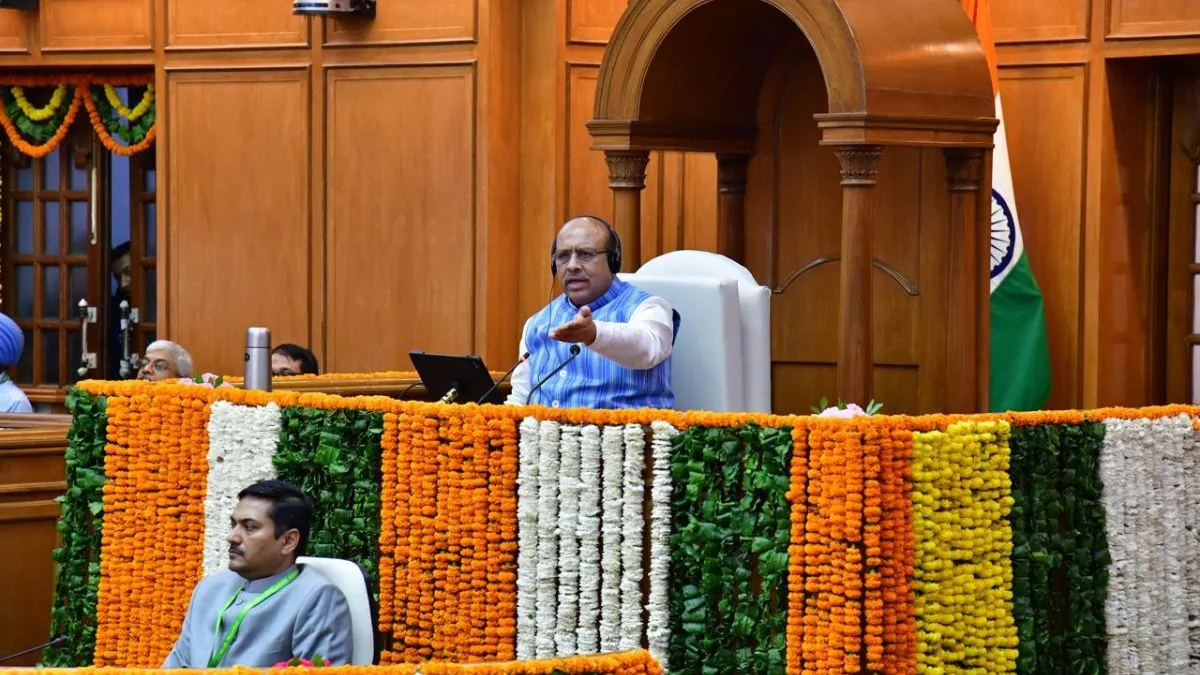
Delhi Assembly Speaker Vijender Gupta said on Friday that the four reports of the Comptroller and Auditor General (C&AG) tabled in the house during the monsoon session by Chief Minister Rekha Gupta would be examined in detail by the Public Accounts Committee (PAC), as per the Rules of Procedure.
He said the Committee would present its report on the C&AG’s findings by the next session of the legislative assembly.
Advertisement
He directed the Assembly Secretariat to forward these reports immediately to the concerned departments so that they may submit action-taken notes to the PAC.
According to Gupta, the report on the Appropriation Accounts reveals that during the year 2023–2024, an amount of Rs 15,327 crore remained unspent, of which Rs 8,376.40 crore lapsed due to delay in surrender, and this amount could have been utilised for essential developmental works.
He further said that in the Finance Accounts for 2023–2024, the C&AG observed that government departments failed to submit Abstract Contingent Bills, resulting in Rs 346.82 crore remaining outstanding.
This means there was no way to confirm whether the funds were actually spent in accordance with the authorization of the assembly.
He further mentioned that during 2022–2023, this amount was Rs 574.89 crore, and the auditor general also expressed concern over the non-submission of utilisation certificates for Rs 3,760.84 crore as on 31 March 2024.
The speaker, in his address, said a study of the State Finances report for 2023–2024 shows that the revenue surplus declined from Rs 14,457 crore in 2022–2023 to Rs 6,462 crore in 2023–2024.
If the Centre had not borne Rs 11,123 crore towards pension liabilities and Delhi Police expenditure, the surplus would have turned into a revenue deficit, the speaker added.
From 2019-2020 to 2023-2024, capital expenditure has consistently remained below the capital budget. The fiscal deficit has increased from Rs 416 crore in 2019–2020 to Rs 3,934 crore in 2023–2024, he added.
Further, mentioning the CAG’s report on the Building and Other Construction Workers’ Welfare Board, he said it also points to several serious alleged irregularities.
The then Delhi government did not have reliable data regarding the number of such workers. Out of 6.96 lakh registered workers, the department maintained a database of only 1.98 lakh workers, said the speaker.
Several deficiencies were found in the registration process, such as duplicate images and multiple registrations, he mentioned.