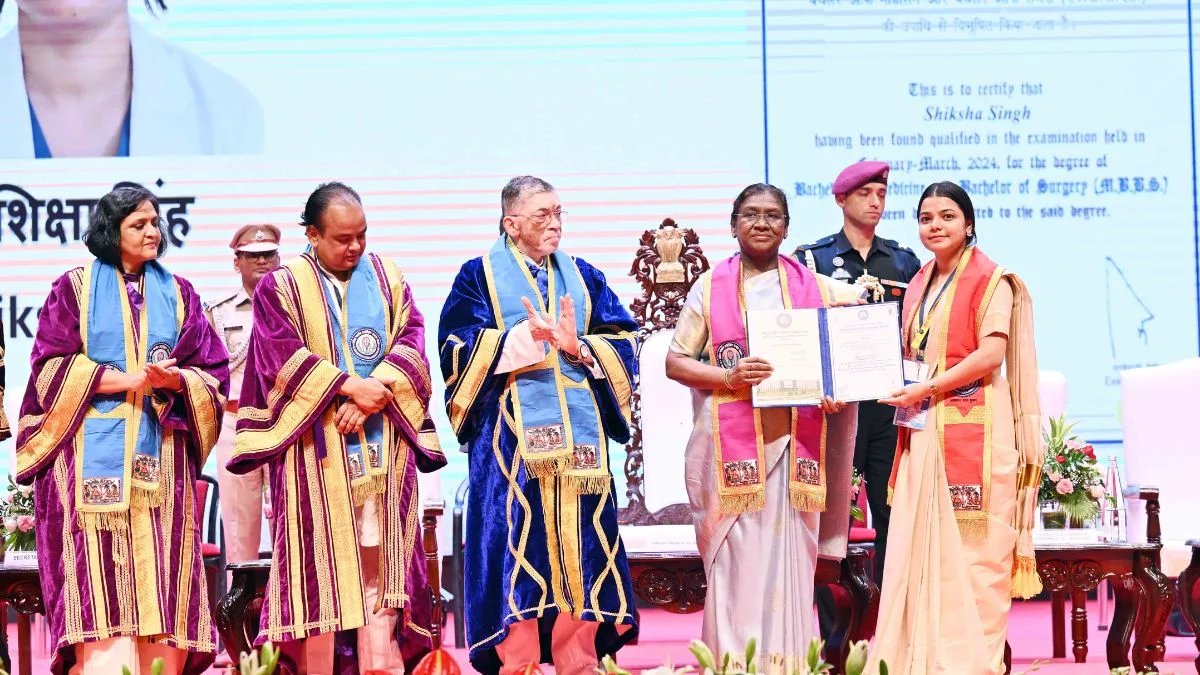
The President of India, Droupadi Murmu, addressed the first convocation of AIIMS Deoghar, calling for a stronger focus on community-oriented healthcare, inclusive medical practice, and institutional responsibility in public health delivery. She reflected on the institute’s journey and its role in advancing tribal and rural health systems.
The convocation took place in Deoghar, Jharkhand, during the month of Shravan. Recalling her presence at the foundation stone-laying ceremony in 2018 as the then Governor of Jharkhand, Murmu described the transition from foundation to convocation as a milestone for both the institution and the state.
Advertisement
While acknowledging AIIMS Deoghar’s role in providing tertiary healthcare, the President urged it to engage more deeply with primary care, which she described as the foundation of universal health coverage. She emphasised the need for doctors and students to visit urban and rural health centres to strengthen local health infrastructure and promote inclusivity at both institutional and individual levels.
Addressing the graduating class, the President noted that an education from AIIMS signifies competence, but stressed that along with medical skill, effective communication and empathy were equally essential. “Doctors should be clinical in diagnosis and treatment, but not in behaviour,” she remarked, underlining the importance of compassionate counsel.
Highlighting the government’s efforts to reduce the financial burden of healthcare on citizens, she pointed out that institutions like AIIMS Deoghar must play a proactive role—both collectively and individually. She called on the institute’s stakeholders to map Sustainable Development Goals related to health and assess India and Jharkhand’s progress toward them.
Murmu noted that AIIMS Deoghar was set up to reduce inequality in medical services by offering specialised care at affordable costs. She urged the institute to not only deliver advanced care but also to contribute meaningfully to the broader healthcare framework.
Recognised as a Centre of Competence for Tribal Health, the institute has made strides in remote medicine delivery, including drone-assisted distribution. The President encouraged continued work on neonatal mortality and genetic disorders, suggesting these efforts could serve as models for replication nationwide.
Progress in public health was also acknowledged. With the elimination of kala-azar and India’s removal from the high-burden list for malaria, Murmu called for renewed focus on remaining health challenges and inter-institutional collaboration.
In closing, she reminded the audience that AIIMS Deoghar’s mandate extends beyond service delivery to include training and research. Graduates, she said, must carry forward the values of care, discipline, and responsibility, becoming agents of improvement in the healthcare ecosystem.
Extending her best wishes to the graduating students, the President expressed hope that the institute would continue supporting the nation’s public health systems through sustained effort and commitment.