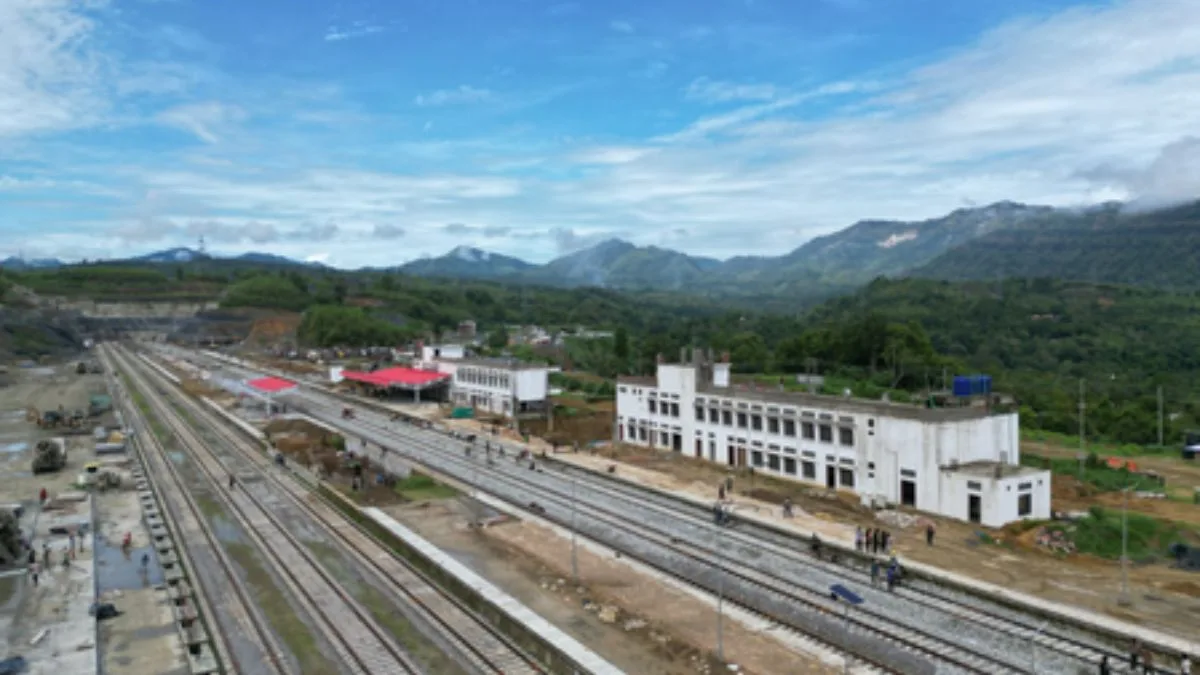
The Cabinet Committee on Economic Affairs, chaired by Prime Minister Narendra Modi, on Thursday approved four multi-tracking projects of the railways covering 13 districts across Maharashtra, Madhya Pradesh, West Bengal, Bihar, Odisha, and Jharkhand, increasing the existing network of Indian Railways by about 574 kms.
These projects include the Itarsi-Nagpur 4th Line, Aurangabad (Chhatrapati Sambhajinagar) – Parbhani Doubling, Aluabari Road- New Jalpaiguri 3rd and 4th Line, and Dangoaposi-Jaroli 3rd and 4th Line.
Advertisement
The total estimated cost of the four projects is approximately Rs 11,169 crore and will be completed by 2028-29. The projects will also generate direct employment for about 229 lakh human-days during construction.
The increased line capacity will significantly enhance mobility, resulting in improved operational efficiency and service reliability for Indian Railways.
These multi-tracking proposals are poised to streamline operations and alleviate congestion. The projects are in line with Prime Minister Narendra Modiji’s vision of a New India, which will make people of the region “Atmanirbhar” by way of comprehensive development in the area, which will enhance their employment/self-employment opportunities.
The projects are planned on the PM-Gati Shakti National Master Plan with a focus on enhancing multi-modal connectivity and logistic efficiency through integrated planning and stakeholder consultations. These projects will provide seamless connectivity for the movement of people, goods, and services.
The proposed multi-tracking projects will enhance connectivity to approximately 2,309 villages, which have a population of about 43.60 lakh. These are essential routes for the transportation of commodities such as coal, cement, clinker, gypsum, fly ash, containers, agriculture commodities and petroleum products. The capacity augmentation works will result in additional freight traffic of magnitude 95.91 MTPA (Million Tonnes Per Annum).
Railways, being an environmentally friendly and energy-efficient mode of transportation, will help both in achieving climate goals and minimising logistics costs of the country, reduce oil import (16 crore litres), and lower CO2 emissions (515 crore kg), which is equivalent to the plantation of 20 crore trees.