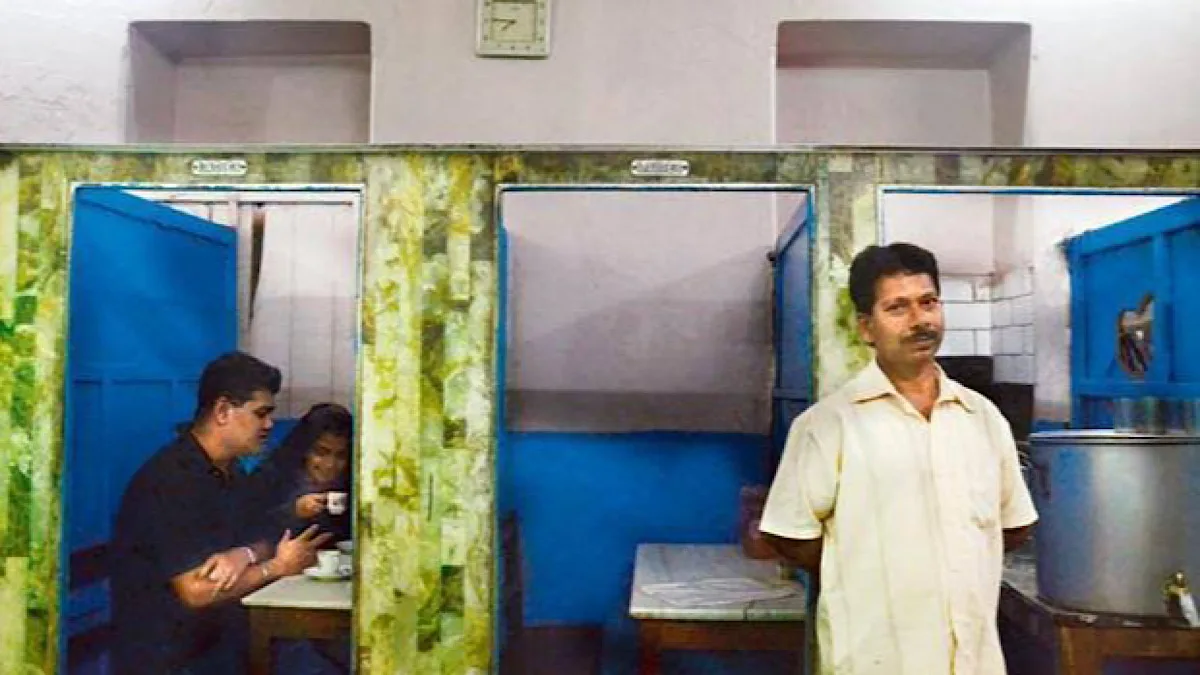
In dimly lit cabins behind glass shutters, where talcum mingled with telebhaja and timid glances swam through steam, love simmered quietly: claustrophobic, curfewed, yet utterly intoxicating.
Today, places like Allen Kitchen, Basanta Cabin, Das, and Dilkhusha are celebrated for their legacy of flavours. Prawn and chicken cutlets are served with a generous side of nostalgia, with food bloggers now crowding their cracked mosaic floors. But once, these cabins were more than culinary pit stops. For an entire generation, they were quiet portals of privacy in a world that offered none to its lovers.
Advertisement
“Back in the day, there were no cafés, no mobile phones. A girl and boy couldn’t just sit and talk,” recalls Supratim Lahiri, 68, who courted his now-wife across one such Formica table. “Just sitting across her behind a wooden partition felt like a rebellion. That curtain wasn’t just a cloth. It was courage.”
Advertisement
For Indrani Saha Roy, now 72, the Fern Hotel and Restaurant was a cocoon during her college years. “We weren’t doing anything wrong,” she says. “But the world made it feel like we were. That thrill— the heart racing as the waiter pulled the curtain— it’s something today’s generation may never know.”
Now that many of these spaces have been commercialised as nostalgic retreats, their once-cloistered charm replaced by open seating and curated menus, what remains are memories.
“I grew up charmed, listening to my grandparents talk about sneaking away from the world to sit across each other over a shared cutlet,” says Priyanka Bhattacharya, 23. “The idea that love once had to be hidden to be lived ~ it feels distant. But some part of me envies that urgency.”
“It’s good that romance no longer has to hide. But in normalising it, we may have lost the slow, blushing intensity that once came from chasing privacy,” she adds.
These cabins weren’t just eateries. They were silent witnesses to stolen afternoons and social transgressions. In a society that policed desire and discouraged visibility, they offered a fragile sort of freedom. To eat, yes ~ but also to look, to listen, and to fall, defiantly, in love. Today, what lingers is not just the taste of fried breadcrumb and sauce, but the reminder that even the most ordinary spaces once carried the weight of quiet revolutions.
Advertisement