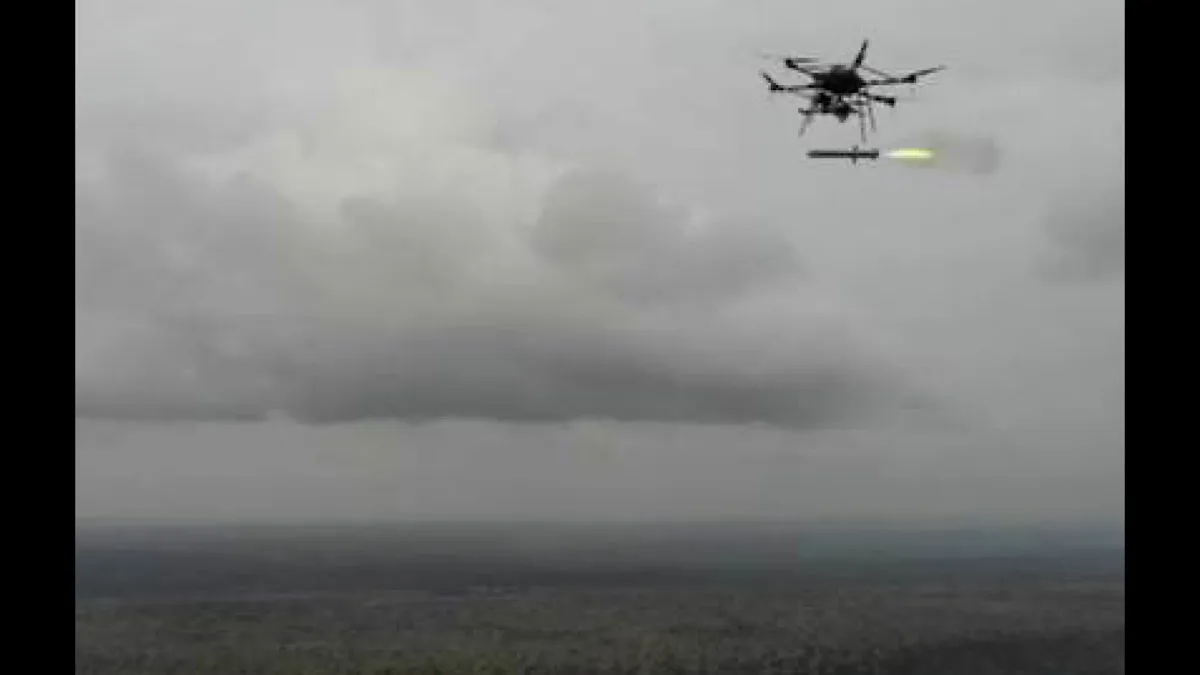
The Defence Research and Development Organisation (DRDO) has successfully conducted flight trials of the Unmanned Aerial Vehicle-Launched Precision Guided Missile (ULPGM)-V3 at the National Open Area Range (NOAR) in Kurnool, Andhra Pradesh. The ULPGM-V3 is an advanced version of the ULPGM-V2, previously developed and delivered by DRDO.
Equipped with a high-definition dual-channel seeker, the ULPGM-V3 is capable of engaging a wide range of targets in both plain and high-altitude terrains. It features day-and-night operational capability and a two-way data link that enables post-launch target or aim-point updates.
Advertisement
The missile offers three modular warhead options – an anti-armour warhead designed to neutralise modern armoured vehicles equipped with Rolled Homogeneous Armour (RHA) and Explosive Reactive Armour (ERA); a penetration-cum-blast warhead for anti-bunker applications, and a pre-fragmentation warhead effective over a high lethality zone.
The missile has been jointly developed by several DRDO laboratories, including the Research Centre Imarat, Defence Research and Development Laboratory, Terminal Ballistics Research Laboratory, High Energy Materials Research Laboratory, Integrated Test Range, and Defence Electronics Research Laboratory. The current trials focused on the anti-armour configuration.
The missile was launched from a UAV developed indigenously by Bengaluru-based start-up NewSpace Research & Technologies. DRDO is also actively working on integrating ULPGM systems with long-range, high-endurance UAVs developed by other Indian firms.
Development-cum-Production Partners (DcPPs) — Adani Defence and Bharat Dynamics Limited, Hyderabad — along with 30 MSMEs and start-ups, played a key role in making this ambitious project a success.
Defence Minister Rajnath Singh congratulated DRDO and its industry partners, including DcPPs, MSMEs, and start-ups, on the successful development and trials of the ULPGM-V3 system. He described the achievement as evidence that Indian industry is now ready to absorb and produce critical defence technologies.