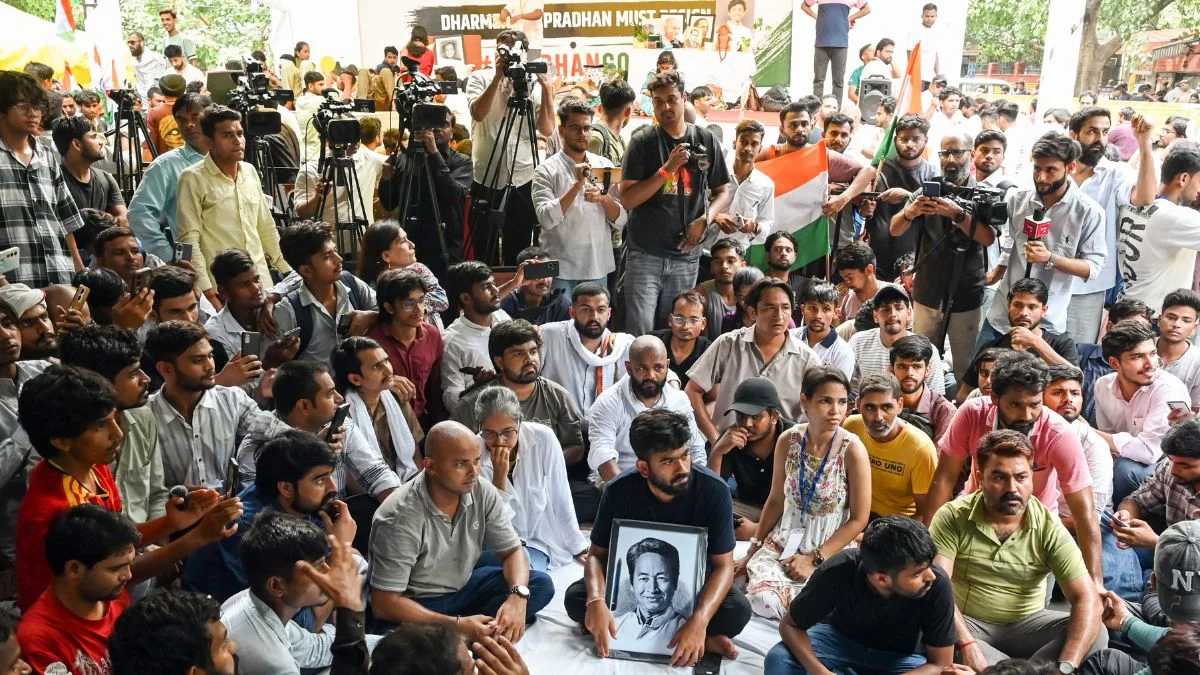
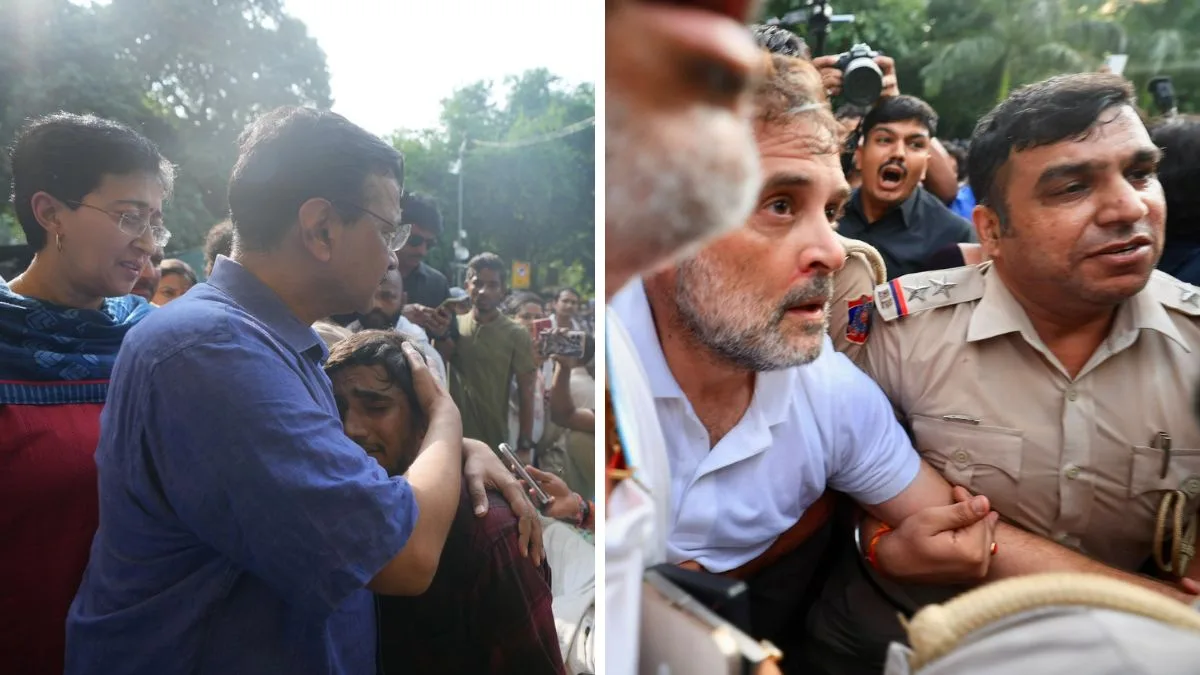
Cockroach Janta Party gets Delhi Police nod for protest at Jantar Mantar today
An official police communication shows the Cockroach Janta Party received permission to hold a day-long demonstration at Jantar Mantar under a one-time exemption.
Delhi University’s Academic Council in May approved the curriculum for the seventh and eighth semesters. The decision marks a crucial milestone under the Undergraduate Curriculum Framework (UGCF) 2022, which seeks to align India’s higher education system with global standards.





File Photo
Lodging a strong protest against the implementation of the Four-Year Undergraduate Programme (FYUP) under NEP 2020, the Delhi University Teachers’ Association (DUTA) has submitted a petition to President Droupadi Murmu.
Delhi University’s Academic Council in May approved the curriculum for the seventh and eighth semesters. The decision marks a crucial milestone under the Undergraduate Curriculum Framework (UGCF) 2022, which seeks to align India’s higher education system with global standards.
Advertisement
The new structure offers students the opportunity to graduate with a degree titled “Honours with Research”, provided they pursue a dedicated research track in their fourth year. Alternatively, students may opt for academic projects, entrepreneurship modules, or additional elective courses tailored to their interests and career goals.
Advertisement
The FYUP model is designed to promote flexibility, multidisciplinary learning, and deeper academic engagement — key goals of India’s National Education Policy (NEP) 2020.
The petition submitted by DUTA to the President, through the Ministry of Education, called for the withdrawal of the Draft UGC Regulations, 2025, in the absence of the PRC Report. The petition was endorsed by nearly 2,000 faculty members from across the University of Delhi.
Addressing a press conference here today, DUTA President Prof. A.K. Bhagi called the move a flawed implementation. Stating that the rigid and impractical structure of the UGCF, combined with an excessive paper load and reduced credit for core and discipline-specific subjects, has led to the dilution of academic depth, the DUTA President said, “Faculty members are increasingly overburdened due to rising teaching and administrative responsibilities, with no corresponding recruitment or infrastructural expansion.”
“Overcrowded classrooms and laboratories, alongside inadequate access to essential teaching resources, have further worsened the learning environment. Moreover, the absence of a synchronized academic calendar and continued delays in the admission cycle have led to staggered semesters, disrupting the academic rhythm for students and faculty alike,” he said.
Prof. Bhagi also slammed the decision of permitting regular students to earn academic credits through online platforms such as SWAYAM and MOOCs, adding that it will seriously compromise the academic standards and integrity of the University’s UG and PG programmes. “It will undermine classroom teaching, reduce meaningful student-teacher engagement, and adversely affect teaching workloads,” he said.
DUTA Treasurer, Dr. Akanksha Khurana, too echoed the urgency of systemic reform, cautioning that ill-planned policy implementation without sufficient infrastructure, funding, or feedback mechanisms threatens the stability of public universities and compromises the goals of NEP 2020.
The petition stated that the Regulations purportedly aim to align higher education with the National EducationPolicy (NEP) 2020 goals, such as academic flexibility, improved governance, and institutional accountability.
“Still, it has also sparked widespread discussion about their desirability, feasibility, and long-term implications. An urgent need was felt to critically examine how these reforms affect academic autonomy, recruitment and promotion processes, and institutional functioning across diverse educational contexts in India,” it read.
DUTA further reiterated that the Draft UGC Regulations, 2025, need major changes to contribute positively to building a more inclusive, equitable, and future-ready higher education system, especially in the absence of any formal assessment of NEP implementation – and the rolled out four year programme is yet to have its first batch graduate, many other aspects including the one year PG are yet to be implemented.
Advertisement